2026 Agentic Coding Trends — Technical Implementation Guide

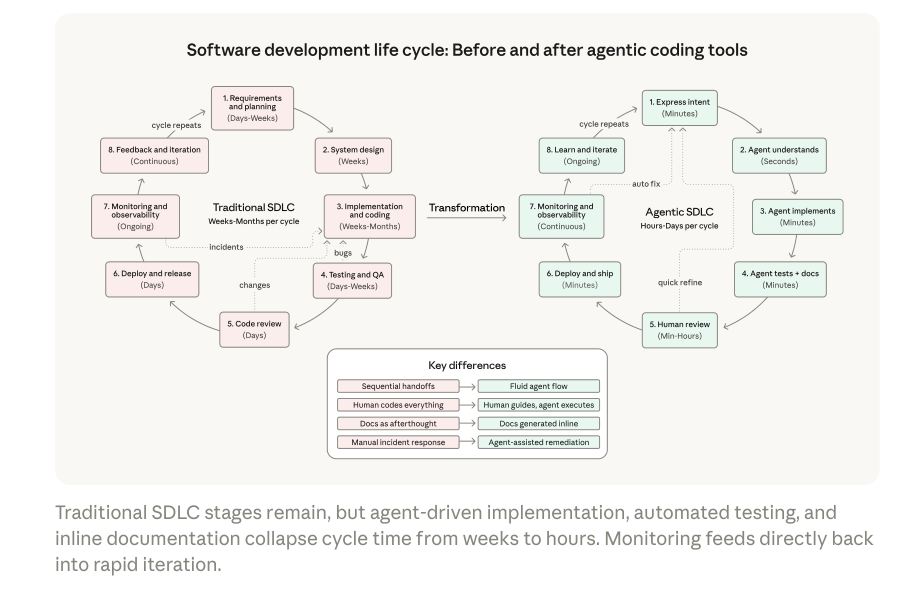
Anthropic's 2026 Agentic Coding Trends Report described eight major shifts reshaping software engineering. What it didn't provide was a blueprint for actually building them. This post from the HuggingFace community fills that gap — taking each trend and translating it into concrete architecture decisions, config patterns, and engineering checklists that teams can act on today.
The mappings are specific and useful. The shift toward an Agentic SDLC becomes a state machine pattern where agents can only advance pipeline stages when deterministic gates pass — preventing cascading errors from propagating forward. The move to multi-agent coordination maps to an orchestrator/worker topology with explicit dependency graphs. Long-running agent tasks require checkpointing, context summarization, and session recovery mechanisms that most teams haven't built yet. Scaled human oversight translates to interrupt-on-uncertainty hooks and approval queues, so that agents pause and surface ambiguity rather than guessing at low-confidence decision points. And the security-first trend becomes a practical discipline: dual-use risk analysis and minimal-permission agent identities scoped to exactly what each workflow requires.
The post includes reference architecture diagrams, repo layout recommendations, and a 2026 engineering roadmap template. If your team has read the Anthropic trends report and wondered what to actually do with it, this is the implementation guide that bridges observation to execution — and a useful framework for any organization formalizing its agentic coding infrastructure this year.