A Tiny Grok API Bug Shows Why xAI's May 15 Model Retirement Will Hurt Real Integrations

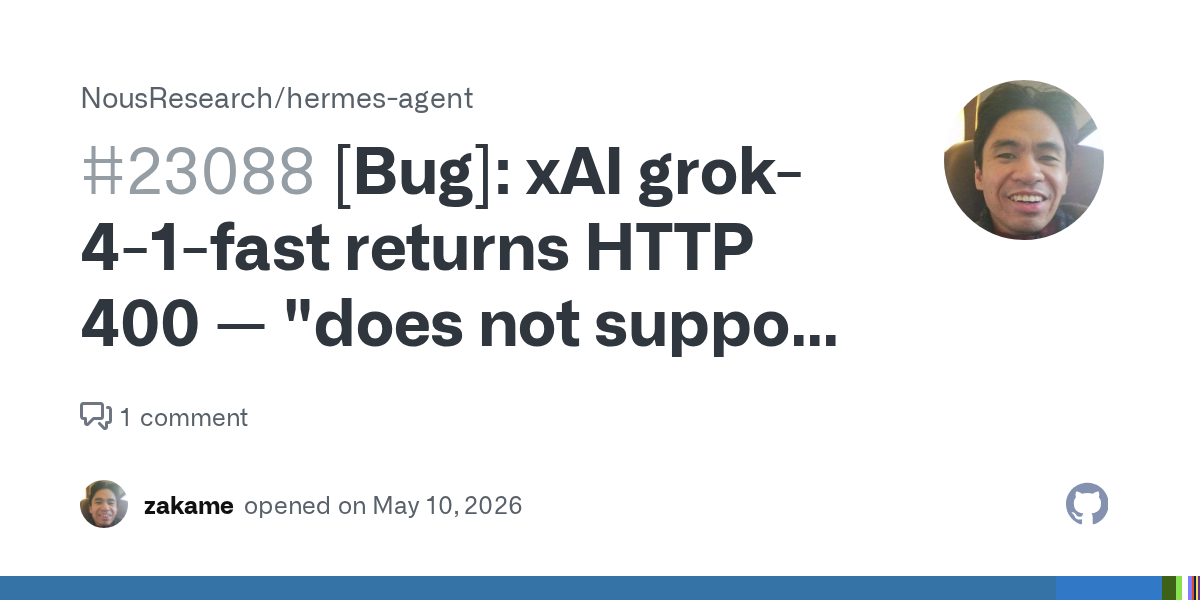
A small 400 error is usually not a story. It is a line item in somebody's issue tracker, a one-line guard in a provider adapter, and maybe a patch release if everyone is lucky. But the fresh Hermes Agent report against xAI's grok-4-1-fast is useful because it compresses the whole risk of xAI's May 15 model retirement into one boring, reproducible failure: the client sends a reasoning parameter, the model rejects it, and the agent silently falls back to another vendor.
That is not catastrophic. It is worse: it is ordinary. This is exactly how API migrations break real software.
The GitHub issue reports that after updating Hermes Agent to v0.13.0 (2026.5.7), every primary model call using the xAI provider and grok-4-1-fast failed immediately with HTTP 400. The error is precise: Model grok-4-1-fast does not support parameter reasoningEffort. Hermes then moved to its configured fallback, anthropic/claude-sonnet-4.6 through OpenRouter. From an uptime perspective, that is a decent failure mode. From a data-routing and migration-readiness perspective, it is a warning light on the dashboard.
The migration is not just a model string
xAI's own retirement guide says that on May 15, 2026 at 12:00pm PT, requests to several older models will no longer work. The retired list includes grok-4-1-fast-reasoning, grok-4-1-fast-non-reasoning, grok-4-fast-reasoning, grok-4-fast-non-reasoning, grok-4-0709, grok-code-fast-1, grok-3, and grok-imagine-image-pro. The recommended replacement for most text and code workloads is grok-4.3; for non-reasoning workloads, xAI recommends grok-4.3 with reasoning effort set to none.
That sounds simple until you put it inside an agent framework. The Hermes report suggests the xAI provider path routes requests through /v1/responses and adds reasoning: {"effort": "medium"} for xAI. Somewhere in that stack, the request reaches xAI as a reasoningEffort parameter, and grok-4-1-fast rejects it. The proposed fix is exactly the kind of fix every provider adapter now needs: only send reasoning effort to models that actually support it.
xAI's docs are explicit here. grok-4.3 supports reasoning_effort with none, low, medium, and high, defaulting to low. The same reasoning page says grok-4.20-multi-agent also accepts reasoning.effort, but there it controls agent count rather than reasoning depth. That is a portability trap wearing a clean API name. The same conceptual knob has different semantics depending on the model family.
Provider support is now a capability matrix
The old integration pattern was easy: pick a provider, pass a model name, send messages, handle tokens. That world is gone. A serious xAI integration now needs to know the endpoint, the model family, the retirement date, the accepted parameter shape, whether reasoning can be disabled, whether encrypted reasoning is available, whether fallbacks are allowed, and whether old aliases are still safe. “Supports xAI” is not a meaningful claim unless the adapter can answer those questions per model.
This matters most for teams using wrappers: Hermes, OpenRouter, Vercel AI SDK, OpenAI-compatible SDKs, internal gateways, and hosted agent platforms. Wrappers are useful precisely because they hide provider differences. They become dangerous when they hide them too well. If an adapter treats grok-4-1-fast, grok-4.3, and grok-4.20-multi-agent as interchangeable xAI chat models, production will find the edge cases faster than your test suite did.
The field-name surface is already messy enough to justify tests. xAI's docs show reasoning_effort="high" in xAI SDK style, reasoning={"effort":"high"} in OpenAI Responses API style, and providerOptions: { xai: { reasoningEffort: 'high' } } in Vercel AI SDK style. Those are not hard to map, but mapping is where bugs live. Add legacy models that reject the field and a multi-agent model that reinterprets it, and you have a classic adapter-conformance problem.
What engineers should do before May 15
First, inventory your model IDs. Search config, environment variables, dashboards, worker definitions, fallback chains, and examples copied into internal docs. Do not just look for the exact retired IDs from the migration guide; also look for older aliases like grok-4-1-fast, grok-4-fast, grok-4, and grok-code-fast-1, because xAI's models page says several older model families are being retired or migrated around the same cutoff.
Second, run a minimal conformance test for every Grok path you ship. One request with no reasoning fields. One request with reasoning_effort: none. One request with low or medium. One streaming request if you stream. One tool-calling request if you use tools. The goal is not to prove Grok is smart; the goal is to prove your adapter sends only the parameters each model accepts.
Third, inspect fallbacks as a security and compliance feature, not just an uptime feature. In the Hermes report, the primary xAI call failed and the system switched to Claude via OpenRouter. That may be a perfectly reasonable product choice. It may also be unacceptable for workloads where users, customers, or internal policy expect data to stay with a specific vendor. Migration windows are when silent fallbacks become surprise data flows.
Fourth, pin behavior during the migration. xAI's models page describes aliases intended to help users automatically move to newer versions, and aliases are convenient for experiments. Production systems need more caution. If you rely on an alias, you are delegating a change-management decision to the provider. That can be fine, but it should be a deliberate choice, not something inherited from a quickstart.
The bigger lesson is not that xAI made a bad API. The docs are actually clearer than many platform docs at this stage: the retirement deadline is stated, replacements are listed, pricing for grok-4.3 is published at $1.25 per 1M input tokens and $2.50 per 1M output tokens, and the reasoning controls are documented with examples. The issue is that platform maturity creates migration surface area. More capable models mean more parameters. More SDKs mean more naming conventions. More agent frameworks mean more hidden assumptions.
A tiny GitHub bug is the right kind of early warning. Nobody needs to panic. But if your Grok integration is production-adjacent and you have not tested the May 15 migration path yet, the failure mode has now introduced itself: one unsupported reasoning field, one HTTP 400, one fallback you may not have intended, and one reminder that “change the model string” is rarely the whole diff.
Sources: GitHub Issue: NousResearch/hermes-agent, xAI reasoning documentation, xAI May 15 retirement migration guide, xAI models documentation