Active Memory Turns OpenClaw Into a More Opinionated Assistant

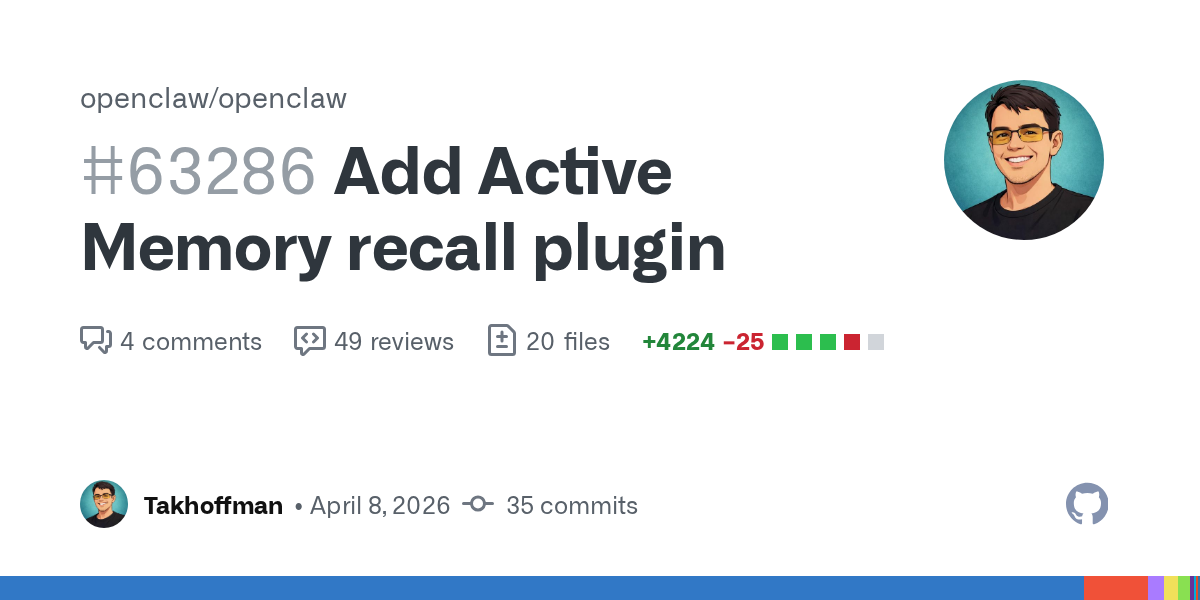
Memory features usually get marketed as magic. OpenClaw's new Active Memory plugin is more interesting because it is not pretending to be magic. It is a design decision about where orchestration should happen. Instead of waiting for a user to remember the incantation, the system now gets one bounded, pre-reply pass to look for relevant context. That sounds like a convenience feature. In practice, it is a shift in assistant behavior, product trust, and system architecture.
The official docs describe Active Memory as an optional, plugin-owned blocking memory sub-agent that runs before the main reply for eligible conversational sessions. The default recommended setup is conservative: one targeted agent, direct-message style chats only, queryMode: "recent", promptStyle: "balanced", a 15 second timeout, summary output capped at 220 characters, and transcript persistence off. Those defaults tell you the maintainers are trying to solve a product problem without pretending the retrieval problem is solved. That restraint is the good part.
Most memory systems in current assistants are technically capable and experientially clumsy. They work only when the user already knows the product well enough to ask for recall, or when the main agent happens to remember that memory exists and chooses to invoke it. By the time either one happens, the assistant has already missed the natural moment to feel helpful. OpenClaw is trying to close that gap by making memory an internal preflight step instead of a user-facing ritual.
That distinction matters. There is a world of difference between "the assistant can search memory" and "the assistant decides whether memory should influence this turn before it responds." The second model is more useful because it reduces friction. It is also more dangerous because it changes who is in charge of context selection. Once hidden retrieved context is injected before the main reply, the quality of retrieval, summarization, sanitization, and session gating matters a lot more than it did when memory was just an optional tool call.
The implementation details show that OpenClaw is aware of that risk. The plugin only runs for eligible interactive persistent chat sessions. It is gated by agent targeting and allowed chat types. It can be paused per session with /active-memory off and re-enabled with /active-memory on. Verbose mode can expose a human-readable status line and debug summary, without leaking raw internal markup. The docs explicitly position it as a conversational enrichment feature rather than a platform-wide inference behavior. That is good product hygiene. Hidden personalization is tolerable when it is constrained, inspectable, and easy to disable. It becomes creepy the moment it is everywhere.
The April 10 PR history around the plugin is even more revealing than the docs. The change log inside the pull request is full of exactly the kind of cleanup you only do after hitting real edge cases: reduce overhead, abort the sidecar on timeout, preserve active memory session scope, sanitize recalled context before retrieval, harden transcript handling, add prompt styles, fix stale status cleanup, add session and global toggles, scope transcripts by agent, and refine chat-type gating. That is the signature of a feature graduating from concept to product. It is one thing to imagine proactive memory. It is another to live through the first round of "why did it recall that," "why is this still on," and "why did the debug output linger after the reply."
Personalization gets better when the product stops making users do ceremony
The product case for Active Memory is strong. Users do not want to micromanage memory. They want assistants to remember stable preferences, recurring habits, long-term projects, and previously stated constraints without turning every conversation into a database transaction. If someone always wants blue cheese with wings, or consistently prefers terse answers, or is working on the same codebase every day, forcing them to re-establish that context is not a feature. It is UX debt.
Active Memory tackles that debt directly. If it works well, OpenClaw feels less like a clever shell around tools and more like a coherent assistant that has actually met you before. That is the upside, and it is real. Plenty of agent products are still losing on this exact point.
But the hard part is not retrieval. It is restraint. Retrieval systems fail in two especially annoying ways: they inject irrelevant trivia, or they elevate stale context into something the model treats as current fact. A reactive memory tool already causes problems when it does that. An active one can quietly skew the entire response before the user sees anything. That is why the safest and smartest part of OpenClaw's design is not that the plugin exists. It is that the plugin has clear boundaries, debug visibility, and an easy off switch.
This is also a story about internal multi-agent orchestration
The deeper strategic point is that OpenClaw is not merely adding memory. It is normalizing helper-agent orchestration inside the product. A blocking memory sub-agent that runs before the main reply is still a sub-agent, even if users never see it. That matters because it hints at where assistant architecture is going. Instead of one giant prompt trying to do everything, mature systems will compose small, bounded internal workers for recall, classification, safety, routing, and maybe even tool planning. If that sounds familiar, it is because the software industry always rediscovers specialization once the monolith gets too hard to reason about.
For practitioners, the lesson is straightforward. If you are building assistants for real users, proactive memory is probably inevitable. The question is not whether to do it. The question is whether you can do it with enough guardrails that the behavior remains intelligible. OpenClaw's current answer is promising because it treats proactive recall as optional infrastructure, not as a mystical intelligence upgrade. That is a healthier framing, and frankly a more honest one.
My take: Active Memory is one of the more important OpenClaw changes this month because it is not about bigger models or shinier demos. It is about smoothing one of the most obvious product rough edges in modern assistants. If OpenClaw can keep the feature observable, bounded, and boring in the best possible way, this is the kind of change users will start to rely on without ever learning the implementation name. That is usually how you know a product feature is real.
Sources: Active Memory PR #63286, Active Memory docs, OpenClaw releases