Agent Benchmarks Just Stopped Measuring Models and Started Measuring the Data Center

Agent benchmarks are growing up, which means they are getting less flattering and more useful.
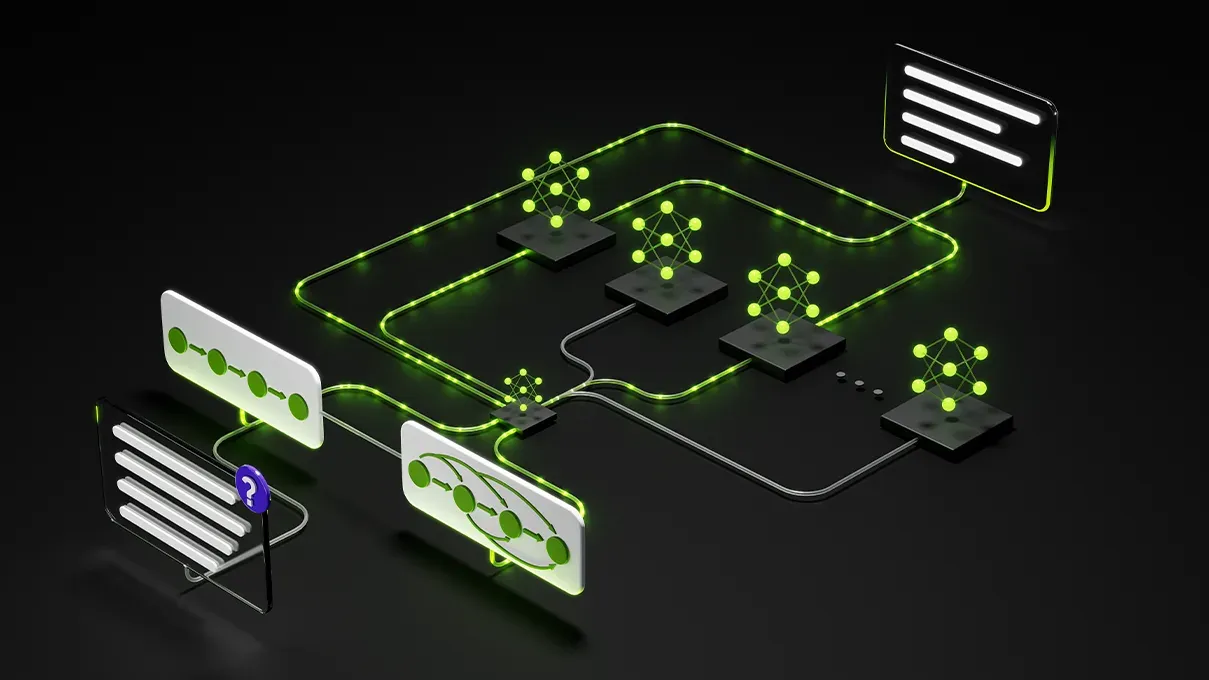
NVIDIA’s latest post around Artificial Analysis’ new AA-AgentPerf benchmark looks, at first glance, like the usual hardware victory lap: Blackwell GB300 NVL72 beats older systems by a lot, the chart goes up and to the right, everyone applauds the rack. But the more important shift is not the specific GB300 number. It is the thing being measured. AA-AgentPerf is not asking which model wins a prompt contest. It is asking how many concurrent coding agents a system can keep alive while meeting service-level targets for first-token latency and output speed.
That is a much better question for the era we are actually entering. Coding agents are not single API calls. They are long-running loops with expanding context, tool calls, retries, subagents, shell output, file diffs, compaction events, and periodic moments where the model has to regain the plot after 30 minutes of state accumulation. A system that looks fast on a clean chat benchmark can still feel broken when 40 engineers start running repo-scale agents in parallel.
The benchmark is really about capacity planning
Artificial Analysis describes AA-AgentPerf as a benchmark for maximum concurrent agents under explicit service-level objectives. At launch, the DeepSeek V4 Pro tiers include output-speed and P95 time-to-first-token requirements — for example 20 tokens per second with P95 TTFT under 10 seconds, 60 tokens per second with P95 TTFT under 5 seconds, and 180 tokens per second with P95 TTFT under 3 seconds. NVIDIA’s own table uses a slightly different tested framing — 30, 100, and 300 tokens per second with 10, 5, and 3 second P95 TTFT targets — which is exactly the kind of methodology wrinkle operators should read before quoting the biggest number in a slide deck.
The workload shape matters more than the label. AA-AgentPerf replays prerecorded coding-agent trajectories with interleaved reasoning and tool use instead of synthetic one-shot prompts. Artificial Analysis says real trajectories can run up to 200 turns and exceed 100K tokens. NVIDIA says the requests in its tests ranged from 5K to 131K tokens, with a mean around 27K tokens. Tool latency is simulated on the CPU side, including a one-second median delay distribution, so this is not merely GPU decode throughput wearing an agent costume.
That design is a useful correction to the leaderboard economy. For years, AI model evaluation has trained buyers to ask “what scored higher?” Agent infrastructure forces a different question: “what remains interactive when the context is large, the tools are slow, and the queue is full?” That is the question your users notice. Nobody cares that your provider can produce an impressive isolated tokens-per-second number if their coding agent pauses long enough for them to alt-tab into despair.
GB300 is the headline, but the stack is the story
NVIDIA reports 61.4K concurrent agents per megawatt for GB300 NVL72 versus 2.6K for H200 in the cited SLO configuration, and 57.5 concurrent agents per GPU versus 1.4 for H200. The company attributes the gap to the full Blackwell rack-scale design: a 72-GPU NVLink scale-up domain, MoE serving optimizations such as WideEP and DeepEP, DeepGEMM and fused MoE kernels, MXFP4/MXFP8 execution, and KV-cache movement across the rack.
Translated out of vendor dialect: agent workloads make the whole serving stack visible. KV cache is no longer an implementation detail. Context compaction is no longer a UX nicety. Network fabric, CPU/GPU coordination, expert routing, precision format, and cache movement are now product features because they decide whether an agent can stay responsive while juggling long histories and tool loops.
NVIDIA’s supporting infrastructure analysis gives the right kind of workload example. One Claude Code-style session ran 33 minutes, included 283 inference requests, 58 main-agent turns, 225 sub-agent invocations, and grew from 15K to 156K tokens before compaction brought it back to roughly 20K. That is the shape of real agent usage: not “ask a model a question,” but “keep a semi-autonomous process coherent while it repeatedly touches the world.” Anthropic’s estimate that multi-agent systems can consume up to 15× more tokens than standard chat explains why this benchmark exists. The economics are not hypothetical anymore.
What builders should take from this
If you run agents internally, the action item is not “buy GB300.” It is “instrument your own trajectories before your bill explains them to you.” Log input length, output length, cached-token ratio, tool-call count, wall-clock time, retry count, compaction events, subagent fan-out, and task success by category. Track latency at the agent-session level, not just the model-call level. An agent that makes 200 individually acceptable calls can still deliver an unacceptable user experience.
Teams choosing providers should also stop treating model price as the whole cost model. Agent cost is a stack outcome. A provider that is cheaper per token but worse at cache reuse, long-context latency, or tool-loop throughput may be more expensive per completed task. Conversely, a pricier serving stack can win if it finishes tasks with fewer stalls, fewer retries, and less human babysitting. The unit that matters is no longer tokens. It is successful agent work under an SLO.
There are caveats here. This first AA-AgentPerf cycle is still early, focuses on DeepSeek V4 Pro, and includes vendor-submitted configurations. NVIDIA submitted its B300 and GB300 results, while Artificial Analysis built H200 and MI355X configurations. That does not invalidate the benchmark, but it does mean the honest read is “promising methodology with vendor-influenced first data,” not “final law of inference infrastructure.” We need more models, more independent submissions, more public trace detail, and more clarity around SLO tiers before anyone should generalize the 20× headline across every agent workload.
Still, the direction is right. Agent benchmarks are moving out of the model beauty contest and into capacity planning. That is progress. The next coding-agent race will not be won only by the model with the prettiest SWE-bench score. It will be won by the stack that keeps long-context, tool-using loops cheap, concurrent, and interactive after the demo ends.
Sources: NVIDIA Technical Blog, Artificial Analysis AA-AgentPerf, Artificial Analysis hardware benchmarks, NVIDIA agentic systems infrastructure analysis