Alibaba Is Building the Agent Factory Under Qwen3.7-Max

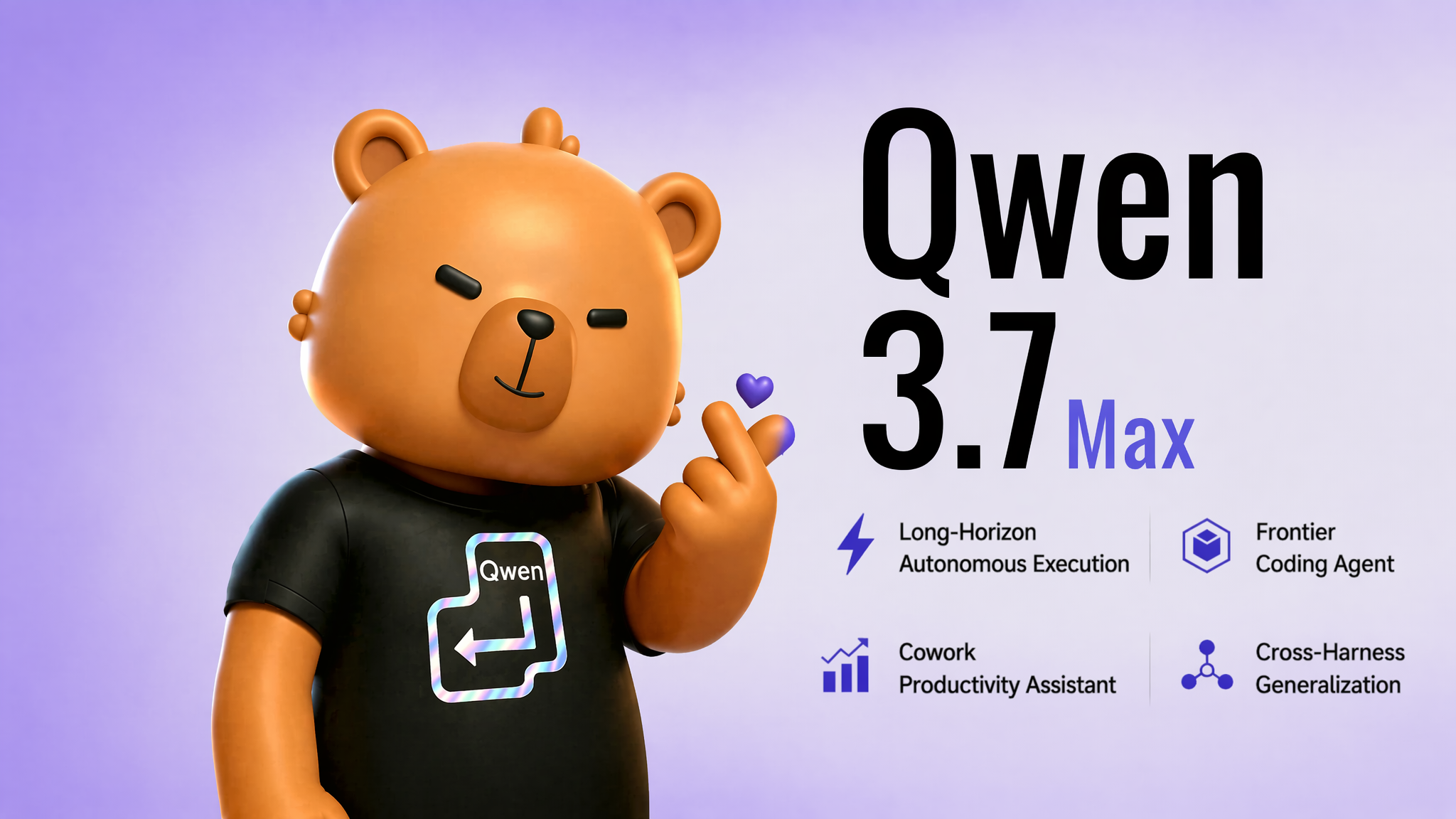
Alibaba’s Qwen3.7-Max announcement is not really a model launch. It is a platform pitch with a model attached — and that distinction matters.
The company used its Alibaba Cloud Summit in Hangzhou to unveil Qwen3.7-Max, a new Zhenwu M890 AI processor, the Panjiu AL128 rack-scale server, Model Studio/Bailian upgrades, and an agent-oriented cloud stack. The press-release version is easy to flatten into “Alibaba has a better LLM now.” The more useful read is sharper: Alibaba is trying to own the whole factory that makes long-running agents economical — model, chip, interconnect, runtime, reinforcement learning feedback, and governance.
That is the right shape of the problem. Agent workloads are not chat workloads with a more ambitious prompt. A coding agent running for hours needs repeated model calls, tool execution, file edits, test loops, permission checks, retries, rollback paths, memory management, and logs that a human can inspect after the fact. Once the unit of work becomes “operate for half a day and call tools a thousand times,” the boring infrastructure becomes the product.
The 35-hour claim is the hook, not the proof
Alibaba says Qwen3.7-Max is built for “agentic workloads” and “sustained, multi-step operations rather than single-turn responses.” The headline demo is designed to land with engineers: according to Alibaba, Qwen3.7-Max was given a task brief on a Zhenwu M890 chip it had not encountered in training, ran without human intervention for 35 consecutive hours, executed more than 1,000 tool calls, and produced a production-grade AI computing kernel that outperformed the chip maker’s official implementation by 10x.
That is either a serious result or a very carefully staged benchmark. Probably some of both. Vendor demos are useful when they point at the right workload; they are dangerous when treated as evidence that the general case is solved. The questions practitioners should ask are not optional: what exactly was the task spec, what scaffolding did the model get, how were failed attempts counted, what tools were available, how many runs were discarded, and does the resulting kernel generalize beyond the internal target?
Still, the benchmark is notable because it moves the conversation away from single-shot coding examples. Alibaba is claiming endurance, not just cleverness. That is where coding-agent evaluation has to go next. A useful internal test for Qwen3.7-Max would not be “solve this LeetCode problem.” It would be: take a messy multi-file migration, run inside a sandbox, require audited tool calls, enforce a budget, and measure accepted diff quality, test pass rate, human review time, hallucinated file paths, rollback behavior, and total cost. If the model is as strong as Alibaba implies, it should show up there.
The hardware story is an admission about agent economics
The Zhenwu M890 is Alibaba’s most important tell. T-Head says the chip delivers 3x the performance of its Zhenwu 810E predecessor, carries 144GB of on-chip memory, supports 800GB/s inter-chip bandwidth, and works across precision formats from FP32 down to FP4. The new ICN Switch 1.0 claims up to 25.6Tbps of aggregate bandwidth and congestion-free communication across 64 accelerators. Panjiu AL128 then packages 128 AI accelerators into a rack-scale unit with petabyte-per-second internal bandwidth.
Those numbers are not just spec-sheet theater. Long-running agents are margin machines in the worst possible way: they burn tokens while thinking, burn latency while waiting on tools, and burn operational attention when they get stuck. Memory capacity, interconnect bandwidth, and low-precision inference decide whether a thousand-tool-call workflow is something you can sell or something your finance team notices before your users do.
Alibaba also says more than 560,000 Zhenwu chips have shipped, with 400-plus external customers across 20 industries. That does not make M890 an Nvidia killer. CNBC’s analyst context is the right guardrail here: memory and bandwidth are only part of the picture, and Alibaba has not published enough compute-performance detail to support direct frontier-chip comparisons. But the strategic point is real. Under export pressure, Alibaba is building a domestic path where it can tune Qwen-family models against infrastructure it controls.
Open Qwen and cloud Qwen are no longer the same story
For developers, the most important deployment question is not “is this Qwen?” It is “which Qwen surface am I actually getting?” Alibaba’s ecosystem now spans open-weight Qwen models, ModelScope-hosted models, Qwen Code and QwenPaw tooling, Model Studio/Bailian APIs, and proprietary flagship tiers. Decrypt reports the Qwen3.7 Plus variant is expected to be open-sourced while Max remains proprietary, continuing the pattern where Alibaba gives the ecosystem a capable open tier and monetizes the best model through cloud access.
That split is not automatically bad. It is just not the same procurement story. A local Qwen model running through vLLM, SGLang, Ollama, LM Studio, or llama.cpp has different privacy, latency, compliance, and lock-in properties than Qwen3.7-Max behind Model Studio. Teams using Qwen because it feels “open” need to be more precise. The Qwen brand is no longer a deployment model.
The open tier still matters enormously. Decrypt’s hands-on review says Qwen3.7-Max-Preview appeared on Arena AI before the summit and ranked strongly in math, expert prompts, and software/IT categories. It also found the model concise in coding tasks and especially strong on a hard math problem, while weaker on some narrative reasoning. That maps to the existing Qwen pattern: strong engineering utility, occasionally less impressive general taste. If the open Plus model inherits enough of Max’s agent and coding behavior, it could become the next serious local-agent default. If the best behavior stays locked behind Alibaba Cloud, Qwen shifts from “open local frontier” toward “cloud frontier with an open ecosystem halo.”
Governance is the part Alibaba still needs to make concrete
Alibaba says Bailian / Model Studio now includes Agentic RL, using real task outcomes to improve models, plus built-in safety governance that keeps agents inside defined boundaries. That is directionally right and operationally thin. Long-running agents need policy at the service and runtime layer, not a safety paragraph near the bottom of an announcement.
The checklist for builders is concrete: tool allowlists, secrets boundaries, sandboxed execution, replayable logs, approval flows, per-session budgets, MCP or remote-tool provenance, termination conditions, and a review trail that explains why the agent touched a file, called an API, or kept retrying a failing command. A 35-hour agent without a trustworthy stop button is not autonomy. It is a very expensive while-loop.
Community reaction is appropriately skeptical. Hacker News discussion around the announcement focused less on cheerleading and more on the things practitioners actually care about: hallucination metrics, token efficiency, whether Qwen can replace Claude Code for smaller tasks, and whether leaderboard results translate into daily reliability. That is the right posture. The useful question is not whether Alibaba can produce an impressive benchmark. It is whether Qwen3.7-Max can make long-running coding and office agents cheaper, more auditable, and reliable enough to move real work.
My read: Alibaba is making the correct full-stack bet. The model matters, but the infrastructure admission matters more. Agents are no longer cheap chatbot calls wearing a tool belt. They are distributed systems with budgets, permissions, retries, memory, and blast radius. Qwen3.7-Max is interesting only if Alibaba can prove that entire stack works outside the summit demo.
Sources: Alibaba Cloud, Decrypt, Hacker News