AMIE Shows Google’s Medical AI Moving From Diagnosis to Care Management

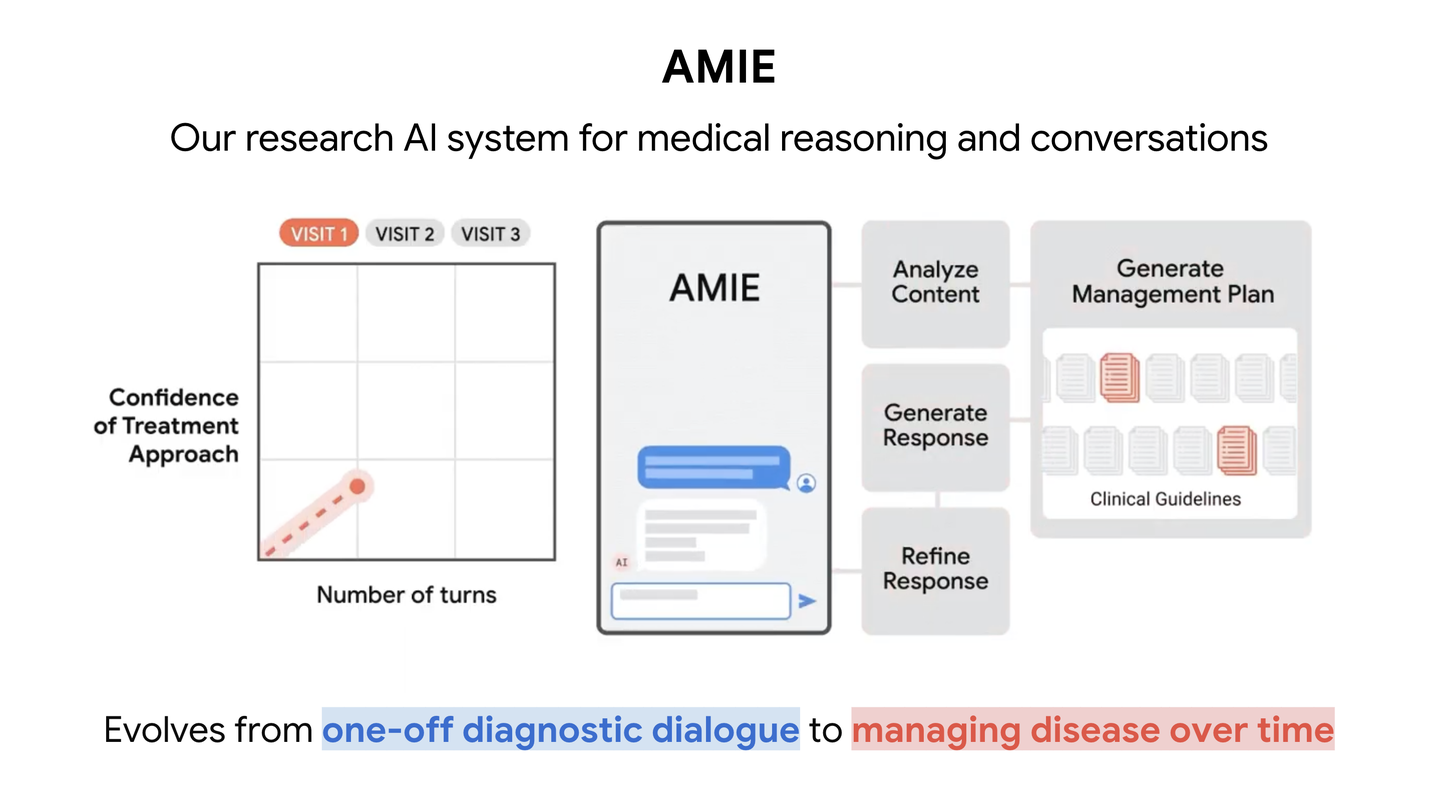
Google’s newest AMIE paper is easy to misread as another “AI versus doctors” headline. That is the least interesting version of the story. The more useful read is that Google is moving its medical AI research from the neat world of diagnostic puzzles into the much uglier world of longitudinal care: follow-up visits, medication changes, guideline conflicts, patient preferences, and the paperwork swamp where clinical intent goes to lose velocity.
That shift matters because diagnosis is the demo-friendly part of medicine. Disease management is the software problem. It is stateful, regulated, human, and full of edge cases that do not fit cleanly into a single prompt. Google’s Articulate Medical Intelligence Explorer, or AMIE, is now being tested against that harder problem.
The Nature paper, published June 17, evaluates AMIE in a randomized, blinded virtual Objective Structured Clinical Examination using 100 multi-visit case scenarios based on UK NICE Guidance and BMJ Best Practice. Specialist physicians compared AMIE with 21 primary care physicians, according to Nature’s abstract. Google’s own blog says 20 PCPs; when the paper and the blog disagree, use the paper as the source of record. AMIE was non-inferior on overall management reasoning and scored higher on treatment and investigation precision and guideline alignment.
The architecture is the real medical AI story
The important technical detail is not that AMIE is “a chatbot.” Google split the system into two roles: a user-facing Dialogue Agent for patient conversation and a Management Reasoning Agent that performs slower, deliberate reasoning over longitudinal patient history, clinical guidelines, drug formularies, and hundreds of pages of reference material. The company says the system uses Gemini’s long-context capabilities to cross-reference that material while maintaining a patient-centered conversation.
That pattern should look familiar to anyone building serious agents outside healthcare. The interface is not the planner. The pleasant conversational layer should not be the only thing deciding what happens next. Good agent systems increasingly look like a front-of-house assistant backed by a separate reasoning and policy layer with retrieval, constraints, evaluation hooks, and auditability. Healthcare simply makes the requirement impossible to ignore.
Google also introduced RxQA, a 600-question medication-reasoning benchmark validated by board-certified pharmacists. It covers indications, contraindications, dosage, side effects, and drug interactions. That benchmark detail matters because medication reasoning is where vague “helpfulness” turns dangerous fast. A model that sounds empathetic but misses a contraindication is not a product. It is a liability with bedside manner.
The results are encouraging, but they are not a deployment license. This was a simulated, text-based setting. Real clinical care includes messy EHR data, local formularies, incomplete histories, lab timing, imaging, staff handoffs, insurance constraints, and patients who do not behave like standardized actors. Google knows this; the company points to prior feasibility work at Beth Israel Deaconess Medical Center involving 100 adult patients, 98 completed appointments, and zero safety stops triggered by human supervisors. It also says it has launched a pending-IRB nationwide randomized study with Included Health to test conversational AI in real virtual-care workflows.
From benchmark theater to staged evidence
This is the part builders should copy. AMIE is not being justified by a single leaderboard. Google is stacking evidence: simulated OSCEs, specialist review, a medication benchmark, supervised clinical feasibility work, and now a planned randomized real-world study. That is what evaluation looks like when the downside is not “bad answer on a demo” but “bad plan in a person’s care pathway.”
Most agent products do not come close to this standard. They ship with a handful of internal eval prompts, a confidence score nobody understands, and a human-in-the-loop checkbox that means “we hope someone is watching.” In low-risk domains, that may be acceptable for iteration. In healthcare, finance, legal, public services, and infrastructure operations, it is not. If your agent can materially affect someone’s health, money, legal status, or access to services, the eval stack is part of the product, not a launch appendix.
The practitioner takeaway is also architectural. Do not build a high-stakes agent as one large prompt with tool access and a friendly UI. Split responsibilities. Keep conversation separate from planning. Ground decisions in authoritative sources. Track longitudinal state explicitly. Produce structured plans that can be reviewed. Build domain-specific tests, not just generic model evaluations. And assume the product must graduate through staged deployment: simulation, expert review, supervised pilots, randomized studies, and only then broader autonomy.
AMIE is also a useful warning against the cheap version of medical AI optimism. “AI doctors are here” is a bad conclusion. “The shape of serious clinical AI is becoming visible” is better. The system is still research. The study is still bounded. But the components are the right ones: long context, guideline grounding, medication-specific evaluation, role separation, and real-world validation on the roadmap.
The forward-looking question is not whether AMIE can impress specialists in a virtual exam. It is whether the system can improve outcomes, reduce clinician burden, and avoid creating a new review queue where humans rubber-stamp machine-generated care plans because the software appears authoritative. That is the failure mode to watch. AI in medicine does not need to replace doctors to cause harm. It only needs to create plausible plans faster than clinicians can safely inspect them.
Still, this is the most credible direction for medical AI: not a general oracle in a white coat, but a constrained management assistant that reads the chart, knows the guidelines, reasons about medication risk, and helps clinicians spend more time with patients instead of reconciling documents. That is less flashy than the diagnostic showdown. It is also much closer to where real clinical software has to go.
Sources: Google Research, Nature, Google nationwide Included Health study announcement, Google BIDMC feasibility study