Anthropic Wins Preference. Open Models Win the Workload.

The most important result in this week’s model rankings is not that GLM 5.3 moved up one place. It is that the two most-watched leaderboards now look as if they are measuring different industries.
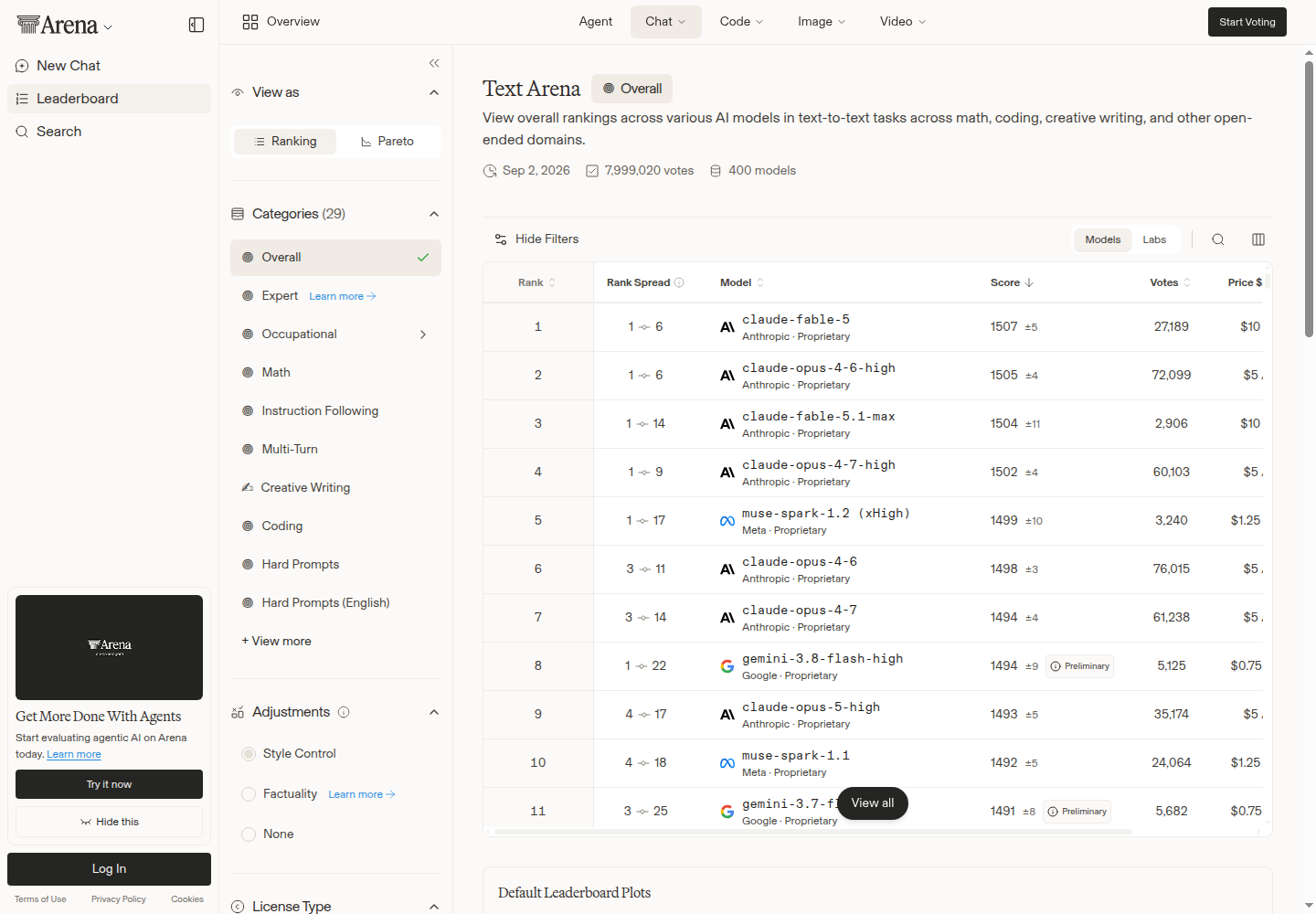
Arena AI’s text table did not move at all. Anthropic models hold seven of its first nine positions, with claude-fable-5 leading at 1507 Elo and claude-opus-4-6-high two points behind. On OpenRouter, meanwhile, Tencent’s Hy4 preview leads public API traffic with 14.1 trillion tokens in the trailing seven-day window. Z.ai’s GLM 5.3 Flash, DeepSeek V4 Flash 0731, and OpenAI’s GPT-5.6 Luna follow at 12.5T, 12.3T, and 12.2T.
That is not a contradiction. It is a warning about the word “best.” Arena asks which of two anonymous answers a voter prefers. OpenRouter counts prompt and completion tokens routed through public requests. One hides price and provider behind a blind comparison; the other bundles quality together with price, availability, verbosity, context length, routing defaults, free promotions, and the shape of actual workloads. Treating either table as a universal model ranking is a category error.
Anthropic wins the room; open models win the workload
Arena’s stability is meaningful. Anthropic’s seven top-nine placements suggest that when users compare outputs without seeing a bill or deployment checklist, Claude’s response quality remains unusually hard to beat. Meta’s Muse Spark 1.2 at fifth and Google’s Gemini 3.8 Flash High at eighth interrupt the run, but the preference market is otherwise emphatically Anthropic’s.
OpenRouter tells a different story. Models from Tencent, Z.ai, DeepSeek, Xiaomi, and Moonshot occupy eight of the first thirteen positions. Hy4 alone processed 14.1T tokens, up from 13.6T in the previous daily snapshot, with a displayed week-over-week growth rate of 639%. Its predecessor Hy3 is still seventh at 4.44T. Developers are not merely sampling one new endpoint; they are repeatedly choosing a family of models with open weights, million-token context windows, and deployment paths that fit existing agent infrastructure.
Economics and distribution are doing real work here. Tencent prices Hy4 at $0.834 per million input tokens, $2.501 per million output tokens, and $0.042 per million cached tokens. It also offered two weeks of free access through WorkBuddy and CodeBuddy. A launch promotion can produce a lot of tokens before it produces durable production adoption, which is why Hy4’s enormous first-week number should be read as proof of reach, not proof of retention.
The model is technically designed for that reach. Tencent describes Hy4 as a 770-billion-parameter mixture-of-experts system that activates 49B parameters per token, routes across 256 experts, selects eight, and supports a one-million-token context. The Apache 2.0 release includes FP8 weights plus official vLLM and SGLang recipes. For a platform team, those details may matter more than two Elo points: they determine whether the model can be served, observed, budgeted, and swapped into an existing stack without a quarter of integration work.
Token volume can reward the wrong thing
There is an uncomfortable wrinkle in using tokens as a proxy for adoption: inefficient models can look busier. Tencent’s model card acknowledges that Hy4 can reason for too long and over-verify its work. Both behaviors inflate completion volume while increasing latency and cost. A model that produces twice as many tokens to solve the same task receives twice the leaderboard credit, even if the user would prefer the shorter answer.
This is the first practical insight the rankings do not print: teams should normalize evaluations by accepted outcome, not by request or token. “Cost per million tokens” is an input price. “Cost per merged patch,” “cost per resolved ticket,” or “cost per correct extraction” is an operating metric. A cheap verbose model can lose to an expensive concise one after retries, tool errors, and review time are included.
Tencent reports a 31.8% end-to-end throughput improvement after Hy4 helped optimize parts of its own inference stack. That is promising, but it also illustrates why vendor benchmarks need reproduction. In Tencent’s blind test, 163 experts rated 203 engineering tasks: Hy4 averaged 2.99 out of four, compared with 2.92 for GLM 5.3 and 2.94 for Kimi K3. Against GLM it recorded 46.8% wins, 12.8% ties, and 40.4% losses. The advantage exists, but it is narrow enough that a different workload, judge rubric, or serving configuration could reverse it.
GLM’s one-place gain is really a deployment story
The only change inside OpenRouter’s top ten was GLM 5.3 passing Xiaomi’s MiMo-V2.5. GLM reached 2.81T weekly tokens versus MiMo’s 2.76T—a gap of 50 billion tokens, or about 1.8% of MiMo’s volume. Elsewhere, GLM 5.2 passed Gemini 3.7 Flash by 40B tokens, while the free Laguna S 2.1 endpoint passed DeepSeek V4 Pro 0423 by 20B. These are usage signals, not victory laps. One large customer, routing change, or promotion could flip every pair tomorrow.
Still, GLM’s rise has substance behind it. Z.ai says GLM-5.3 uses the same base model as GLM-5.2 and gets its improvements from post-training. Its reported Terminal-Bench 3.0 score jumped from 4.6 to 28.3, DeepSWE v1.1 rose from 46.2 to 66.9, and Agents’ Last Exam improved from 23.8 to 28.5. The endpoint supports one-million-token context, speaks both OpenAI- and Anthropic-compatible protocols, and plugs directly into coding agents. Z.ai also reports a 34.5% task-completion rate at roughly 75,000 output tokens, compared with 23.4% at 96,000 for GLM-5.2. If that efficiency survives independent testing, it is exactly the kind of improvement that can turn trial traffic into sustained usage.
MiMo’s slip should not be mistaken for collapse. Xiaomi’s 310B sparse MoE activates only 15B parameters, supports a million-token context, was trained on 48T tokens, and still processed 2.76T tokens this week while showing 72% growth. Its rank changed because GLM grew faster, not because developers abandoned it.
Build a scorecard that matches your bill
Engineering teams should use these rankings to select candidates, never winners. Take 50 to 200 representative tasks from your own traces, remove sensitive data, and pin model versions and reasoning settings. Record task success, wall-clock latency, input, output, and cached tokens, tool-call failures, retries, reviewer interventions, and total cost per accepted result. For coding agents, run generated changes in a sandbox and score tests passed, regressions introduced, and review effort—not whether the explanation sounded confident.
Long context deserves its own experiment. Compare a million-token prompt with retrieval plus a smaller working set. Context capacity is not context competence, and sending an entire repository can make attention noisier while making the invoice larger. Cache pricing can improve the economics, but cached tokens are still an architectural choice, not free correctness.
Finally, wait for the subsidies to expire. Watch Hy4 for another seven to fourteen days, separate free from paid traffic where the data allows it, and look for stable latency under load. Adoption that persists after credits disappear is signal. Launch-week token fireworks are a smoke test.
The leaderboard split is not a problem to reconcile. It is useful information about two buying decisions. Arena says users like Anthropic’s answers when constraints are hidden. OpenRouter says builders will aggressively route work toward models that are cheaper, open, long-context, and easy to integrate. The model that wins your workload may sit below both leaders—and the only ranking that can tell you that is the one your team builds itself.
Sources: OpenRouter LLM Rankings, Arena AI Text Leaderboard, Tencent Hy4 announcement, Hy4 model card, Z.ai GLM-5.3 documentation, Xiaomi MiMo-V2.5 announcement