Cheap Tokens Are Reordering the LLM Market Faster Than Benchmarks Can

The most important model leaderboard move this week is not a quality breakthrough. It is a pricing event wearing a ranking badge.
GPT-5.6 Luna climbed two places to No. 2 on OpenRouter after processing 12.9 trillion tokens in the trailing seven-day window. It now sits behind Tencent's Hy4 preview at 14.7 trillion and just ahead of GLM 5.3 Flash and DeepSeek V4 Flash 0731, both at roughly 12.4 trillion. Four models, from four providers, are separated by only 2.3 trillion tokens at the top of a chart where launch incentives and unit economics can redirect enormous workloads almost overnight.
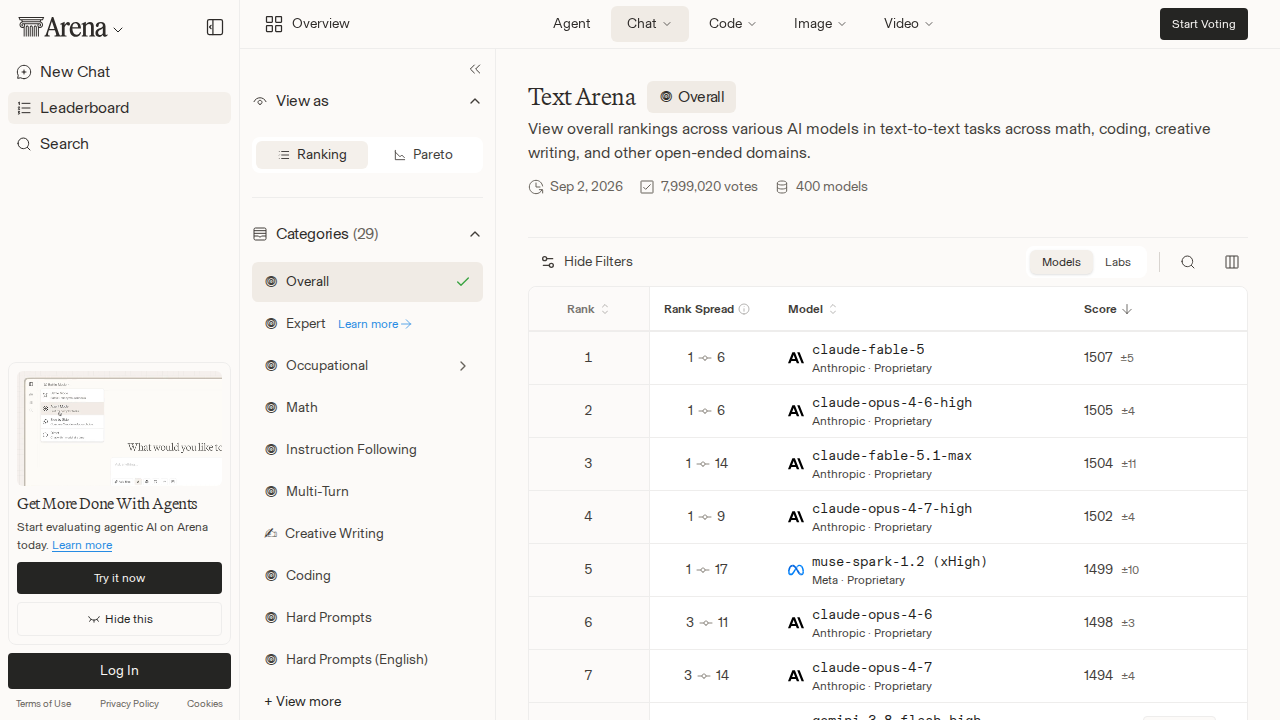
Meanwhile, Arena's text leaderboard did not move. Anthropic models still occupy the first four positions, led by claude-fable-5 at 1507 Elo, with claude-opus-4-6-high at 1505 and claude-fable-5.1-max at 1504. The split is cleaner than any marketing deck: blind preference and routed production usage are measuring different markets.
Luna bought access to workloads that used to be uneconomic
OpenAI cut Luna's API price by 80% on July 30, to $0.20 per million input tokens and $1.20 per million output tokens. That pricing is not a small procurement win. It changes which product ideas survive a spreadsheet: bulk classification, repository-wide maintenance, continuous document processing, inexpensive subagents and retry-heavy automation all become easier to justify when the marginal call costs a fraction of the previous rate.
Luna's weekly volume rose from 12.2 trillion to 12.9 trillion tokens even as its displayed growth rate cooled from 80% to 66%. GLM 5.3 Flash remained near 12.4 trillion and fell to third; DeepSeek V4 Flash 0731 held roughly the same volume and slipped to fourth. The rankings changed because Luna gained real throughput, not because the chart merely reshuffled ties.
OpenAI says Luna delivers year-old frontier-class performance at roughly six cents per “task-dollar,” nearly nine times the speed, and beats Fable 5 on Agents' Last Exam at an estimated per-task cost almost 99% lower. Those are vendor claims and should be treated as such. But the mechanism behind them matters: OpenAI says GPT-5.6-assisted kernel work cut serving cost by 20%, while automated experiments improved token-generation efficiency by more than 15%.
That is the first larger signal in this week's rankings. Model companies are no longer improving only the artifact customers call; they are using the artifact to optimize the machinery that serves it. Better kernels lower inference cost, lower inference cost permits lower prices, and lower prices generate more production traces for the next round of optimization. The model-serving flywheel is becoming as strategically important as the benchmark flywheel.
Hy4 is selling a different kind of control
Hy4 preview remains OpenRouter's leader and grew from 14.1 trillion to 14.7 trillion weekly tokens, although its displayed growth cooled from 639% to 379%. Tencent launched it with two weeks of free WorkBuddy and CodeBuddy access, so some demand is plainly launch-shaped. OpenRouter's chart covers its own API traffic rather than Tencent's bundled products, but promotions, tutorials and ecosystem attention still spill across channels.
The technical proposition is distinct from Luna's cheap hosted API. Tencent describes Hy4 as a 770-billion-parameter mixture-of-experts model with 49 billion active parameters and a context window above one million tokens. Its list price is $0.834 per million input tokens, $2.501 per million output tokens and $0.042 per million cached tokens. Luna wins the simple sticker-price comparison; Hy4 adds open weights, a huge context window and the possibility of deployment control.
Tencent's internal blind evaluation asked 163 experts to rate outputs across 203 engineering tasks. Hy4 averaged 2.99 out of 4, narrowly ahead of Kimi K3 at 2.94 and GLM-5.3 at 2.92. Useful evidence, yes; independent adjudication, no. Tencent also reports a 31.8% end-to-end throughput improvement from operator fusion, communication optimization and other model-assisted inference work. That mirrors OpenAI's story closely enough to matter: both vendors increasingly compete on the efficiency of the entire serving stack, not parameter count alone.
The second larger signal is that “best value” now depends on organizational constraints. A team with bursty demand and no appetite for inference operations may rationally choose Luna. A regulated shop that needs data residency, weight access or predictable self-hosted capacity may prefer Hy4 even when the hosted call is more expensive. Price per token is only the first line of the cost model; staffing, cache behavior, retry rates, latency tails and human correction time decide the invoice that matters.
Token volume is easy to misread—and easy to game accidentally
OpenRouter counts prompt and completion tokens in trailing seven-day UTC buckets. It excludes private requests and separates free from paid variants. It does not measure unique users, request count, revenue, total market share or model quality. A token can represent a crisp final answer, a million-token context upload, a verbose failure or an agent repeatedly rereading the same state.
That makes raw volume structurally favorable to long-context models, free tiers, migration campaigns and agent loops. Hy4's million-plus-token window can create more measured usage per task than a compact classifier. A free model may rank above a paid model without supporting a durable business. And a model that needs two retries can produce more leaderboard volume than one that succeeds immediately. The chart is a demand signal, but not necessarily a productivity signal.
The practitioner discussion reflects that ambiguity. In an r/opencodeCLI thread with 86 votes and 47 comments when indexed, the original poster described a workload split: Luna for complex tasks, DeepSeek V4 Flash for small fixes and routine writing. Another LocalLLaMA comparison reached the opposite qualitative judgment, arguing DeepSeek was stronger and Luna could be “lazy.” This is not noise to average away. It is evidence that model selection has moved from one-dimensional brand preference toward workload routing.
The rest of OpenRouter's board reinforces that fragmentation. DeepSeek V4 Flash 0423 rose to No. 5 with 5.19 trillion tokens as MiniMax M3 free slipped to sixth at 5.02 trillion. Claude Sonnet 5 gained two places to No. 17. Solar Pro 4 entered at No. 20 with 1.21 trillion tokens and 87% weekly growth, displacing Nemotron 3.5 Lightning free. There is no stable two-vendor market here; distribution can rapidly manufacture a trial, but retention must still be earned task by task.
Build a router test, not a leaderboard dependency
Engineering teams should treat this week's rankings as a shortlist generator. Pull 50 to 100 representative tasks from real work, remove sensitive data, pin exact model versions and run the candidates through the same harness. Record task success, wall-clock latency, prompt and completion tokens, cache hits, tool-call failures, retries and human correction minutes. “Cost per million tokens” is useful only after it becomes cost per accepted result.
Trial Luna on well-specified implementation work, extraction and high-volume classification. Trial Hy4 where long context, artifact generation, open weights or deployment control can justify extra operational complexity. Keep a stronger reasoning model in the route for ambiguous requirements and failure recovery. Most importantly, rerun the evaluation after launch promotions expire. If usage collapses when free access ends, that is distribution decay—not sudden model regression.
A third conclusion follows from the unmoving Arena board: production adoption can change much faster than human preference. Anthropic owns Arena's top four while OpenRouter's top four come from Tencent, OpenAI, Z.ai and DeepSeek. Neither list is wrong. One asks which answer people prefer in a blind comparison; the other reports where tokens happened to flow through a particular gateway. Copying either ranking directly into production is outsourcing architecture to a chart.
Luna did not become the world's second-best model this week, and Hy4 was not crowned the best. They demonstrated that cheap, accessible capability can move workloads before benchmark consensus catches up. The teams with an edge will be the ones measuring completed work, routing deliberately and remaining deeply skeptical of any leaderboard that compresses quality, price and adoption into one ordinal number.
Sources: OpenRouter LLM Leaderboard, Arena AI Text Leaderboard, Tencent Hy4 preview announcement, OpenAI GPT-5.6 price-performance announcement, r/opencodeCLI practitioner discussion