Claude Code 2.1.181 Is a Reliability Release Disguised as UX Polish

Claude Code 2.1.181 is the kind of release that does not look important until you map the fixes onto how teams actually use coding agents: remote sessions, custom gateways, MCP servers, subagents, cloud-synced folders, and long-running transcripts that outlive a single terminal tab. That is not “UX polish.” That is the control plane getting less dishonest.
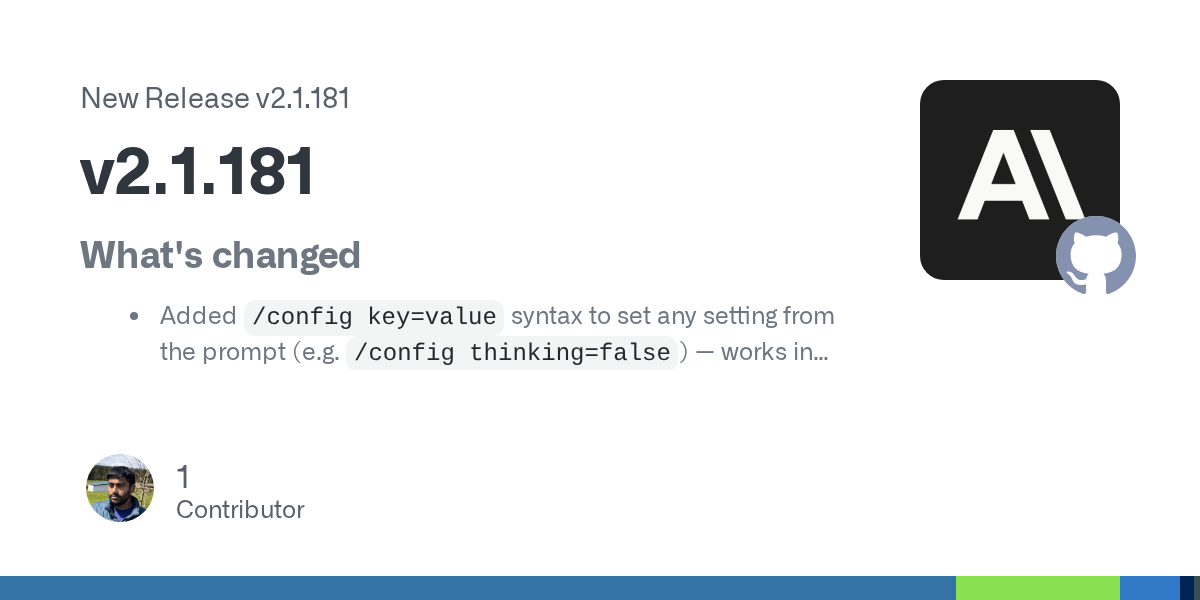
The headline feature is modest: /config key=value now works from the interactive prompt, non-interactive -p, and Remote Control. Anthropic’s own example is /config thinking=false, which tells you where this is headed. Configuration is no longer a local preference buried in a terminal UI; it is becoming an addressable interface for scripts, remote clients, and managed workflows.
That matters because Claude Code has quietly crossed the line from “developer chat with tools” into “distributed workstation.” It can write files, open browsers, call MCP servers, spawn subagents, run under Remote Control, and talk through custom Anthropic-compatible gateways. Once a tool has that much surface area, reliability bugs stop being annoying and start becoming governance failures.
The boring fixes are the product
The most consequential fix may be prompt caching for custom ANTHROPIC_BASE_URL and Foundry deployments. The release notes point at a bug where a per-request attestation token changed every turn, defeating prompt caching. GitHub issue #68900 gives the practitioner version of the story: third-party providers and gateways saw cache behavior break because billing-header nonce behavior made otherwise repeated context look new.
If you run Claude Code through a gateway, this is not trivia. Gateways are where teams put procurement, routing, policy, audit, model selection, and cost controls. Prompt caching is one of the few levers that can make agent workflows financially sane when the same repository context, instructions, and tool descriptions are sent over and over. If a client-side token accidentally invalidates cache hits, the team experiences that as higher latency and mysterious spend. Nobody changed the workflow. The bill just got worse.
The practical move is simple: upgrade, then test cache behavior against your own logs. Run the same repository task twice through your gateway and verify cache hits, latency, and token accounting. Do not trust a changelog entry as a cost-control strategy. Trust an observable regression test.
File writes are where demos meet enterprise laptops
Claude Code 2.1.181 also fixes Write/Edit producing 0-byte or truncated files on network drives and cloud-synced folders. That sentence should make enterprise developers sit up a little straighter. Real work rarely happens in pristine local directories. It happens in OneDrive, Dropbox, network shares, mapped drives, corporate home folders, container mounts, and IDE-managed worktrees with sync clients watching every write.
A failed write is survivable when it throws. A 0-byte write is worse because it looks like success until the next tool, test runner, or human reviewer discovers the corruption. For an agent, that is especially dangerous: the transcript may say it edited a file, the file may exist, and the model may proceed as if the change landed. The filesystem has become a liar in the loop.
Teams using Claude Code on synced or mounted paths should add a stupid, useful smoke test: ask it to create, edit, and re-read a file inside the nastiest folder in the fleet. Include a file large enough to exercise chunking and sync timing. This is not glamorous QA, which is why it will catch bugs before your incident review does.
Bounded subagents are a governance feature
The subagent change is another release-note line with bigger implications. Foreground subagents now obey the same five-level nesting limit as background subagents. The UI also auto-hides idle subagents after 30 seconds and caps the visible list at five rows with scroll hints.
The depth cap is the important part. Nested agents create cost, latency, permission, and reviewability problems. Every additional layer makes it harder to answer basic operational questions: which agent asked for this tool call, what was the original user intent, what context did the child inherit, and why is the workflow still running? A five-level cap is crude, but crude controls are better than recursive agent soup.
This is where coding-agent platforms are learning the same lesson distributed systems learned years ago: unbounded fan-out is not a feature unless you also ship observability, cancellation, quotas, and ownership. If a team has prompts or slash commands that intentionally delegate through multiple subagents, it should test those flows after upgrading. If the workflow breaks at the cap, that is a useful design review, not just a compatibility problem.
MCP status gets a similar honesty upgrade. claude mcp get/list no longer reports ✓ Connected when tools/list fails. It now says ! Connected · tools fetch failed with detail. This is the difference between a decorative status light and a debuggable one. A connected transport with unusable tools is not connected in the way a developer cares about.
The same pattern shows up in Remote Control. The transcript now confirms connection instead of leaving a stale connecting… line. Remote Control attachment and transcript-state bugs have been visible in the issue tracker, including reports of attached photos not reaching sessions. The release is not just cleaning text in a UI; it is trying to make remote state match reality.
Mac automation gets an explicit permission boundary
The new sandbox.allowAppleEvents option is worth treating carefully. It lets sandboxed macOS commands send Apple Events, and related fixes repair open, osascript, and browser-based auth flows failing with macOS error -600. In practice, this is the kind of permission that developers need just often enough to make workarounds tempting.
That is why opt-in is the right shape. Apple Events can automate other apps; other apps may hold secrets, browser sessions, documents, or credentials. A coding agent that can script the local machine is powerful, but the permission needs to be explicit and reviewable. Teams should document when allowAppleEvents is allowed, which workflows require it, and whether those workflows should run in a separate profile or machine context.
Claude Code 2.1.181 also removes a roughly 120ms first-prompt delay in fresh environments without MCP servers, avoids blank-terminal startup blocking for up to 15 seconds when account settings fetches are slow, prevents long-running idle sessions from losing history when another process runs the 30-day transcript cleanup, upgrades bundled Bun to 1.4, and introduces CLAUDE_CLIENT_PRESENCE_FILE so desktop or terminal clients can suppress mobile push notifications while the user is present. None of these wins a keynote. Together, they reduce the number of moments where the agent feels haunted.
The correct read is that Anthropic is turning reliability bugs into governance primitives: truthful MCP status, bounded subagent recursion, safer file writes, opt-in local automation, and predictable prompt caching. That is what makes a coding agent usable by teams rather than impressive in demos. If your Claude Code setup uses Remote Control, MCP, subagents, custom gateways, Foundry, synced folders, or long-running sessions, this is an upgrade-now release. Not because it is shiny. Because it removes several ways the system could quietly lie to you.
Sources: Anthropic Claude Code v2.1.181 release, Claude Agent SDK TypeScript v0.3.181 release, Claude Agent SDK Python v0.2.104 release, GitHub issue #68900, GitHub issue #68862, GitHub issue #29017