Claude Fable 5 Lands in Copilot, and the Catch Is the Part Admins Need to Read

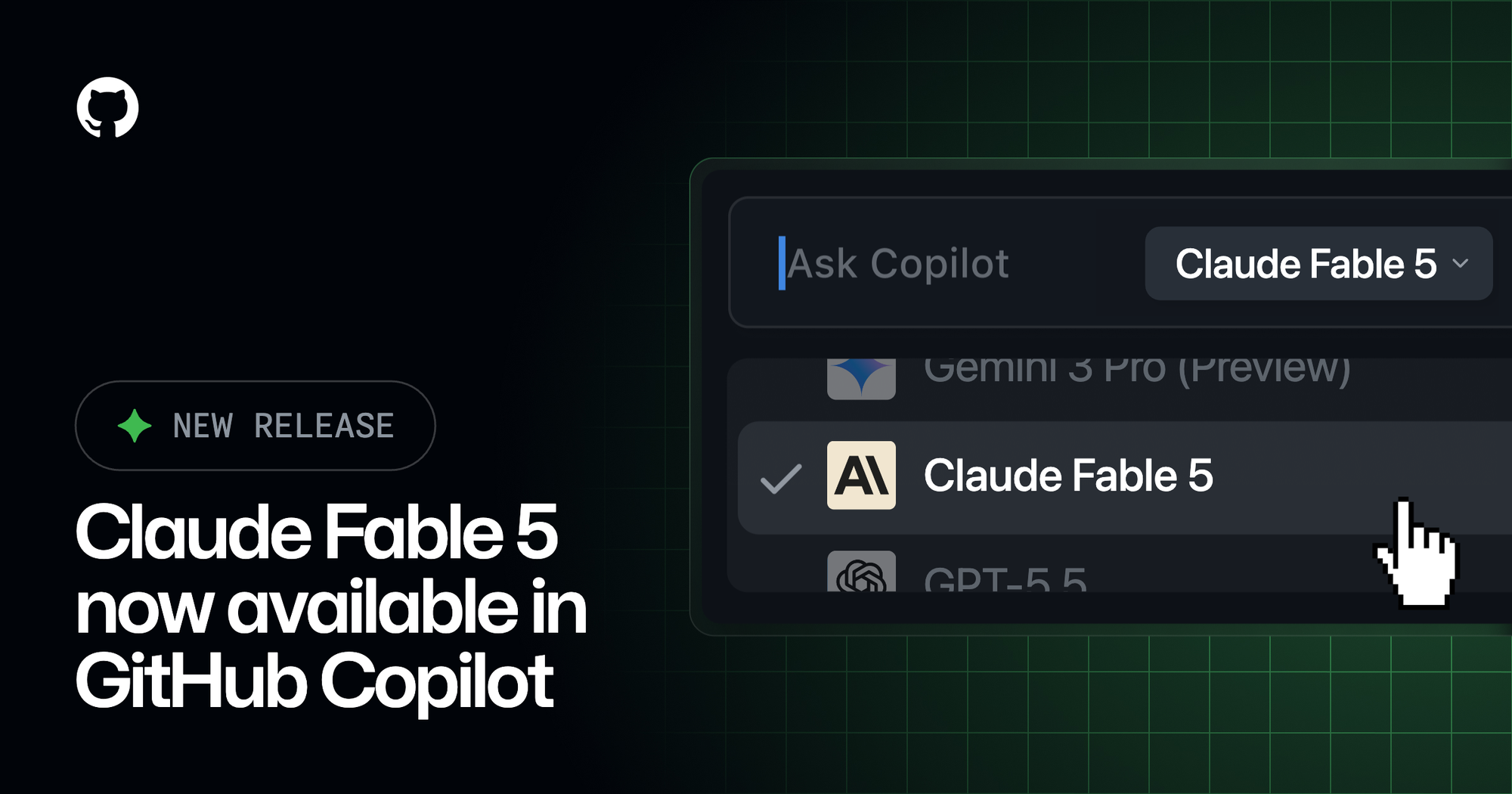
Claude Fable 5 landing in GitHub Copilot is easy to file under “another model in the dropdown.” That would miss the part admins actually need to read. The capability story is interesting; the data-retention story is the product boundary.
GitHub made Anthropic’s Claude Fable 5 generally available across Copilot surfaces, including VS Code chat, ask, edit, and agent modes; Visual Studio; Copilot CLI; Copilot cloud agent; GitHub.com; GitHub Mobile; JetBrains; Xcode; and Eclipse. It is available to Copilot Pro+, Max, Business, and Enterprise users with gradual rollout. GitHub positions it as Anthropic’s first Mythos-class model for long-horizon autonomous coding and knowledge work, and Anthropic is selling the same direction: fewer tool calls, lower token consumption, and stronger performance on complex coding tasks.
But for Business and Enterprise, Fable 5 is off by default. Admins must explicitly enable a Claude Fable 5 policy in Copilot settings because the model carries a different data posture from other Claude models in Copilot. GitHub says Anthropic retains prompts and outputs for up to 30 days to operate safety classifiers, then deletes them. The retained data is not used to train Anthropic’s models. Other Claude models in Copilot, including Claude Opus 4.8, Sonnet 4.5, and Haiku 4.5, continue operating under Zero Data Retention.
That is not paperwork. That is the decision.
The checkbox is doing real governance work
Fable 5 may be a strong long-horizon coding model. GitHub says it is designed for complex coding and autonomous work. Anthropic says Fable 5 and Mythos 5 cost $10 per million input tokens and $50 per million output tokens, less than half the price of Claude Mythos Preview. GitHub’s Copilot pricing docs list Fable 5 at $10/M input, $1/M cached input, $12.50/M cache write, and $50/M output. Anthropic also says its safety classifiers trigger fallback in less than 5% of sessions on average, with more than 95% of sessions involving no fallback; covered cybersecurity, biology/chemistry, or distillation requests fall back to Claude Opus 4.8.
Those numbers matter, but they do not answer the deployment question. A model that can run longer, make fewer tool calls, and solve bigger tasks will naturally be pointed at bigger codebases and messier problems. Those prompts are more likely to contain architectural context, unreleased product plans, internal URLs, customer-shaped logs, stack traces, proprietary APIs, and “temporary” secrets that should not have been there but absolutely are. Thirty-day retention for safety classifiers may be acceptable for many teams. It may be a blocker for regulated repositories, customer-sensitive incident work, unreleased strategy, or environments where prompts routinely contain confidential data.
The responsible answer is not “never enable it.” The responsible answer is to classify the work. Treat Fable 5 like a powerful external processor with a specific retention policy, not like a generic autocomplete upgrade. If your organization already has data classifications for source code, logs, tickets, customer records, and security research, map those classes to Copilot model policy before anyone pilots the model on a production migration.
Expensive models are sometimes cheaper
The pricing looks expensive because it is. At $50/M output tokens, Fable 5 does not belong on formatting churn, small docs edits, test renames, import cleanup, or “explain this file.” That work should go to cheaper models or local workflows unless there is a specific reason otherwise. But per-token price is a bad way to evaluate agent economics by itself.
Long-horizon agent work burns money through loops: tool calls, failed edits, repeated context gathering, retries, test runs, review churn, and human interruption. If Fable 5 really completes equivalent work with fewer tool calls and lower token consumption than previous Opus-tier models, the total cost of a completed task can be competitive even with a high sticker price. A cheaper model that wanders for two hours, rewrites the wrong files, and needs a senior engineer to rescue the branch is not cheap. It is deferred payroll.
That means teams should route by task class. Use high-end long-horizon models for multi-file migrations, hard debugging, architecture changes, brittle legacy code, and agentic work where planning quality determines whether the task converges. Use smaller or cheaper models for bounded edits, generated tests, docs, style fixes, and issue triage. The model dropdown should not be a popularity contest. It should be a dispatch table.
There is a useful measurement opportunity here. A Fable 5 pilot should compare success rate, total tokens, output tokens, tool calls, elapsed time, review defects, human edits, rework, and revert rate against the models your team already uses. Do not let “felt smarter” become the evaluation method. Smart is useful only when it ships correct code with less total friction.
Rollout will be uneven, so test the surface you use
GitHub says Fable 5 is rolling out gradually across Copilot’s major surfaces: IDEs, CLI, cloud agent, GitHub.com, mobile, and more. Builders should not assume availability is uniform on day one. The surface matters because “model in chat” and “model running an autonomous cloud-agent task” have different risk profiles. A one-off explanation in VS Code is not the same as a cloud agent pushing a branch after reading repository context, issue threads, CI logs, and tool outputs.
There is also a documentation-lag problem common to fast model rollouts. Supported-model pages, model-picker UX, admin policy controls, and cloud-agent defaults can update at different speeds. Before announcing a policy, test the exact path developers will use: VS Code agent mode, Copilot CLI, cloud agent task creation, GitHub.com chat, or mobile approval workflows. If the admin console says one thing and the client exposes another, fix that before the pilot becomes folklore.
What admins should do before enabling it
First, decide which data classes are eligible for a model with up-to-30-day prompt and output retention for safety classifiers. Write that down in normal policy language, not an AI exception memo. Second, enable Fable 5 for a small pilot group working on tasks that actually require long-horizon autonomy. Third, require participants to tag Fable-assisted work so platform and security teams can review outcomes. Fourth, measure tool calls and review defects, not just whether the branch eventually merged.
Fifth, define fallback-sensitive work. Anthropic says certain safety-classifier categories can route to Opus 4.8. If your teams do security research, malware analysis, dependency vulnerability work, or anything adjacent to dual-use security, they need to understand what happens when the classifier fires and whether that behavior is acceptable in Copilot. If nobody can explain the fallback path, the rollout is not ready.
The broader point is that model governance has become product architecture. GitHub adding Fable 5 to Copilot is not just more choice. It is another proof that AI coding platforms are now juggling capability, cost, latency, tool autonomy, data retention, and admin policy in the same UI. The best teams will not ask “is Fable 5 better?” They will ask the more useful question: “for which work, under which data policy, at what total cost, with what review evidence?”
That is less fun than a benchmark chart. It is also how grown-up software organizations adopt powerful tools without pretending the checkbox is decorative.
Sources: GitHub Changelog, Anthropic, Microsoft Azure Blog, GitHub Copilot models and pricing, GitHub supported models in Copilot