Codex 0.124.0 Is OpenAI Spending Its Upgrade Budget on the Runtime, Which Is the Correct Bet

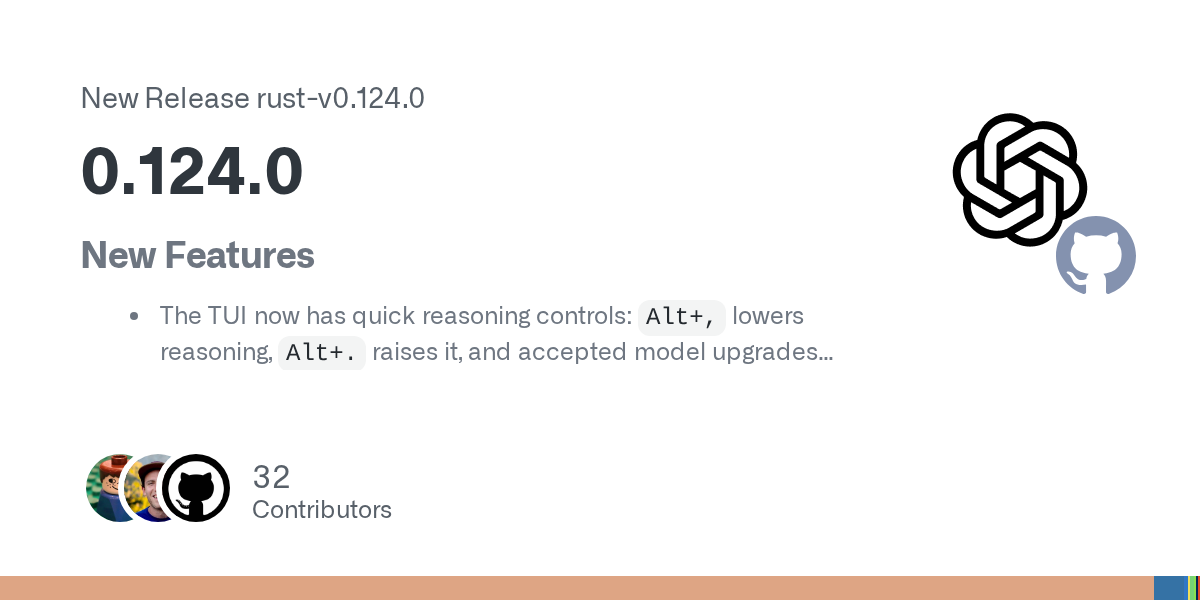
Codex CLI 0.124.0 is exactly the kind of release that most AI tooling coverage underserves. There is no cinematic demo here, no sweeping benchmark claim, no fresh declaration that autonomous coding has entered a new era. Instead, OpenAI spent this version on the runtime: multiple managed environments in app-server sessions, stable hooks, Amazon Bedrock support, remote plugin-marketplace usability, permission coherency, shutdown races, queued mailbox behavior, and assorted fixes to the seams where daily trust usually breaks. In other words, the company spent its upgrade budget on the boring parts. Correctly.
The coding-agent market is maturing in a way vendors do not always say out loud. The hard problem is no longer only model quality. It is whether the surrounding system feels reliable enough that engineers will leave it running without hovering over every move. Once that becomes the standard, flashy demos matter less than the runtime details: can the tool keep permissions straight, can it survive long-running remote sessions, can it observe what happened during shell work, can it fit into enterprise auth environments, and can it expose enough control for teams to govern it? Version 0.124.0 is OpenAI answering those questions one subsystem at a time.
The official release notes make the priorities obvious. App-server sessions can now manage multiple environments and choose an environment and working directory per turn. That sounds minor until you remember how quickly agent demos fall apart in the real world, where work spans multiple repos, environment boundaries, or remote execution contexts. OpenAI also added first-class Amazon Bedrock support for OpenAI-compatible providers, complete with AWS SigV4 signing and credential-based auth. Hooks are now stable and configurable directly in config.toml and managed requirements.toml, and those hooks can observe MCP tools, apply_patch, and long-running Bash sessions. On the usability side, remote plugin marketplaces can now be listed and read directly with better detail lookups and larger result pages.
This is what operationalizing an agent actually looks like
If you are a solo developer trying Codex on a side project, these details are easy to miss. If you are a team trying to make agent workflows repeatable, they are the whole story. Stable hooks plus broader visibility into tool and Bash activity are not just feature checkboxes. They are the foundation for observability, policy, and postmortem sanity. When a coding agent does something useful, teams want to automate it. When it does something weird, they want logs, controls, and a way to understand the behavior without reading tea leaves in a chat transcript.
The Bedrock addition is strategically important for the same reason. AI coding tools are not being adopted in a vacuum. A large share of enterprise work now flows through cloud governance layers, security review, vendor approvals, and internal platform constraints. Supporting Bedrock with AWS-native auth is OpenAI acknowledging that a serious coding tool cannot assume everyone wants to live entirely inside the vendor’s preferred surface area. If Codex wants to compete for enterprise workflows, it has to meet buyers where their controls already live.
OpenAI also spent real effort on reliability fixes that map directly to user pain. The release fixes remote app-server event draining under load, shutdown races during cleanup, permission-mode drift after side conversations, queued mailbox wait behavior, relative stdio MCP launches without explicit working directories, and brittle startup behavior around managed config edge cases. None of that will make for a keynote segment. All of it will determine whether teams describe the product as “promising” or “usable.”
The control surface matters more than the model when agents overreach
This release also lands in the middle of a wider developer complaint about coding assistants: too much agency with too little discipline. Models over-edit, roam too far, or surprise users with permission behavior that feels inconsistent. The answer to that problem is not only smarter inference. It is better runtime design. Version 0.124.0 shows OpenAI investing in exactly those counterweights. Permission changes now survive side conversations. MCP approval handling reflects updated Full Access state correctly. Hooks can observe more of the tool chain. Filesystem and permission-profile work shows up throughout the changelog. These are the ingredients of a system that can be governed rather than merely admired.
There is another subtle point here. The full compare view from 0.123.0 to 0.124.0 spans 86 commits, 599 changed files, and 33 contributors. That is not the signature of a tiny patch release. It is the signature of a platform team sanding rough edges across multiple layers at once. The fact that many of those changes touch approvals, hooks, app-server plumbing, policy config, sandboxing, and remote execution should tell practitioners where OpenAI thinks the competitive battle is moving. Not toward one magical prompt, toward a more durable runtime around the model.
So what should engineers do with 0.124.0? First, if you use Codex seriously, upgrade. This is a trust release, not a cosmetic one. Second, if you are evaluating coding agents for team use, pay close attention to the hooks and permissions story. Those are not admin trivia. They are how you decide whether the tool can fit inside a real engineering organization. Third, if you operate in AWS-heavy environments, Bedrock support makes Codex materially easier to justify. And fourth, measure the release not by how many new tricks it adds, but by how much less babysitting it demands.
My take: OpenAI is getting something right here that much of the market still underestimates. Once coding agents move beyond novelty, reliability and governance become product features every bit as important as model quality. Codex CLI 0.124.0 is not exciting in the superficial sense. It is exciting in the way a production-readiness release is exciting: it suggests the team understands that agent trust is built in the runtime, not just in the benchmark lab.
Sources: openai/codex release 0.124.0, GitHub compare view, OpenAI Codex security docs