Codex Adds the Telemetry Layer Agentic Coding Needed

The most important coding-agent features are increasingly the ones nobody wants to put in a launch video: telemetry attributes, proxy resolution, safety-buffering metadata, and log filters. Codex’s June 23 PR cluster is a useful reminder that agent adoption inside teams is not blocked by whether the demo can edit a React component. It is blocked by whether the runtime can explain what it did, how much it cost, why it paused, which network route it used, and why the local database is not filling up with trace noise.
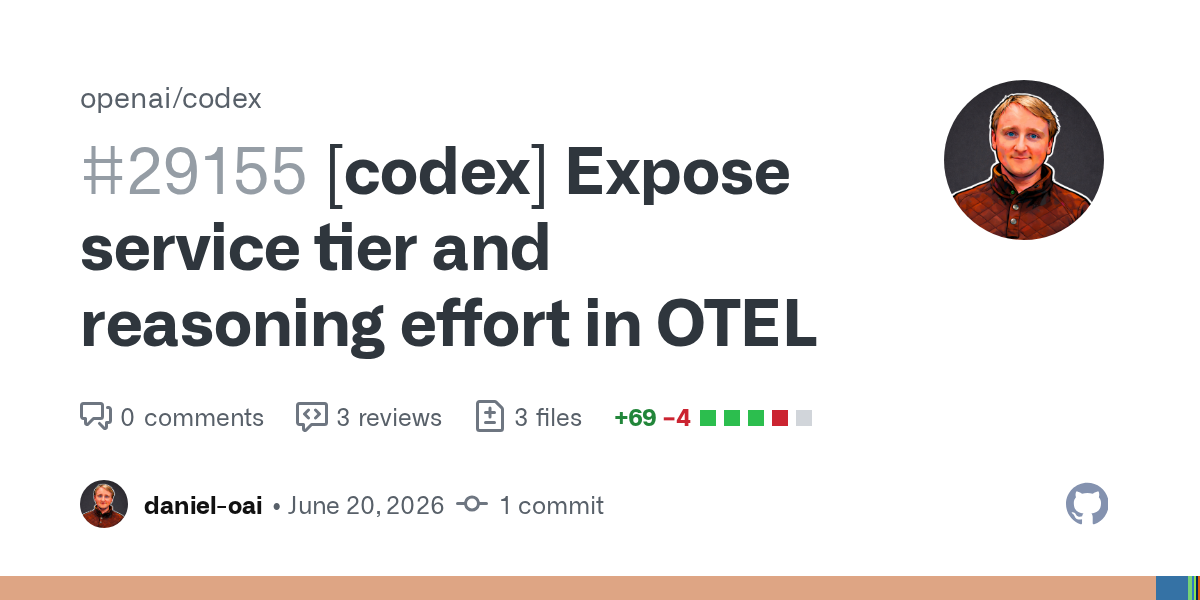
That is the real story behind OpenAI Codex PR #29155. The patch is small — three files, 69 additions, four deletions — but the motivation is unusually direct: “NVIDIA asked to measure Fast mode usage and reasoning effort from Codex CLI OTEL logs.” In response, Codex now emits finalized service_tier and model_reasoning_effort on the existing OpenTelemetry codex.sse_event response.completed record.
That is not glamorous. It is also exactly what serious users need.
Agent cost is no longer a billing-page problem. It is an operations problem. A coding run is shaped by model choice, reasoning effort, service tier, token usage, compaction, retries, safety waits, tool calls, and network behavior. If those fields live only in UX labels or vendor-side dashboards, engineering teams cannot correlate “this task felt slow” with “this run used priority tier and high reasoning effort and burned more tokens than the standard/low baseline.” Codex adding these attributes to the existing completion event means teams can measure runtime choices without inventing side-channel logs.
Fast mode is a production variable, not a vibe
The validation notes matter because they show the intended shape of the data. OpenAI tested an end-to-end run with a local OTLP/HTTP collector. Fast/high emitted service_tier=priority and model_reasoning_effort=high with token usage. Standard/low omitted service_tier and emitted model_reasoning_effort=low with token usage. That is the sort of join an engineering manager, platform team, or FinOps owner can actually use: which tasks deserve the expensive path, which ones should default lower, and where latency or cost is coming from.
The industry tends to discuss AI coding-agent cost as if the only knob is price per token. That is too shallow. The real unit is “successful task completed under the right policy.” High reasoning effort might be cheap if it prevents three failed attempts. Priority tier might be wasteful if the task is a low-stakes refactor. Token usage might look high because context compaction failed, because a tool loop repeated, or because the model genuinely needed the repository history. Without telemetry, all of those cases collapse into one invoice-shaped shrug.
This is where OpenTelemetry is the right boring answer. The broader GenAI semantic-conventions work is pushing vendors toward model-call attributes, events, spans, and usage data that can flow into existing observability stacks. Codex does not need to invent a new “AI agent dashboard” for every enterprise. It needs to put the right facts on the right events so teams can use the same pipelines they already use for latency, errors, routing, and spend.
The rest of the June 23 cluster fills in the surrounding runtime story. PR #29473 propagates safety-buffering treatment metadata from HTTP response headers and WebSocket per-turn metadata through a shared parser, combines it with Responses API safety-buffering signals, and sends showBufferingUi plus nullable fasterModel through the existing model/safetyBuffering/updated app-server notification. The public implementation deliberately uses generic placeholders such as current-model and faster-model; it does not expose real internal model mappings as accidental protocol commitments.
That is a careful line to walk. Users need to know that the agent is alive and waiting on a named backend state, not simply hanging. Clients may need to decide whether to show buffering UI or offer a faster path. But the protocol should not leak internal model-routing policy as a public API just because a spinner needed better copy. Good agent UX needs state without turning every implementation detail into a contract.
There is also an enterprise networking clue in PR #26709, which adds a macOS system proxy resolver behind a disabled-by-default respect_system_proxy feature. Codex-owned auth clients can use the route macOS selects for each auth URL through SystemConfiguration and CFNetwork, including PAC and WPAD results. The resolver reads settings from SCDynamicStore, resolves URLs with CFNetworkCopyProxiesForURL, executes PAC URLs and inline PAC JavaScript through a bounded run loop with a five-second timeout, handles DIRECT, HTTP proxies, and CFNetwork HTTPS entries through HTTP CONNECT, maps unsupported SOCKS entries to UnsupportedProxyScheme, brackets IPv6 hosts, and hashes URL-specific cache keys so PAC decisions remain distinct without retaining raw request URLs or query strings.
The corporate network is part of the agent runtime
That paragraph will not trend on Hacker News. It may unblock more real deployments than a model benchmark. Developers inside large organizations do not connect from idealized networks. They sit behind PAC files, WPAD, forward proxies, VPNs, custom CAs, IP allowlists, and auth flows that break when a CLI ignores the operating system’s routing decision. A coding agent that cannot authenticate cleanly through the corporate network is not an enterprise tool; it is a toy with a procurement blocker.
The details also show restraint. A five-second PAC timeout prevents proxy discovery from becoming an unbounded hang. Unsupported SOCKS entries are not silently translated into something else. Cache keys avoid retaining raw request URLs and query strings. Custom CA handling is kept separate from route selection. This is the boring, correct shape of enterprise support: respect the platform, limit the blast radius, and do not smuggle sensitive URLs into local caches because it was convenient.
Finally, PR #29599 stops high-volume bridged target=log TRACE events from reaching SQLite. The change is only seven additions in one file, but the reason is familiar to anyone who has run noisy systems: filtering earlier in the pipeline was not enough, so dependency TRACE events were still landing in persistent storage after the 0.142.0 log filter. Codex now rejects those bridged log events at the SQLite sink before formatting or queueing them.
That is the difference between observability and hoarding. Agent runtimes generate enormous amounts of event exhaust: model events, tool calls, bridge logs, app-server notifications, protocol traces, safety states, and rollout metadata. If the persistence layer stores everything because “maybe we’ll need it,” debugging gets slower, storage grows, and the signals that matter become harder to find. Sink-level filters are not exciting, but they are where observability systems prove they have taste.
For builders, the checklist is straightforward. Per completed response, can you answer which service tier ran, what reasoning effort was requested, and how many tokens were used? Can you correlate that with latency, retries, compaction, safety buffering, and task outcome? Does your client render safety review as a named live state instead of a generic hang? Do your auth paths respect OS proxy, PAC, and WPAD behavior without logging raw URLs into cache keys? Do your persistent logs filter at the sink, not just at the first logger that happened to see the event?
If the answer is no, your agent may still work for one developer on one clean laptop. It will become expensive, mysterious, or brittle inside a team.
Codex is not solving the whole agent-operations problem in one morning. But these patches point in the right direction: the winning coding agent will not just write code. It will explain its cost, latency, safety pauses, route choices, and log volume after the fact. That is not a nice-to-have for enterprises. That is the difference between “cool CLI” and infrastructure.
Sources: OpenAI Codex PR #29155, PR #29473, PR #26709, PR #29599, OpenTelemetry GenAI semantic conventions, OpenAI Codex changelog