Codex Exposes Safety Buffering and Context Compaction as Runtime State

The most important Codex updates this morning are not new buttons, model names, or demo-friendly tricks. They are the kind of runtime plumbing users only notice when it fails: a safety review state that used to look like a hung agent, and a context-management escape hatch that admits automatic compaction is not always your friend.
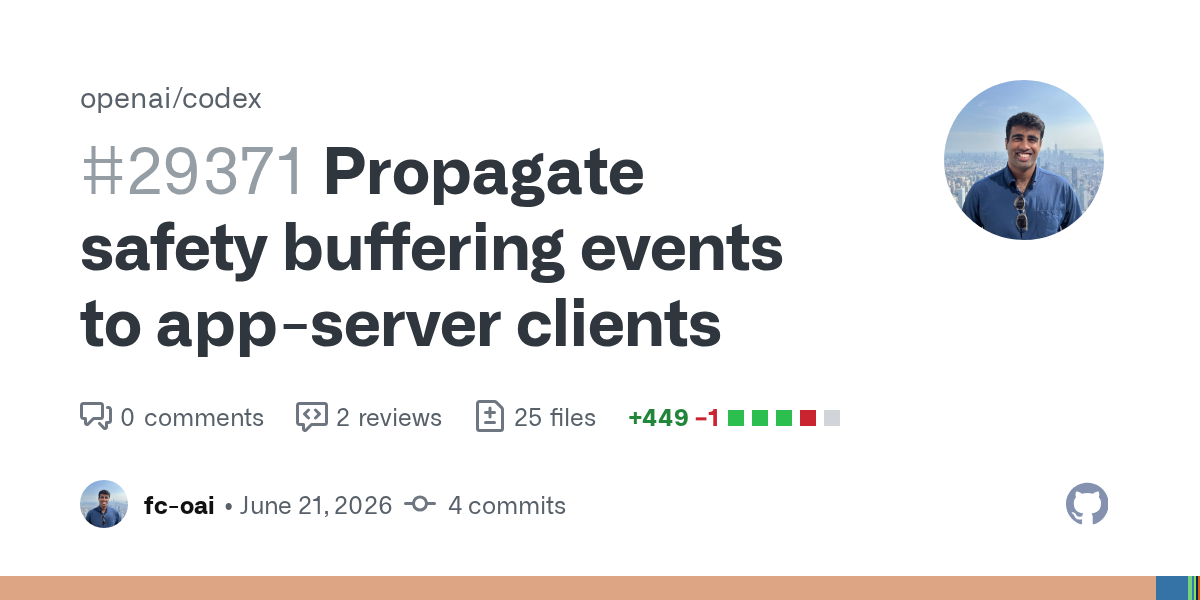
OpenAI merged PR #29371 on June 22 at 03:39 UTC, propagating Responses API safety_buffering metadata through Codex core and app-server v2 as a typed turn/safetyBuffering/updated event. A few minutes earlier, PR #28260 added an internal auto_compaction feature flag, defaulting on, so certain long-running rollouts can disable automatic context compaction and fail loudly when the provider context window is exhausted. Then PR #29393 cleaned up the inevitable integration fallout from that flag the same morning.
That is not a feature-launch sentence. Good. The coding-agent market has enough feature-launch sentences. This is more useful: Codex is starting to expose the hidden state machine behind “the agent is thinking,” and that is where the next reliability fight is.
Silence is not a product state
Safety buffering is a backend review state. The Responses API can emit metadata indicating that safety buffering is happening, with details about the requested model and backend use cases or reasons. Before this change, that metadata stopped at the transport boundary. Codex clients downstream of the app server could not render the state, so the user experience was effectively: the agent pauses, the interface waits, and everyone pretends a spinner is adequate observability.
It is not. In an interactive coding agent, unexplained silence is expensive. A developer watching an agent edit a repo has to decide whether to wait, interrupt, retry, kill the session, or assume the model got stuck. If the backend is doing a legitimate safety review, the client should say so. If the agent is blocked on a tool approval, the client should say that. If it is compacting context, waiting for a shell command, retrying a network call, or rate-limited, those are different states with different user decisions attached.
PR #29371 changed 25 files, adding 449 lines and deleting one. The implementation decodes and deduplicates safety_buffering metadata from Responses API SSE and WebSocket events without suppressing the original response event. Codex core emits a typed event, app-server v2 forwards it as turn/safetyBuffering/updated, and generated protocol schemas were updated so clients have something concrete to consume.
The subtle part is what OpenAI chose not to persist. The side-channel safety-buffering event stays out of persisted rollouts and turn timing. That is the right boundary. A live safety-review state matters for UX and observability, but it is not necessarily part of the task transcript. Persisting every transient UI state as if it were agent output would make replay and audit trails noisier, not more truthful.
This is the shape mature agent platforms need: separate channels for conversation, tool execution, telemetry, safety state, billing signals, and UI hints. The early agent stack treated the transcript as the universal dump truck. Everything went into the prompt or the chat log because that was easy. But serious clients need cleaner semantics. A safety-buffering event is not a model message. A compaction summary is not the original context. A token-budget warning is not a user instruction. Treating them as separate runtime state is how you keep the system debuggable.
Compaction is an editorial act, not free memory
The auto-compaction flag is the sharper engineering lesson. Codex now has a default-on auto_compaction feature flag, with an internal escape hatch to disable it via codex --disable auto_compaction. When disabled, Codex skips pre-turn, model-switch/hash, and mid-turn automatic compaction. Manual /compact remains available, and if the provider context window runs out, Codex surfaces the existing context-exhaustion error instead of quietly entering another compaction window.
That sounds counterintuitive if your mental model is “compaction keeps the agent alive, therefore compaction is good.” Sometimes it is. For everyday app edits, a lossy summary of older turns is often better than stopping. For long-running optimization rollouts, benchmark runs, or audit-sensitive workflows, the opposite can be true. You may want the full context preserved, and you may prefer a hard failure over a background rewrite of the task history that changes the trajectory of the run.
This is the part builders should steal for their own systems: context compaction is not storage compression. It is an editorial operation performed on the agent’s past. It decides what survives, what becomes summary, what nuance gets dropped, and what assumptions are carried forward. That can be useful. It can also invalidate a benchmark, hide the reason an agent made a choice, or make two supposedly comparable runs diverge because one crossed a compaction threshold and the other did not.
PR #28260 says the motivating use case is long-running SPO optimization rollouts that need the option to preserve full context and fail on exhaustion rather than enter another compaction window. The validation was appropriately narrow: just test -p codex-features passed 51 tests, targeted codex-core auto-compaction-disabled tests passed, and config schema generation was updated. This is not a consumer-facing preference yet. It is a runtime control for people who know why they need it.
That distinction matters. Most users should not have to become context-window operators. But platform teams, benchmark authors, internal-tool builders, and anyone running long-lived agents absolutely need policy control. Auto-compact for casual edits. Manual compact for workflows where the human wants to choose the boundary. Fail-fast for reproducibility-sensitive work. Those should be explicit modes, not accidental behavior hidden behind a growing transcript.
The follow-up fix is part of the story
PR #29393 merged at 05:11 UTC to fix a merge race introduced around the new feature flag. The code tried to access turn_context.features after that field had moved under config, producing Rust compile error E0609. The follow-up read the flag through TurnContext::config, after which targeted auto-compaction tests passed, codex-core compiled, and 2,722 tests passed with 89 unrelated local-environment failures.
There is no scandal here. This is what fast-moving runtime development looks like when the runtime touches config, schemas, core turn loops, app-server protocol, rollout trace code, telemetry, and tests. But it is a useful warning for teams consuming Codex alphas or building on similar foundations: agent runtime changes are rarely isolated. A small feature flag can cross compile boundaries because “context management” is not one module. It is part of the turn lifecycle.
The same applies to safety buffering. A live safety state has to move from provider event streams through core decoding, deduplication, typed events, app-server protocol, generated schemas, and client rendering. Any one of those layers can turn a meaningful backend state into a generic pause. If your agent client has a single “thinking” spinner for every backend condition, you do not have observability. You have a mood light.
Practitioners should do three things with this information. First, audit your agent UI for silent states. Tool approvals, safety review, rate limits, retries, shell execution, context compaction, model switching, and network stalls should not all render as the same ambiguity. Second, define your compaction policy by workflow. Casual development, long-running research, regulated code changes, and benchmarks have different tolerance for lossy context rewriting. Third, keep transient runtime state out of the durable task transcript unless it actually belongs there. Clean channels make replay, audit, and debugging possible.
The broader signal is that useful coding agents are becoming less about a single clever model call and more about explicit runtime contracts. Codex is exposing safety review as an event, compaction as a policy, and context exhaustion as a decision point. That is the boring layer, which means it is probably the layer that will decide whether these tools become dependable infrastructure or stay impressive demos with a spinner.
Sources: OpenAI Codex PR #29371, OpenAI Codex PR #28260, OpenAI Codex PR #29393, OpenAI Codex changelog