Codex Starts Giving Context Windows Provenance, Not Just Token Counts

Token counters are table stakes now. The more interesting question is whether a coding agent can explain how it arrived at the context it is using after compaction, rollback, resume, and a few long-running tool sessions have rearranged the furniture.
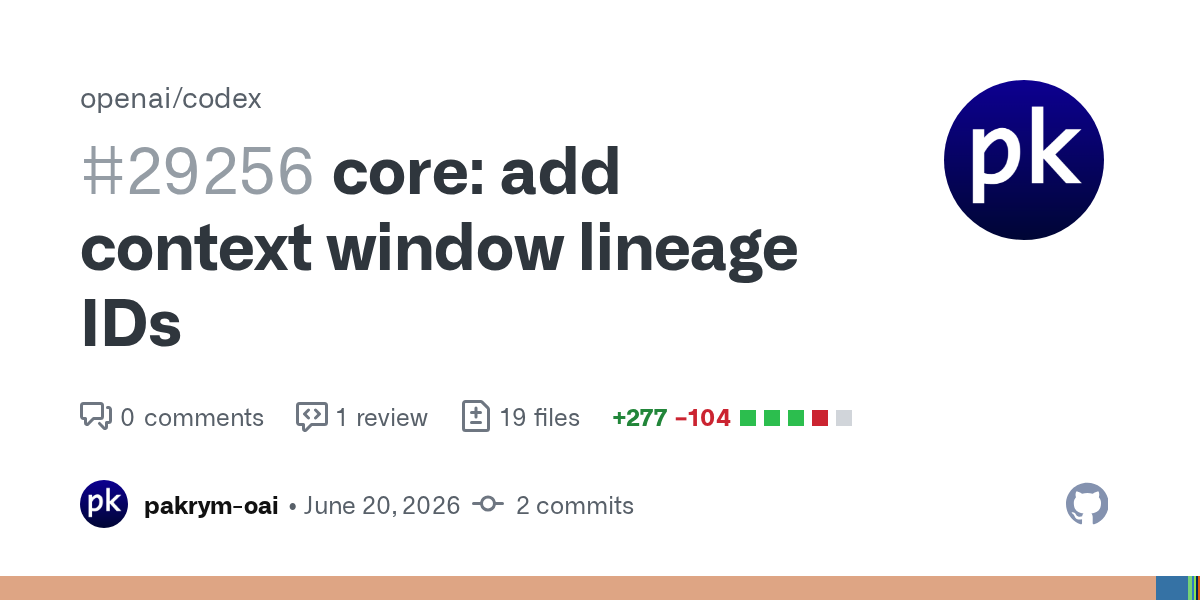
That is the useful read on OpenAI’s latest Codex runtime work. After the 0.142.0-alpha.7 release landed earlier on June 20, OpenAI merged PR #29256, a small-looking change that adds lineage IDs to Codex context windows. The patch does not make for a flashy demo. It does something more operationally important: it starts turning the context window from an invisible model constraint into an identifiable runtime object.
For teams trying to govern coding agents, that distinction matters. “How many tokens are left?” is a dashboard metric. “Which context window produced this change, what was its first ancestor, what immediately preceded it, and what survived compaction?” is audit infrastructure.
The context window is becoming part of the trace
PR #29256 merged to main at 2026-06-20T20:15:49Z, according to the GitHub Pulls API. It carries 2 commits across 19 changed files, with 277 additions and 104 deletions. The core issue, per the PR description, is that Codex’s rendered <token_budget> fragment already identified the thread and current context window, but did not expose enough lineage to identify either the first window in the thread or the immediately previous window.
Codex now tracks first, previous, and current UUIDv7 context-window IDs in auto-compaction state. The full <token_budget> fragment renders thread_id, first_window_id, previous_window_id, and the current window ID. Those new first/previous IDs are persisted in compacted rollout checkpoints and restored during rollout reconstruction, while remaining compatible with older compacted records where the optional fields do not exist.
That is a mouthful, but the product shape is simple: Codex is beginning to describe context as lineage, not just capacity.
The validation list is also telling. OpenAI cites tests including just test -p codex-core token_budget, just test -p codex-protocol compacted_item::tests, just test -p codex-core tracks_prefill_and_window_boundaries, just test -p codex-core reconstruct_history_uses_replacement_history_verbatim, and just test -p codex-core thread_rollback_restores_cleared_reference_context_item_after_compaction. Those are not tests for a prettier CLI prompt. They are tests for whether Codex can maintain continuity through the weird parts of long agent runs: prefill, window boundaries, compaction, replacement history, reconstruction, and rollback.
Compaction is not just a quality problem
Most agent conversations about compaction frame it as a memory-quality issue: did the agent preserve the important facts when the context window got too large? That is real, but incomplete. Compaction is also an accounting problem and a provenance problem.
A compacted checkpoint is a claim. It says: the runtime compressed prior state into this replacement representation, and the next model call should treat that representation as continuity. If the agent later edits authentication code, changes a migration, or explains why a test failed, the team needs more than a transcript-shaped blob. It needs to know which segment of the run the agent was operating in and how that segment relates to the earlier ones.
Lineage IDs are the boring primitive that make better answers possible later. They could let future tooling attach token spend, model settings, tool-call volume, compaction events, rollback points, and generated artifacts to a specific context-window chain. That moves the system from “this thread got expensive” to “this reconstructed window consumed budget after compaction from that prior window.” One is a complaint. The other is debuggable.
This is where the change connects directly to AI coding-agent FinOps. Budget controls that live only at the account level arrive too late. Budget controls that live only at the latest prompt are too shallow. Real agent runs are multi-turn, tool-heavy, frequently compacted, sometimes resumed, and increasingly split across local and cloud surfaces. If the budget is supposed to constrain the agent run, the runtime needs durable identifiers for the parts of the run. Codex is laying that track.
The CLI also needs to stay usable while the runtime is busy
The companion change in the evening cluster is PR #29154, merged earlier at 2026-06-20T04:37:02Z with 5 commits, 10 changed files, 126 additions, and 40 deletions. It allows commands such as /resume, /model, /permissions, /personality, and service-tier commands like /fast while a task is running, including during MCP startup.
That sounds like terminal polish until you have used one of these tools under load. MCP startup can be slow. Background tasks can keep a session busy. A developer should not have to kill the process just to queue up the next model choice or inspect settings. But the semantic boundary matters: PR #29154 notes that turn settings such as model selection and reasoning effort are captured when a turn starts. Changing them mid-turn affects the next turn, not the active one. The status bar may update immediately, but the active turn keeps the settings it began with.
That is the right split. Mutating model, permissions, personality, or service tier mid-turn would create an interpretability mess. Queuing the next-turn state while the current turn continues gives humans control without pretending a running inference can be safely edited in place. More agent CLIs should make that distinction explicit instead of burying it in vibes.
World state is the next thing to watch
The evening research also points to PR #29252, which merged to a stacked feature branch rather than mainline. It migrates environment context toward typed EnvironmentsState, removes a parallel legacy environment-context representation, keeps persisted/diffed state limited to cwd, and continues rendering live-only values such as shell, date, timezone, network, filesystem, and subagents.
That has not shipped as a mainline release candidate in this window, so treat it as directional rather than done. But the direction is important. Coding agents need a cleaner distinction between durable state and live context. The current working directory is not the same kind of fact as the current date. Network availability is not the same kind of fact as a persisted environment identifier. Subagent state is not just prose for a prompt; it is runtime state that may change while the user is watching.
If Codex combines context-window lineage with typed environment state, it gets closer to a serious trace model: this window, in this thread, descended through these compacted checkpoints, while seeing this structured environment. That is the kind of substrate teams need before they can make confident claims about cost, reproducibility, approval scope, and post-hoc debugging.
What practitioners should do with this
Do not upgrade or evaluate Codex because “context windows got IDs.” That undersells the point. Use this as a checklist for your own agent stack.
First, ask whether your coding agent can identify context windows across compaction, resume, and rollback. If it cannot, every long-running task becomes harder to audit the moment it crosses the first context boundary.
Second, inspect whether token-budget displays are tied to durable run state or merely rendered into the current prompt. The latter can be useful UX; the former is what lets platform teams debug cost and enforce policy.
Third, test settings changes during active tasks. If changing model, permission mode, or service tier mid-run silently affects the current turn, that is a governance smell. If it cleanly applies to the next turn, document that behavior so developers understand what the UI is actually promising.
Fourth, watch environment-state work closely. The more coding agents move across local shells, cloud tasks, MCP servers, browser sessions, and subagents, the less acceptable it becomes to treat “environment” as a loose blob of prompt text. Structured state is not bureaucracy. It is how you stop losing track of where work actually happened.
This is not a headline feature. It is better than that. It is Codex inching toward the runtime bookkeeping that serious agentic coding requires. The next useful coding-agent governance feature is not another animated demo of a generated pull request. It is being able to prove which context window, compaction path, settings boundary, and environment state produced the diff.
Sources: OpenAI Codex PR #29256, OpenAI Codex PR #29154, OpenAI Codex PR #29252, OpenAI Codex compare: rust-v0.142.0-alpha.7...main, OpenAI Codex 0.142.0-alpha.7 release