Codex Turns Agent Runtime Edge Cases Into Protocol Contracts

The late-day Codex work on June 23 reads like OpenAI taking a red pen to every place an agent runtime used to shrug. Budget exhausted? That should not masquerade as a generic interruption. Code-mode host negotiation? Version it before the clever messages arrive. Context windows? Give the first one an identity, not just the compacted ones. Executor paths? Stop translating a Windows executor’s filesystem into a Unix host’s idea of a path and pretending that was validation.
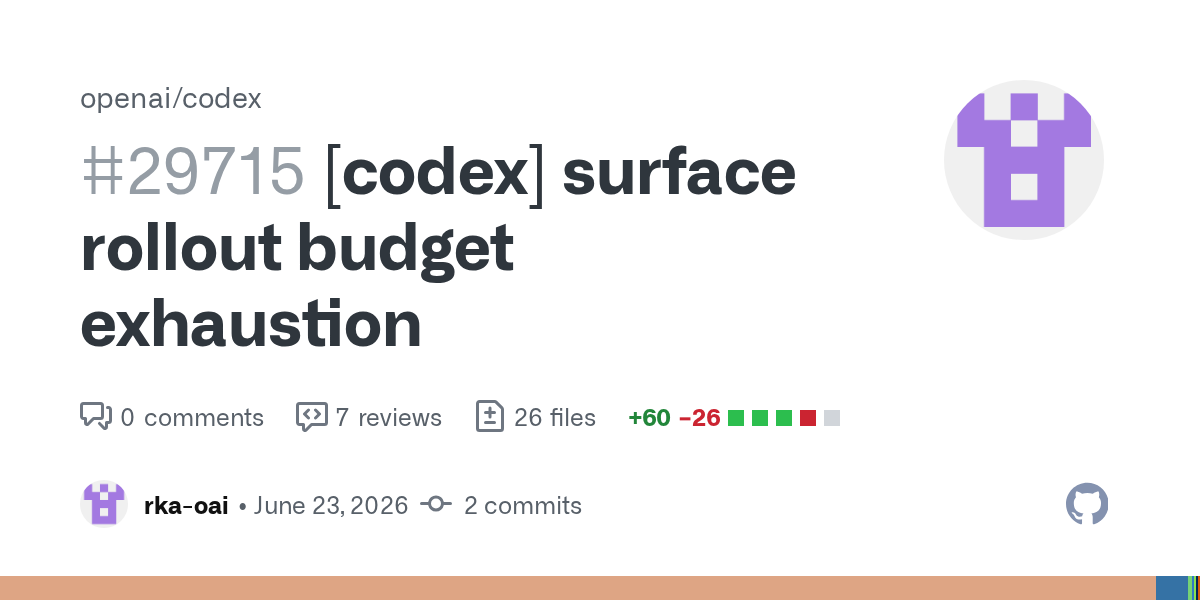
This cluster is not one feature. It is a set of contracts. The main source is PR #29715, merged at 22:01 UTC, which surfaces shared rollout-budget exhaustion as a classified rolloutBudgetExceeded error. Around it, OpenAI merged PR #29515 for a code-mode host handshake, PR #29519 for initial context-window metadata, PR #29626 for executor-native skill loading, PR #28918 for URI-native plugin roots, and PR #29158 to remove legacy path deserialization. That is a lot of plumbing. It is also what trustworthy agent platforms are made of.
“Interrupted” is not an error taxonomy
The budget change is small by diff size — 26 files, 60 additions, 26 deletions — but important by semantics. PR #29715 introduces CodexErr::RolloutBudgetExceeded, maps it through CodexErrorInfo and the app-server v2 codexErrorInfo path, and prevents local compaction from retrying after the shared budget is exhausted. The validation line is targeted: just test -p codex-core rollout_budget.
The valuable part is not the enum name. It is that downstream clients no longer need to infer cause from a turn that merely says status="interrupted". “Interrupted” tells you what happened to execution. “Budget exhausted” tells you why. That distinction changes the correct UI, the correct retry policy, and the correct operator response. A generic interruption might deserve a retry. Budget exhaustion should show the configured limit, explain that compaction will not help, and let the user decide whether to raise the budget or stop.
Teams adopting coding agents should audit their own failure vocabulary. If context exhaustion, budget exhaustion, policy denial, tool crash, sandbox rejection, auth failure, and user cancellation all collapse into “failed,” the runtime will push bad advice into every client built on top of it. The more autonomous the agent becomes, the less acceptable fuzzy error reporting gets. A useful agent does not merely fail safely. It fails with enough precision that the next action is obvious.
Version the handshake before the party starts
PR #29515 is bigger — six files, 624 additions, no deletions — and deliberately foundational. It defines validated protocol-version, capability, and session-identifier types, plus explicit ClientToHost and HostToClient JSON envelopes for connection negotiation and session open/close acknowledgements. It rejects invalid states and unknown fields during decoding and includes wire-format plus round-trip coverage. The PR also says the interesting messages — cells, tool callbacks, and failure-domain behavior — are deferred until actor semantics and behavior tests establish the required contracts.
That sequencing is the point. Agent platforms love to grow informal protocols because the first client and the first host are often built by the same team. Then a second client arrives, a remote host appears, replay becomes necessary, and suddenly a pile of “works in my terminal” JSON becomes a compatibility burden. Defining the handshake before richer behavior lands is unsexy, but it creates a place to negotiate protocol versions, capabilities, and session identity without overloading the first real message.
Practitioners should copy this discipline. If your agent has a host/client split, write down the handshake. Make unknown fields a conscious compatibility choice, not an accident. Decide which capabilities are negotiated and which are required. Give session open and close explicit acknowledgements. You do not need a distributed-systems cathedral, but you do need enough protocol surface that debugging does not depend on two processes having the same unstated assumptions.
Context windows need an origin story
Context-window metadata sounds like bookkeeping until you try to reconstruct a session. PR #29519 adds session_meta.context_window.window_id for the initial window. CreateThreadParams now requires initial_window_id: String, and rollout reconstruction uses that metadata as the fallback for window zero: window_number = 0, first_window_id = window_id, and previous_window_id = None. The PR changed 30 files with 254 additions and 13 deletions, with 12 review comments.
Why does this matter? Because compaction makes later context windows explicit, but a session that never compacts still deserves a durable identity for the context it began with. If observability only becomes precise after the first compaction, then short clean sessions are actually less well-described than long messy ones. That is backwards. The first window is the baseline. It should be named at creation, not inferred later from whatever history reconstruction can scrape together.
This also affects benchmarking and auditability. If you compare agent runs, replay sessions, or tail JSONL streams, you want to know whether two events belong to the same context window, a successor window, or a replacement after compaction. Without an initial ID, “window zero” becomes folklore. With it, every session has a real origin point. That is the kind of metadata nobody asks for in a product demo and everybody wants after a debugging incident.
Paths are authority, not decoration
The path work is the sharpest security signal in the set. PR #29626 fixes executor skill discovery after selected roots became PathUri. A Windows executor root should not be converted into the app-server host’s Unix AbsolutePathBuf. Skill traversal now operates through ExecutorFileSystem, keeps environment ID and entrypoint PathUri in the catalog, routes skills.read back through the same environment filesystem, and covers foreign Windows roots plus executor-owned reads. That one PR changed 10 files with 520 additions and 200 deletions.
PR #28918 pushes the same principle into plugin roots. It requires selectedCapabilityRoots[].location.path to be a canonical file: URI, rejects native path strings, keeps selected roots, resolved plugin locations, manifest paths, and manifest resources as PathUri, reads plugin roots and manifests through the selected environment’s ExecutorFileSystem, and enforces resource containment lexically. PR #29158 then removes legacy path deserialization so PathUri values parse exclusively as valid file: URIs, with rejection coverage for top-level filesystem paths and sandbox working directories.
This is not type pedantry. In multi-host agent systems, path strings carry authority. They say which filesystem owns a resource, which environment should validate it, which containment rules apply, and where code will run. If a POSIX orchestrator converts a Windows executor path into a host-native object, it has not made the path safer. It has changed the language of the claim. That is how agents end up reading the wrong file, rejecting valid remote roots, or applying containment checks in the wrong universe.
The practitioner rule is simple: never validate executor paths by first translating them into the orchestrator host’s native path type. Preserve environment identity. Preserve URI form. Route reads through the filesystem that owns the path. Reject ambiguous legacy spellings once callers have had a migration path. Backcompat is useful until it becomes a permission bypass in slow motion.
There is also a small but telling cleanup in PR #29732, which removes unused Session::is_alive() because the API implied callers could preflight liveness or routing instead of handling failed-session errors correctly. That is the same editorial line in miniature: do not expose APIs that encourage wishful thinking. Distributed state changes. Sessions die. The correct contract is to attempt the operation and handle the failure path, not to ask a stale question and pretend the answer will still be true.
Put together, these PRs are Codex turning edge cases into protocol facts. Budget exhaustion gets a classifier. Code mode gets a handshake. The first context window gets an ID. Executor paths stay with the executor. Legacy path magic gets rejected. That is what a serious coding-agent runtime looks like when it grows up: fewer ambiguous states, fewer host-local assumptions, and fewer places where clients have to scrape strings or guess intent.
The forward-looking take is that agent reliability is becoming less about whether the model can write the patch and more about whether the runtime can explain the patch’s operating envelope. What budget did it consume? Which session and context window produced it? Which host negotiated the mode? Which filesystem owned the tools and skills? If an agent platform cannot answer those questions, it is not ready for serious team workflows. If it can, the model finally has a runtime worthy of the autonomy we keep trying to give it.
Sources: OpenAI Codex PR #29715, PR #29515, PR #29519, PR #29626, PR #28918, PR #29158