CodexBar 0.35 Turns Coding-Agent Quota Anxiety Into a Menu-Bar Product

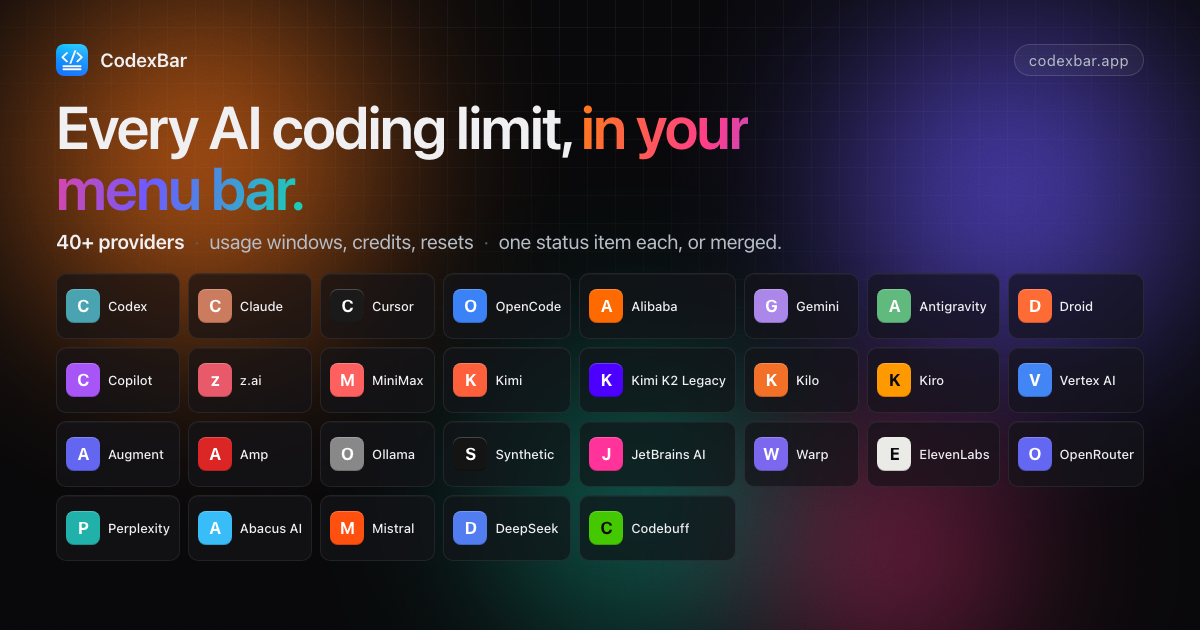
CodexBar is the kind of product category that should not need to exist, which is exactly why it is interesting. A menu-bar meter for AI coding limits sounds like developer desk clutter until you look at the current agent market: Codex has plan-dependent usage windows, Copilot is increasingly tied to credits and premium model economics, Claude has its own quota shape, Gemini and provider marketplaces keep shifting availability, and local models trade dollars for hardware and capability constraints. The new CodexBar 0.35.0 release is not just another macOS utility update. It is a small dashboard for a large market failure: coding-agent vendors have made budget visibility part of the engineering workflow, then mostly buried it in billing pages.
The release landed June 14, 2026, according to the GitHub Releases API, and it is not tiny. The project’s compare view from v0.34.0 to v0.35.0 shows 48 commits, 137 changed files, 6,165 additions, and 542 deletions. During research, the repository showed 14,762 stars, 1,202 forks, 52 open issues, and a fresh push later the same morning. For a menu-bar app, that is a meaningful amount of attention. Developers are voting with installs because the agent stack has become too expensive and too fragmented to track by vibes.
The quota dashboard is becoming part of the IDE
CodexBar describes itself as “Every AI coding limit, in your menu bar,” and the provider list explains why that pitch is landing. It tracks Codex, OpenAI, Claude, Cursor, Gemini, Copilot, Grok, GroqCloud, ElevenLabs, Deepgram, z.ai, MiniMax, Kiro, Vertex AI, Augment, OpenRouter, LLM Proxy, Codebuff, Command Code, AWS Bedrock, and more. That is not a feature list so much as a map of the mess developers now operate in.
Version 0.35.0 adds Kimi Code API usage tracking, Xiaomi MiMo balance breakdowns, and configurable workday-based weekly pace calculations. The workday pacing detail is easy to skip, but it is exactly the kind of thing teams actually need. A weekly allowance does not mean the same thing if your work week is five heavy coding days, a weekend hack sprint, or a globally distributed team handing off work across time zones. The useful question is not “how many credits do I have?” It is “can I safely start a multi-file refactor right now without the agent falling over at 80% done?”
That changes how engineering work gets planned. When quota is opaque, developers delay expensive tasks, avoid useful exploration, or burn premium models on low-value work because the cost signal arrives too late. When quota is visible, teams can route work more intelligently: cheap model for repository search, stronger model for plan synthesis, expensive high-context model for risky edits, local model for repetitive transformations, and a human for anything where the agent is likely to thrash. Cost visibility is not finance hygiene. It is runtime control.
The security fix is the real release note
The most important 0.35.0 change is not another provider meter. It is the security fix preventing test and infrastructure cookie-import paths from accessing real browser profiles, SQLite stores, or Keychain data unless explicitly enabled. That sounds narrow. It is not.
Quota tools sit near sensitive material by design. To infer usage or session state, they may need to inspect provider sessions, OAuth/device-flow artifacts, CLI configuration, local files, browser cookies, SQLite stores, or Keychain entries. Developers want a meter, not another privileged agent living on their laptop. The boundary matters because “read-only visibility” into authenticated provider state can still become a serious local security problem if code paths touch real profiles unexpectedly.
CodexBar’s fix is a useful reminder for anyone installing AI-adjacent utilities: audit the credential path, not just the feature. Ask what the app reads, where it stores tokens or cache data, whether it can run without browser-cookie access, and whether test paths are hermetic. That is not paranoia. The modern developer laptop is a credential warehouse with a keyboard attached. Any tool that promises usage visibility across providers is operating near the vault.
The performance fixes in 0.35.0 point in the same practical direction. The release avoids a zombie menu after provider-switcher shortcut monitoring re-entered AppKit’s tracking run loop, memoizes Keychain-backed cookie-cache labels to avoid seconds-long Settings freezes, enforces diagnostic probe timeouts, and updates provider switch content without flicker. None of those are headline features. All of them matter if the app is supposed to be ambient infrastructure rather than another thing developers close when it gets annoying.
Budget anxiety is now developer experience
The broader indictment belongs to the vendors. If users need a third-party menu-bar app to understand reset windows, credit balances, provider status, and local cost scans, first-party usage UX is not good enough. The same week’s search and community context around Codex showed developers asking about monthly and Pro usage limits, reset dates, credits, admin confusion, and model availability. Treat individual snippets cautiously, but the pattern is obvious: people are not only comparing agent intelligence anymore. They are comparing predictability.
That matters because coding agents are unusually bad products to price opaquely. A model that stops mid-refactor wastes not only tokens but also developer trust. An agent that silently burns high-cost capacity on a low-value search teaches users to babysit it. A credit system that makes sense to procurement but not to the person running the tool becomes friction in the coding loop. The best agent can still lose daily usage if it feels financially unpredictable.
For solo builders, CodexBar’s category is immediately useful: check runway before launching a large task, keep reset windows visible, and notice provider incidents before blaming your repository. For teams, a menu-bar app is not enough. You need centralized usage reporting, documented model-tier guidance, budgets by project or group, and explicit rules for high-effort modes. “Use the good model” is not a policy. “Use high-context reasoning for migration plans, security-sensitive edits, and cross-repo refactors; use cheaper tiers for search and mechanical cleanup” is closer.
There is also a product lesson here for the big platforms. The agent comparison that matters in 2026 is not simply Codex vs. Claude Code vs. Copilot vs. Gemini on benchmark capability. It is which platform exposes enough usage data, policy controls, routing knobs, and quota predictability that a real team can trust it for daily work. A slightly weaker model with transparent cost controls can beat a stronger model that surprises users at the worst possible time.
CodexBar 0.35.0 is a menu-bar release, but the signal is bigger than the app. The market is telling coding-agent vendors that spend, quota, and reset visibility are part of the development environment now. If your agent can edit production code but cannot clearly explain how much runway it has left, the product is not finished. It just has a billing page pretending to be observability.
Sources: GitHub release — CodexBar 0.35.0, CodexBar repository, OpenAI Help — using Codex with your ChatGPT plan