Copilot BYOK Turns GitHub’s App Into a Model-Routing Front End for Azure OpenAI and Foundry

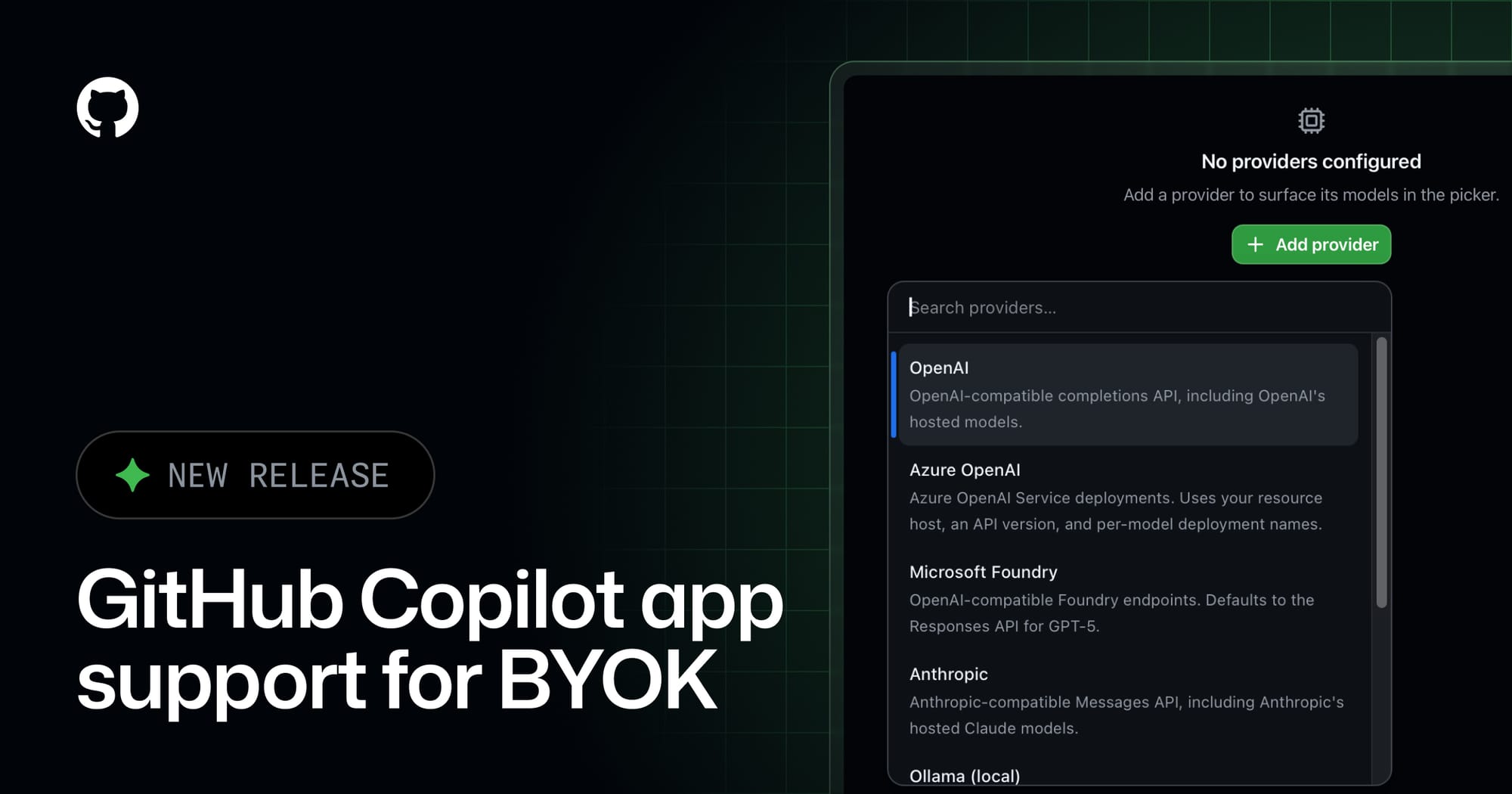
Bring-your-own-key support in the GitHub Copilot app sounds like a settings-page feature. It is not. It is GitHub quietly turning Copilot’s standalone app into a front end for whatever inference estate an engineering organization has already approved: Azure OpenAI, Microsoft Foundry, Anthropic, local models, private OpenAI-compatible gateways, and the developer’s laptop running Ollama or LM Studio.
That matters because the next phase of coding agents is not about whether one vendor’s bundled model wins every prompt. It is about routing work to the right model, in the right region, under the right contract, with the right logging and budget controls. The product surface is a chatty coding app. The architectural shift is a model gateway with a GitHub logo on it.
Copilot is becoming a client for heterogeneous inference
GitHub’s changelog says the GitHub Copilot app now supports BYOK providers including OpenAI, Azure OpenAI, Microsoft Foundry, Anthropic, Foundry Local, LM Studio, Ollama, and any OpenAI-compatible HTTP endpoint. Configured models appear in the model picker alongside GitHub-hosted models, and the developer chooses the model per session. Keys are stored in the local operating system keychain or credential store and are not displayed or read back by the UI.
That is a small implementation detail with a large trust implication. Enterprises already spend months getting model endpoints approved: data residency, retention, contractual terms, abuse monitoring, network controls, quota policy, audit requirements, procurement, security review. If Copilot’s app required a totally separate inference path for every serious coding-agent workflow, platform teams would have to choose between user adoption and governance. BYOK narrows that gap.
The Azure angle is especially direct. Azure OpenAI and Microsoft Foundry are no longer just back-end platforms that teams integrate into their own tools. They can become selectable providers inside a first-party GitHub agent experience. For Microsoft, that is strategically tidy: GitHub owns the developer workflow; Azure owns a lot of the enterprise AI infrastructure; Foundry is the model-routing and governance pitch. BYOK lets those pieces meet in the developer’s actual workbench instead of a diagram from a Build keynote.
Business and Enterprise users still need administrators to enable the Copilot CLI policy, which is the correct friction. BYOK without admin boundaries becomes a loophole. BYOK with policy becomes a useful escape hatch from bundled-model monoculture.
The dropdown is not the policy
The tempting mistake is to treat this as developer empowerment and stop there. “Choose your model” is a feature. “Choose the right model for this job under organizational constraints” is a system. The difference is where incidents live.
Azure OpenAI, Microsoft Foundry, Anthropic, Ollama, LM Studio, and a random OpenAI-compatible gateway are not equivalent. They differ on data handling, retention, quality, latency, cost, observability, region, rate limits, and operational maturity. A local model may be perfect for mechanical refactors and safe code transformations. It may be a bad choice for deep architectural reasoning over a large repo. A frontier model may be justified for a gnarly concurrency bug. It may be wasteful for renaming a symbol across files.
So platform teams should not roll this out as “BYOK is available.” They should publish blessed provider configurations. Label them by job, not model vanity: fast-local-refactor, secure-enterprise-coding, deep-debug, docs-summarization. Put endpoint naming, region expectations, logging posture, and model-selection guidance in writing. If the team uses Microsoft Foundry as a routing layer, make Foundry the default front door rather than asking every developer to paste individual deployment URLs into a client.
Key storage in the OS credential store is sensible, but it does not solve lifecycle management. Keys still need rotation, revocation, ownership, and least privilege. If a developer leaves, changes teams, or accidentally configures a personal endpoint for company code, the credential store will not save you from weak policy. Treat Copilot BYOK credentials like production-adjacent developer secrets because that is what they are.
Cost moved; it did not disappear
BYOK also changes the economics. With GitHub-hosted Copilot models, the meter is Copilot’s subscription, premium requests, AI credits, and whatever GitHub exposes in admin reporting. With BYOK, usage may land on Azure OpenAI, Foundry, Anthropic, or an internal GPU cluster. Finance may like that because it aligns spend with existing cloud contracts. Engineering may like it because quotas and model access are familiar. Nobody should confuse moved cost with lower cost.
The better version of this feature lets teams do real model arbitrage. Simple local changes go to local or smaller models. Sensitive enterprise work goes to approved regional Azure OpenAI deployments. Broad planning and synthesis go to a stronger frontier model. Long-running agent sessions get routed through a gateway that records call counts, latency, failure modes, and dollars per successful outcome. That is how BYOK becomes architecture.
The worse version is predictable: every developer picks the biggest model because it once solved a hard bug, local endpoints proliferate, no one knows which code went where, and the cloud bill becomes a postmortem artifact. The problem will not be GitHub’s support for BYOK. The problem will be pretending a model picker is the same thing as a routing policy.
For teams already invested in Azure AI, the practical move is clear. Create a small approved catalog of Copilot app providers. Put Azure OpenAI and Microsoft Foundry endpoints behind stable names. Use gateway logging where allowed. Document when local models are acceptable. Make revocation boring. Then train developers to switch models intentionally, not aesthetically.
BYOK makes the Copilot app more useful because it admits a truth the industry keeps relearning: no single model is the right runtime for every coding task. GitHub is giving developers a router. Now enterprises have to do the unglamorous work of deciding where the roads are allowed to go.
Sources: GitHub Changelog, GitHub Docs, GitHub Copilot app docs