Deep Agents Deploy Starts Looking Like a Real Platform, Not Just a Clever CLI

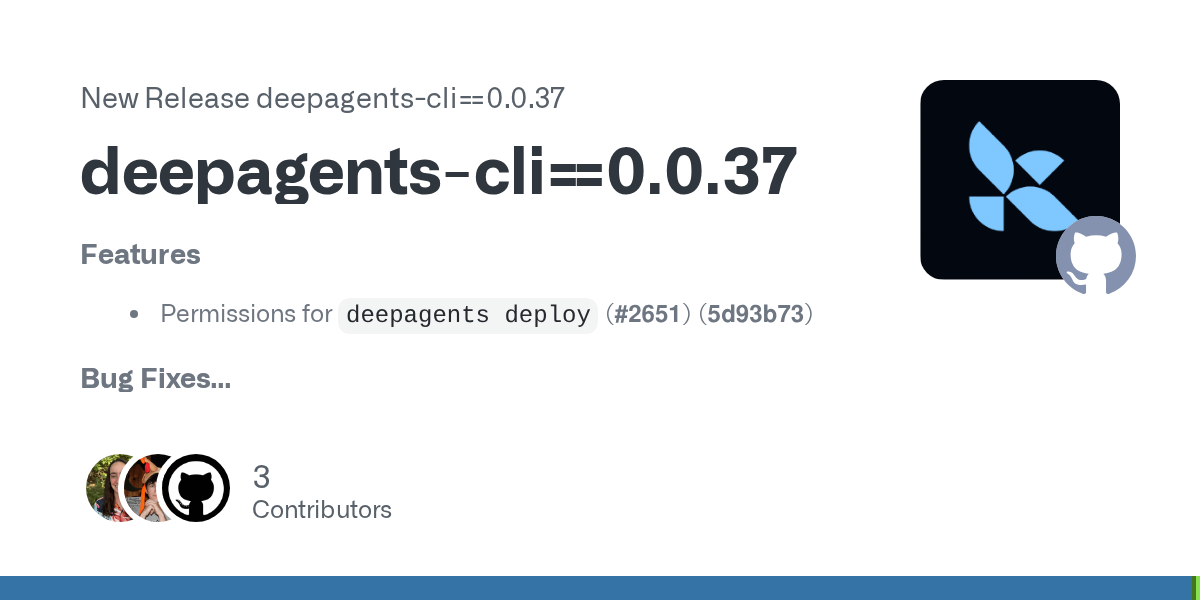
LangChain is making a bigger bet than the version number suggests. deepagents-cli==0.0.37 looks like one more point release in a repo that ships often, but the substance is not cosmetic. Permissions for Deep Agents Deploy, stricter config parsing, missing provider dependencies fixed in the bundler, and loading .env before validation are all signs of the same shift: LangChain wants Deep Agents to be judged less like an SDK demo and more like a deployable runtime.
That is the right fight to pick. The agent-framework market has already spent two years arguing about who has the prettiest orchestration abstraction. Graphs, crews, swarms, workflows, handoffs, memories, subagents, and whatever this week’s naming layer happens to be, none of that matters much if deployment remains fragile. Teams do not adopt frameworks because the README is poetic. They adopt them because the infrastructure behaves predictably when the model does something creative and the operator decidedly does not want surprises.
The release notes for deepagents-cli==0.0.37, published April 10, are short but revealing. The headline feature is plain: “Permissions for deepagents deploy.” The bug-fix list is even more interesting. LangChain fixed missing model-provider dependencies in the deploy bundler, removed a bug that injected AGENTS.md into the system prompt twice, hardened deploy-config parsing with tests, and changed startup so project .env files load before deploy or dev validation. None of these are marketing bullets. All of them are things you notice immediately when you are trying to ship an agent server that needs to work for someone other than the framework author.
The docs are telling on the strategy
If you read the release in isolation, it looks small. If you read it next to LangChain’s Deep Agents Deploy docs, the strategy becomes obvious. LangChain describes Deep Agents Deploy as a horizontally scalable server with more than 30 endpoints, including MCP, A2A, Agent Protocol, human-in-the-loop, and memory APIs. The docs emphasize open standards, open-source harnessing, support for any model provider, and self-hosting so memory stays inside your infrastructure. That is not the language of a helper CLI. It is the language of a platform bid.
The compare table against Claude Managed Agents is the tell. LangChain explicitly contrasts Deep Agents Deploy’s MIT-licensed harness, broad model support, AGENTS.md support, self-hosting, and standards-based endpoints with Anthropic’s more vertically integrated managed stack. In other words, LangChain is trying to sell an open managed-agent layer without calling it that too loudly. The release work in 0.0.37 makes more sense in that context. Once you frame the product as an alternative runtime, permissions and bundling are not implementation details anymore. They are core credibility.
The adjacent SDK release strengthens that read. deepagents==0.5.2 added filesystem permissions, route-scoped permissions for composite backends, stricter path validation, and file-upload support in the state backend. That is not random housekeeping. It is a coherent move away from prompt-level “please be careful” security and toward infrastructure-enforced boundaries. This is the mature direction for the whole agent category, and the vendors that do not internalize that are going to spend the next year writing apologetic blog posts about tool misuse.
Why boring deployment work is suddenly the product
The easy mistake in agent tooling is to assume the model is the product. In practice, the product is increasingly the reliability envelope around the model. Developers have plenty of ways to call Claude, Gemini, GPT, or Bedrock already. What they lack is confidence that packaging, tool configuration, auth, and runtime boundaries will behave sanely when the system goes from a notebook to a team-owned service.
That is why the “missing model provider deps” fix matters. If your deploy step silently omits a provider dependency, the resulting experience is not “slightly inconvenient.” It is the kind of environment-specific failure that makes framework adoption look reckless in front of the rest of the engineering org. The .env-before-validation change matters for the same reason. A deploy system that validates before it has loaded the credentials or settings it is supposed to validate against is a generator of false failures. Teams have limited patience for that class of problem, especially when the framework is also asking them to trust it with agent memory, human approval flows, and external tools.
Even the duplicated AGENTS.md injection bug is more consequential than it sounds. Deep Agents leans hard on AGENTS.md as an open standard for durable instructions. If the deploy pipeline is double-injecting that context into the system prompt, you are not just wasting tokens. You are changing behavior in a way that is hard to reason about and harder to debug. For framework operators, that kind of hidden prompt mutation is exactly the thing that erodes trust.
LangChain is trying to win the layer above orchestration
There is a broader market story here. The first generation of framework comparison was mostly about ergonomics: LangGraph for explicit flows, CrewAI for quick team-based prototyping, AutoGen and now Microsoft Agent Framework for multi-agent enterprise patterns. The next comparison will be less flattering and more useful. Which framework makes deployment boring? Which one gives you sane permission boundaries? Which one exposes standard endpoints instead of trapping you inside a proprietary shell? Which one can be self-hosted without turning your ops team into unpaid product testers?
LangChain appears to understand that this is where the real differentiation is moving. Deep Agents Deploy is not just a convenience wrapper around an agent config. It is becoming LangChain’s answer to the managed-runtime question. The company’s pitch is clear: open harness, open protocols, flexible model choice, standards like MCP and A2A, and the option to keep control of memory and infrastructure. That is a smart lane, because many teams want managed-agent convenience without managed-agent lock-in.
The catch is that openness raises the quality bar. Once you claim flexibility, you inherit the combinatorial pain of more providers, more backends, more config states, and more ways to fail. Closed products can sand off those edges by narrowing the platform. Open products have to do the harder engineering. That is why a release like 0.0.37 matters. It shows LangChain spending time on the nasty seams where framework ambition meets deployment reality.
What practitioners should do with this
If you are evaluating Deep Agents today, the right question is not “does this have enough features?” It obviously does. Ask instead whether your team values openness enough to accept beta-stage rough edges, and whether standards-based deployment is a strategic requirement. If you care about self-hosting, provider portability, AGENTS.md, MCP, and future-facing protocol compatibility, Deep Agents Deploy deserves a serious look.
If you already have a pilot, this release is a good excuse to harden your packaging assumptions. Test multi-provider deployments explicitly. Verify that your dependency graph is complete in CI, not just on one laptop. Review how you structure .env, permissions, and skill bundles. Treat AGENTS.md as source code, because the deploy system clearly does. And if your threat model still depends mostly on prompt instructions instead of actual permission boundaries, fix that before your agent framework makes the decision for you under less pleasant circumstances.
My read is simple. LangChain is building an open managed-agent stack in public, and the interesting competition is no longer demo quality. It is operational trust. deepagents-cli==0.0.37 is not a glamorous release, but it is the kind of release that decides whether a framework stays a clever developer toy or graduates into something a platform team can live with.
Sources: langchain-ai/deepagents release notes, LangChain Deep Agents Deploy docs, deepagents 0.5.2 release notes