DeepSeek V4.1 Flash’s 8 Trillion Tokens Show Where the LLM Race Is Moving

The most important number in this week’s model rankings is not five. It is 8.02 trillion.
DeepSeek V4.1 Flash has climbed one place to fifth on OpenRouter’s seven-day usage chart, narrowly passing Xiaomi’s MiMo-V2.5, which processed 7.96 trillion tokens. A single rank change would normally be newsletter lint. But V4.1 Flash launched on September 10, while OpenRouter’s complete daily data runs through September 15. The model reached 8.02 trillion tokens in a window that includes days when it did not exist.
That is not proof that DeepSeek built the fifth-best model in the world. OpenRouter measures input and output tokens, not users, successful tasks, revenue, or quality. Private traffic is absent, variants are listed separately, and long-context agents can consume vastly more tokens than classification or autocomplete jobs. Yet the result answers a question benchmark releases usually dodge: did developers actually send production-shaped work to the thing? Here, the answer is plainly yes.
The breakthrough is memory economics, not a bigger benchmark
V4.1 Flash is an MIT-licensed multimodal mixture-of-experts model with a 552-billion-parameter backbone, trained from scratch on 45 trillion multimodal tokens. It activates 8 billion parameters per token during prefill and 16 billion during decoding, supports native image input, and advertises a one-million-token context window with output up to 384,000 tokens. Those are large numbers, but they are not the interesting engineering decision.
The expensive part of long-context inference is often the state a model must retain while generating. The key-value cache grows with the prompt, consumes memory that could otherwise serve more concurrent requests, and can force operators to spill state into slower storage. A million-token context window is a demo feature if using it destroys throughput.
DeepSeek says its Causal Encoder-Decoder design, Compressed Sparse Attention 2, FP4 KV caching, and bounded replay cut global KV-cache storage to 890 bytes per token. The company describes that as roughly one quarter of V4 Flash and about one four-hundred-and-thirty-seventh of DeepSeek V1. Vendor claims need independent replication, especially when several techniques are bundled together. But the target is exactly right: the next practical jump in agent capability may come from making context cheaper to retain, not from making the context limit on a product page longer.
This is especially relevant to coding and operations agents. They accumulate repository files, screenshots, terminal output, tool schemas, retries, and earlier failed approaches. The model is not merely answering a prompt; it is dragging a working set through a long sequence. Compressing that state can improve concurrency and latency in a way users feel immediately.
One practitioner thread, with 226 votes and 59 comments when indexed, called the model’s speed “unbelievable” and estimated about four times the throughput they had seen from Terra or Sonnet. That is anecdotal, not a controlled result. It is still revealing: developers notice time-to-result and iteration speed long before they notice another two points on an academic benchmark.
Eight trillion tokens is adoption—with an asterisk
V4.1 Flash now trails GPT-5.6 Luna at 17.4 trillion tokens, Tencent’s Hy4 preview at 13.6 trillion, DeepSeek V4 Flash 0731 at 11.5 trillion, and Z.ai’s GLM 5.3 Flash at 11.4 trillion. Its rapid arrival in that group suggests DeepSeek cleared three gates at once: useful capability, attractive economics, and low-friction integration.
The pricing is difficult to ignore. Peak API rates are $0.30 per million uncached input tokens and $1.20 per million output tokens; off-peak rates are half that. A cache-hit input token costs $0.006 per million at peak and $0.003 off-peak. DeepSeek’s V4 Pro, by comparison, costs $1.32 for input and $3.96 for output at peak. For workloads that repeatedly reuse a large prefix—repository context, policy documents, or agent instructions—the cache-hit price is not a footnote. It changes which product loops are affordable.
Integration choices helped too. The API supports the OpenAI Responses format and Anthropic’s API format, plus tools, JSON output, vision, and a reasoning-effort setting expressed as an integer from 1 to 100. Teams can experiment without rebuilding their entire client layer. DeepSeek also routes the older V4 Flash and V4 Flash Vision Exp endpoints to V4.1 Flash, so part of the usage surge is migration by compatibility rather than eight trillion tokens of deliberate model selection.
That caveat does not erase the signal; it explains how infrastructure products win. Compatibility aliases, predictable schemas, aggressive caching, and low prices can move usage faster than a benchmark crown. Model adoption increasingly resembles database adoption: the engine matters, but operational fit closes the deal.
Your agent scaffold may matter more than the model rank
DeepSeek’s own published results show V4.1 Flash scoring 90.6 on Terminal-Bench 2.1, 74.2 resolved on DeepSWE v1.1, 88.1 on CyberGym, 64.0 on NL2Repo-Bench, 62.8 on SEC-Bench Pro, and 54.8 on AutomationBench at maximum reasoning effort. It reportedly improves over V4 Flash from 54.4 to 74.2 on DeepSWE and from 82.7 to 90.6 on Terminal-Bench. It also beats the larger V4 Pro on DeepSWE, Terminal-Bench, and CyberGym.
But the footnote is more useful than the headline. On DeepSWE v1.1, V4.1 Flash scores 74.2 with mini-SWE, 72.6 with DeepSeek Harness Minimal, 69.8 with Claude Code, and 65.6 with Codex. The same weights span 8.6 points depending on the scaffold. Prompt encoding, tool protocol, retry behavior, context management, and patch application are part of the system under test.
For engineering leaders, that should change the evaluation plan. Do not replace a production model because one marketplace rank moved. Shadow V4.1 Flash on your own repository tasks, image inputs, tool schemas, and recovery loops. Record task completion, wall-clock latency, cache-hit rate, input and output tokens, and cost per completed task—not merely cost per token. Sweep several reasoning-effort values and check whether the quality-cost curve is stable enough to turn into routing policy.
Pin an explicit version wherever the provider permits it. Compatibility aliases are convenient during a launch and dangerous during an incident review: if an endpoint silently changes underneath an evaluation, reproducibility disappears. Canary the model, preserve representative traces, and keep a rollback path.
Self-hosters should be equally unsentimental. MIT licensing is valuable, but a 552-billion-parameter backbone plus 196 billion parameters of conditional Engram memory is not a workstation deployment. Sparse activation reduces per-token compute; it does not eliminate weight storage, expert routing, cross-device communication, quantization work, or serving complexity. Unless a team already operates serious distributed inference infrastructure, the hosted API deserves to be the default comparison—not because open weights are unimportant, but because licensing and economical deployment are different properties.
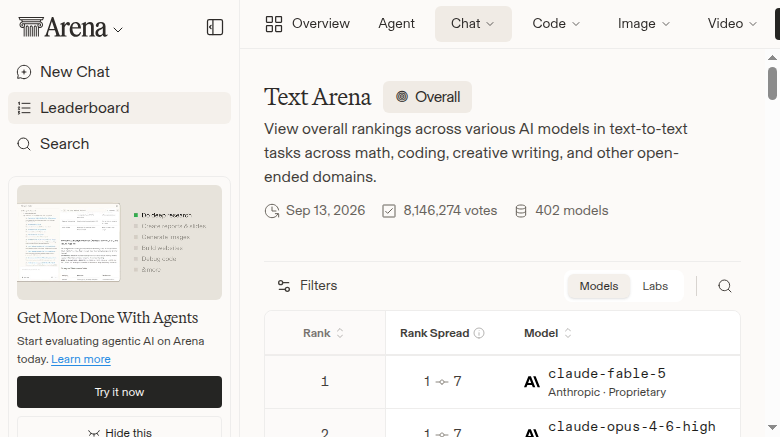
Arena’s overall top 20 did not move this cycle: Anthropic still holds the first three positions, led by Claude Fable 5, while DeepSeek V4.1 Flash’s story is visible in usage rather than Arena rank. That split is healthy. Preference leaderboards tell us what evaluators choose in controlled comparisons; routing marketplaces show what developers are willing to run at scale. Neither is a universal truth, and conflating them produces bad procurement.
The editorial verdict is simple: DeepSeek’s one-place rise matters because it validates a systems bet. The company attacked the cost of remembering long contexts, paired that work with pricing and familiar APIs, and workloads arrived immediately. The next model race will not be won by the lab with the longest context claim or the prettiest benchmark table. It will be won by the system that turns context, tools, latency, and dollars into completed work—and can prove it on someone else’s codebase.
Sources: DeepSeek V4.1 Flash model card, DeepSeek API changelog, DeepSeek API pricing, OpenRouter rankings, Arena AI leaderboard, developer first impressions