Gemini Sneaks Into Apple’s AI Stack Through the API Layer

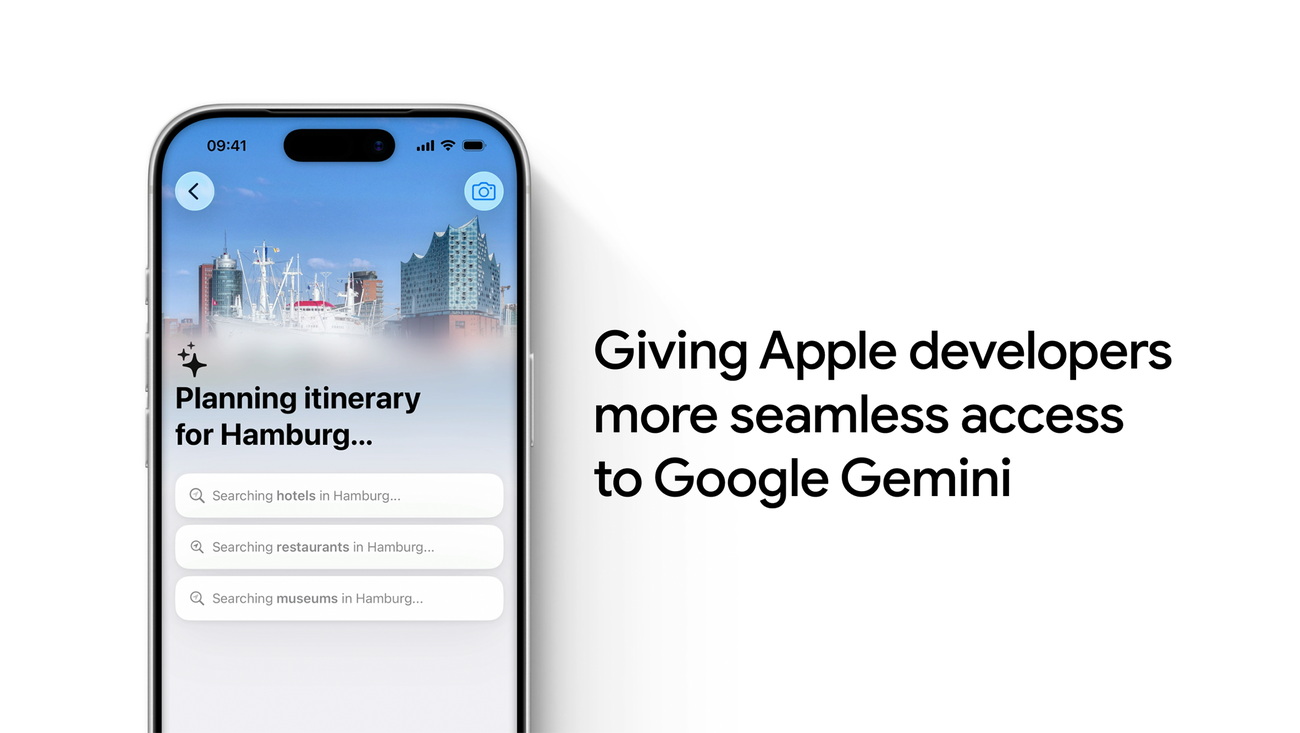
The least flashy AI platform move is often the one that lasts. Google bringing Gemini models into Apple’s Foundation Models framework through Firebase AI Logic is not a dramatic “Gemini takes over the iPhone” moment. It is better than that. It puts Gemini behind Apple’s native developer abstraction, where app builders can route between Apple’s on-device models and Google’s cloud models without treating every provider choice as a rewrite.
Google says Apple developers can now call cloud-hosted Gemini models through Apple’s Foundation Models framework via the Firebase Apple SDK, and can use Gemini inside Xcode for multi-step coding work. The integration starts with Apple’s 2026 platform releases — iOS 27, macOS 27, iPadOS 27, visionOS 27, and watchOS 27 — where third-party cloud model providers can implement Apple’s public LanguageModel protocol. In plain English: Apple is giving developers one AI-shaped interface, and Google is making Gemini one of the models available behind it.
That sounds like plumbing because it is plumbing. Good plumbing is how platforms win. Developers do not want a bespoke Gemini integration, a separate Apple Intelligence path, a custom streaming layer, and five provider-specific structured-output hacks if a common session abstraction can do the job. They want text generation, streaming, multimodal input, structured JSON output, and a way to pick the right model for the task without tearing up the app.
The model switch is the product architecture
Firebase documentation frames the appeal directly: developers can swap between Apple on-device models and cloud-hosted Gemini by changing the model instance. That is the right mental model. Apple’s local models are attractive for privacy, offline support, low latency, and low marginal cost. Gemini is attractive for larger context, stronger reasoning, multimodal capability, image generation, and cloud-scale model updates. Serious apps will use both.
A writing app might use the on-device model for lightweight classification, private rewriting, and short suggestions, then escalate complex document synthesis to Gemini. A health or education app might keep sensitive first-pass interactions local and call Gemini only for opt-in, higher-value analysis. A productivity app might use local intelligence for quick UI actions and Gemini for structured extraction across PDFs or images. The important thing is that the routing decision becomes architectural instead of ideological.
The supported Firebase model list shows the shape of the preview. General-purpose models include gemini-3.1-pro-preview, gemini-3.5-flash, and gemini-3.1-flash-lite. Image models include Nano Banana Pro, Nano Banana 2, and Gemini 2.5 Flash Image / Nano Banana. Gemini Live API models and Imagen models are not supported in this integration. Capabilities include text generation, multi-turn sessions, multimodal image and PDF input, image generation, streaming responses, and structured JSON output through Swift examples.
Those constraints matter. This is not a universal bridge to every Google model surface. It is a preview path with beta OS requirements, Xcode 27 beta, Firebase dependencies, and a capability set that will almost certainly move before production. Builders should prototype the abstraction now, but avoid promising customers features that depend on preview APIs staying exactly where they are.
Xcode is a distribution surface, not just an IDE
The Xcode integration may be the quieter strategic win. Google does not need to own Apple’s IDE if it can become an approved model option inside it. Google says developers can use Gemini in Xcode for code review, bug fixes, and feature work without switching windows. Individual developers can use Google AI Studio Gemini API keys; enterprise developers can use Gemini Enterprise Agent Platform keys with corporate quotas and data-privacy parameters.
That distinction is not trivia. “Paste your personal API key into the IDE” is fine for demos and chaos for companies. Enterprise credentials, quotas, privacy parameters, and managed access are the difference between a toy coding assistant and a workflow a security team might tolerate. If Gemini is going to participate in Xcode-based development at scale, it has to fit the governance layer, not just the autocomplete layer.
This also puts Google into a more durable position than a standalone app would. Apple developers already live in Xcode, Swift, Firebase, App Check, TestFlight, and the OS frameworks. Meeting them inside those surfaces lowers adoption friction. It also reduces the “which AI app do I open?” problem. The model becomes part of the development environment and app runtime, not a destination.
Mobile cloud AI needs abuse protection from day zero
Firebase App Check is easy to read as a setup footnote. It is not. If a mobile client can call a paid cloud model, abuse protection is part of the architecture. Attackers do not care that your launch checklist categorized AI calls as a nice feature. They care that a shipped app can become a proxy for quota theft, credential leakage, or prompt abuse.
Teams building on this integration should treat App Check, backend mediation, quota limits, logging, and user-level rate controls as product requirements. Do not ship a direct, loosely protected model path and then discover that “AI feature went viral” means “your bill went vertical.” The mobile threat model is different from the server-side AI app model because the client is distributed by design. Assume the app will be inspected, modified, replayed, and abused.
There is also a privacy design question. The shared API makes it easier to switch between local and cloud models, but it does not absolve the app from telling users where their data goes. If a task leaves the device for Gemini, the user experience should make that understandable where the data is sensitive. The whole point of having local and cloud options is to choose intentionally. Hiding the choice behind an abstraction may be convenient for developers, but it can be misleading for users if the app handles personal documents, health data, children’s content, or enterprise files.
The competitive read is simple: Apple keeps the native abstraction and on-device default; Google gets a sanctioned cloud-model path into Apple apps; developers get a cleaner routing layer. That is a healthier architecture than every provider demanding its own framework and every app accumulating AI glue code like technical debt with a keynote budget.
The editorial read: this is not “Gemini on iPhone” in the lazy headline sense. It is Google entering Apple’s AI stack through the API layer, which is exactly where it should be. The durable win is optionality: local when privacy, latency, and cost matter; Gemini when capability matters; governance when teams need the whole thing to survive contact with production.
Sources: Google, Firebase docs, Firebase capabilities docs