Gemini Wants to Run the Front Desk for Small Businesses

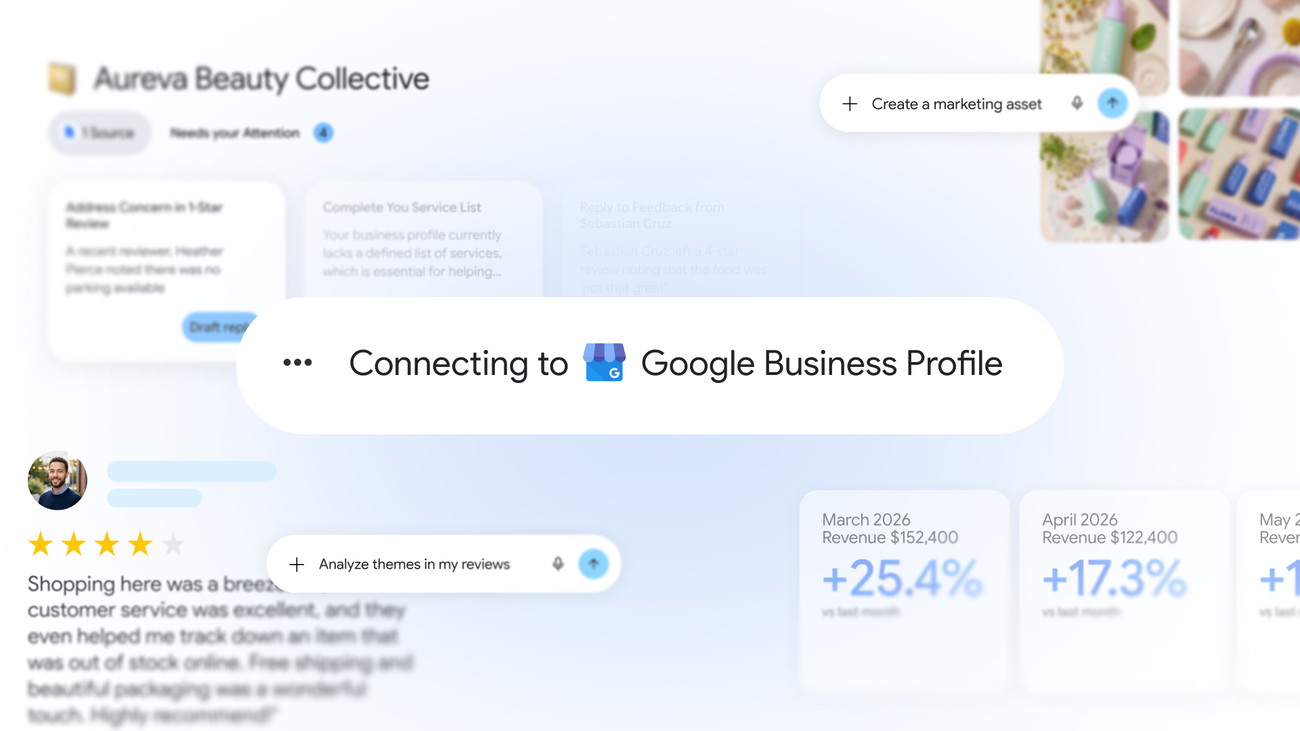
Gemini’s new small-business features are not flashy in the usual AI-demo sense. Nobody is asking a model to solve graduate math or write a startup pitch in the voice of a pirate. Google is doing something more commercially important: putting Gemini next to the public listing, customer reviews, questions, search performance, and website context that already decide whether a local business gets called, visited, trusted, or ignored.
The announcement, made around Google for Brazil, adds Google Business Profile integration and “Business notebooks” to the Gemini app. The pitch is simple: connect a Business Profile with one tap, then ask Gemini how the business performed this month, draft replies to recent reviews, update hours, post seasonal information, identify missing profile details, and surface unanswered customer questions. Google says the rollout begins globally this month, excluding the EEA and UK.
That sounds small until you remember what Google Business Profile is for a restaurant, dentist, plumber, salon, or repair shop. It is not a vanity page. It is often the operational front door: hours, location, reviews, photos, phone calls, direction requests, customer questions, and local search visibility all converge there. Giving Gemini access to that state makes it more useful than a generic chatbot because it can answer from a system the owner already uses, not from vibes and a prompt.
The useful version of agents starts with a trusted system of record
The product pattern is worth stealing. A generic assistant answering “How is my business doing?” has to fake specificity or ask for data. Gemini connected to Business Profile can look at search impressions, direction requests, call activity, review content, customer engagement, and website context. That is the difference between chat and workflow software. The model becomes useful when it is grounded in a scoped, permissioned source of truth and allowed to perform bounded tasks.
Business notebooks are the quiet architectural detail. Google describes them as focused spaces that combine chats, sources, a Business Profile, and website information while carrying context across conversations. That is how practical AI products are going to look: less magic prompt box, more workspace with explicit boundaries. The notebook knows what it is about. It can remember prior work. It can alert the owner when holiday hours are missing or customer questions are unanswered. This is agentic software stripped of the TED-talk costume.
The risk is that the same data is public-facing. A bad answer inside a private chat is annoying. A bad review reply, wrong holiday hours, stale promotion, or misguided pricing recommendation is customer-visible. Google says Gemini can draft tailored responses using the customer’s specific feedback and the business’s brand voice. That is useful. It is also exactly where review-before-publish needs to be the default, not a buried preference for people who read settings pages recreationally.
Local businesses do not have enterprise approval workflows
Small businesses are a brutal proving ground for AI because they have real constraints and almost no process padding. The owner may also be the manager, marketer, scheduler, customer support rep, and person fixing the espresso machine. If Gemini saves fifteen minutes replying to reviews and checking profile gaps, that matters. If it confidently updates the wrong hours before a holiday weekend, there may be no operations team to catch it.
That means builders shipping AI into SMB workflows should bias toward assistive automation before autonomous mutation. Draft the reply. Explain why the profile appears incomplete. Show the data behind a performance claim. Ask for confirmation before publishing, changing hours, or posting offers. Keep a visible activity log. Make rollback obvious. The correct UX is not “AI did a thing”; it is “AI prepared a thing, here is why, approve or edit.”
There is also a platform strategy hiding here. Review-management tools, local SEO dashboards, website builders, scheduling products, CRM-lite systems, and agency services all sell pieces of this workflow. Google does not need to replace them outright. If Gemini becomes the default interface for the highest-frequency tasks — respond to reviews, understand performance, update the listing, answer customer questions — it absorbs the attention layer. The specialized tools still exist, but the front desk moved into Google’s assistant.
For engineers building adjacent products, the action item is to get sharper about where your software owns differentiated state. If your product is mostly a thin UI over data Google already has, Gemini will pressure it. If you own workflow-specific logic, approvals, analytics, vertical compliance, team collaboration, or integrations Google does not see, you have a defensible reason to exist. The AI layer rewards products with real systems of record and punishes dashboards that were already just reformatting someone else’s API.
The editorial read: this is Gemini becoming an operator for Main Street, not merely an assistant for people who like typing prompts. That is good product direction. It is also where guardrails stop being theoretical. The chatbot is now standing at the front desk, holding the marker for your posted hours, and drafting replies to angry customers. Useful, yes. Something you let publish unattended? Not if you enjoy learning incident response from Yelp reviews.
Sources: Google, Search Engine Journal, PYMNTS, 9to5Google