Gemma 4’s Real Story Is Local AI Escaping the Benchmark Slide

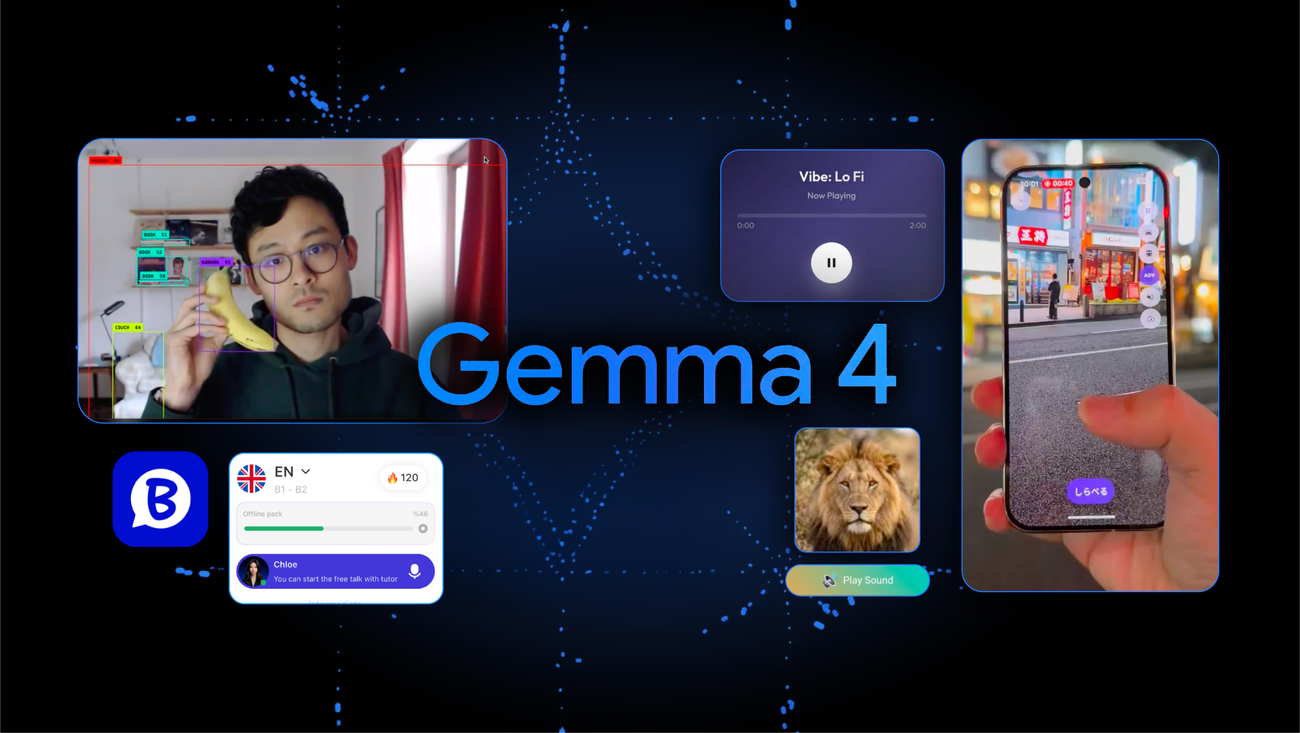
Gemma 4’s latest builder showcase looks, at first glance, like the usual open-model victory lap: a tutoring app, a persona demo, an augmented-reality toy, a few screenshots, and a download number big enough to make the slide feel safe. The useful read is sharper than that. Google is trying to prove that Gemma 4 is not merely a benchmark artifact or a consolation prize for developers who cannot afford frontier APIs. It is becoming a local AI substrate for products where latency, privacy, offline access, and unit economics matter more than leaderboard theater.
Google says Gemma 4 has crossed more than 150 million downloads. The company highlights HubX’s BetterSpeak, which uses the edge-optimized Gemma 4 E2B model as the reasoning engine for offline English tutoring; a persona-driven vision-language demo from @measure_plan; and an AR/game-like world app from @GOROman that uses a larger context window to preserve recent world history. The examples are charming, but the pattern is the point: Gemma 4 is being positioned for real local and on-device workflows, not just notebook experiments.
The technical ingredients are worth separating from the marketing. Gemma 4 ships under Apache 2.0, supports native audio input, includes vision-language reasoning, supports function calling for agentic workflows, and offers context windows up to 256K on larger variants. Google recently expanded the family with Multi-Token Prediction for faster inference, a 12B Unified model, and Quantization-Aware Training checkpoints. DeepMind’s model page lists support for 140 languages and benchmark results including Gemma 4 31B IT Thinking at 89.2% on AIME 2026, 80.0% on LiveCodeBench v6, 84.3% on GPQA Diamond, and 86.4% on τ2-bench Retail.
Local AI is a product constraint, not an ideology
BetterSpeak is the most useful example because it makes the local-model tradeoff concrete. An offline English tutor needs quick feedback, predictable cost, and privacy-sensitive handling of speech and writing data. If every grammar explanation or pronunciation hint requires a cloud round trip, the product becomes slower, more expensive, and less reliable in exactly the markets where language-learning apps often need to work. Google says BetterSpeak runs a 4-bit quantized Gemma 4 E2B model on mobile hardware for grammar explanations and progress monitoring across multiple languages. That is not a stunt; that is the architecture that makes the app viable.
This is where the daily developer interest around “gemma 4 ollama,” “local coding agent VRAM,” and “best local model for coding agents” comes from. Builders are not asking whether a local model can beat the best cloud model at every task. They are asking a more useful question: what can I run cheaply, privately, and reliably enough that I do not babysit API bills or network failures? Intelligence-per-watt and intelligence-per-parameter are becoming product features.
The same logic applies beyond tutoring. A local assistant that classifies documents, drafts simple replies, performs visual Q&A, explains UI state, or runs lightweight tool calls does not need to win a frontier reasoning benchmark. It needs to be available, fast, cheap, and good enough on the actual task. If it passes those evals, local inference buys you something cloud APIs cannot: control over latency, data movement, and marginal cost.
The hybrid stack is the boring answer, which means it is probably right
The mistake is turning local versus cloud into a religion. Gemma 4 is not a replacement for Gemini in every workflow, and Google clearly does not want it to be. The strategy is layered: Gemini handles the frontier and cloud-heavy cases; Gemma handles local, open, edge, and constrained deployments; AI Edge Gallery and AI Studio become the places where developers experiment; QAT and MTP become performance knobs; and routing becomes the product architecture.
For engineering teams, the practical move is to build a model router before the product calcifies. Put private, repetitive, latency-sensitive, or offline-capable tasks on Gemma where evals prove it works. Escalate hard reasoning, long-horizon agents, fresh-knowledge tasks, or high-stakes generation to Gemini or another frontier API. Keep traces so you know when the cheaper path is failing. This is not glamorous. It is how you avoid paying frontier-model prices for work a quantized local model can do on a phone.
The local path still has operational costs. Quantized models need device targeting, thermal testing, battery profiling, memory budgeting, update delivery, safety filtering, and task-specific evaluation. “Runs locally” does not mean “ships itself.” It means the constraints move from a cloud pricing page into your own engineering backlog. That can be a good trade, especially for privacy-sensitive products and predictable workloads, but it is still a trade.
There is also a documentation and ecosystem tax. Developers want Gemma 4 in the tools they already use: Ollama, llama.cpp-style runners, mobile SDKs, browser runtimes, app templates, evaluation harnesses, and deployment guides that do not pretend every device has infinite memory. Google’s builder post is useful as signal, but the local-model market will be won in boring integration details: quantized checkpoints that actually fit, stable runtime paths, clear licenses, working examples, and evals tied to real product tasks.
The benchmark slide is no longer enough
The earlier Gemma 4 launch drew real community attention: the Hacker News thread for Google’s open-model release reached more than 1,800 points and hundreds of comments. That kind of reaction means developers are willing to test the model, argue about it, and deploy it. The builder showcase is Google’s next argument: not just that Gemma 4 is technically credible, but that people are already using it in products where cloud-only AI is the wrong default.
That argument is strongest when Google stays grounded. An offline tutor is persuasive. A device-friendly multimodal assistant is persuasive. A toy AR demo is less commercially obvious, but it still shows the shape of local perception and stateful context. The risk is that “local AI” becomes another vague banner under which every demo is treated as proof. The standard should be harsher: does local inference make the product better, cheaper, safer, faster, or usable where it otherwise would not be?
The editorial read: Gemma 4 matters because it gives builders a serious local option inside Google’s broader AI stack. Not every task deserves a frontier model, and not every product can tolerate a cloud dependency. The winning teams will not declare allegiance to local or cloud. They will route intelligently, test ruthlessly, and use Gemma where its constraints are actually advantages.
Sources: Google, Google DeepMind Gemma 4, Google AI Edge Gallery