GitHub Copilot’s GPT-5.5 Rollout Shows the Model War Is Now an Admin Setting

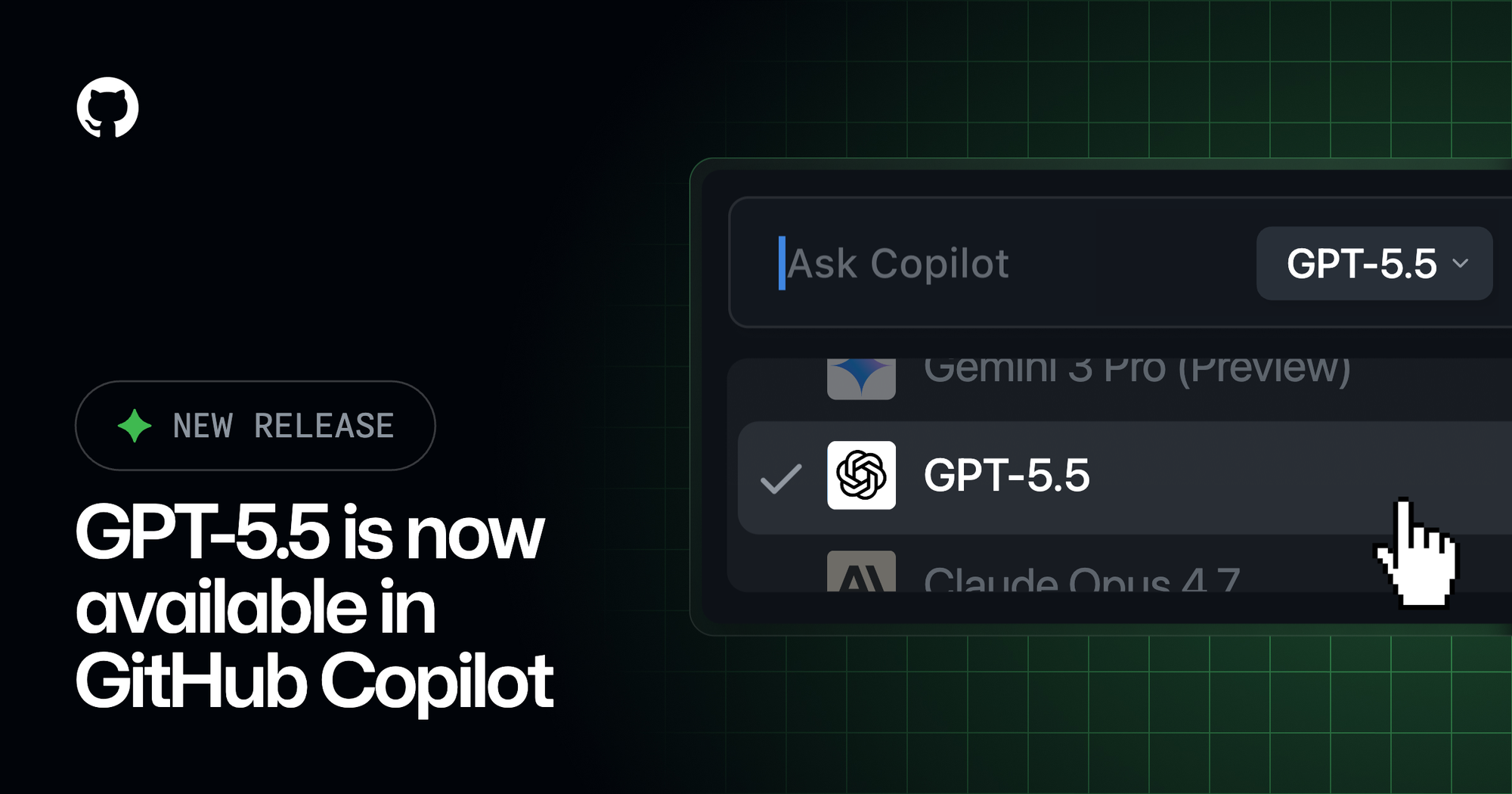
GitHub’s GPT-5.5 rollout is nominally a model-availability update, but the more revealing story is that frontier-model competition in coding tools now shows up as an admin setting, a billing multiplier, and a policy decision. That is a less glamorous narrative than “smartest model wins,” but it is much closer to how these tools actually land inside companies. Once a model can touch IDE chat, terminal sessions, cloud agents, code review, and mobile workflows, the important question is no longer just whether it is better. It is whether an organization can operationalize it without turning its software budget into a jump scare.
GitHub’s April 24 changelog makes that framing explicit. GPT-5.5 is rolling out across Copilot Pro+, Copilot Business, and Copilot Enterprise, and it is not confined to one surface. GitHub says the model will be selectable in VS Code, Visual Studio, Copilot CLI, Copilot cloud agent, github.com, GitHub Mobile, JetBrains, Xcode, and Eclipse. That breadth matters because it turns a model launch into an organizational event. A team can now make one model choice that ripples across interactive chat, autonomous agent sessions, review workflows, and on-the-go triage from a phone.
GitHub also made sure nobody missed the economic fine print. GPT-5.5 launches with a 7.5× premium request multiplier under promotional pricing. That line is doing a lot of work. It tells you that GitHub no longer expects developers to treat model selection as a cosmetic preference, like choosing a dark theme. Model selection is becoming closer to compute scheduling. Pick the expensive thing, and the cost follows you through every place Copilot shows up.
The timing is not accidental. OpenAI launched GPT-5.5 on April 23 with a pitch centered on better long-horizon coding, stronger tool use, lower token usage on Codex tasks, and GPT-5.4-class latency. OpenAI reported 82.7% on Terminal-Bench 2.0, ahead of GPT-5.4 at 75.1%, Claude Opus 4.7 at 69.4%, and Gemini 3.1 Pro at 68.5%. It also claimed 58.6% on SWE-Bench Pro, 78.7% on OSWorld-Verified, 55.6% on Toolathlon, and 98.0% on Tau2-bench Telecom, while later updating the post to say GPT-5.5 and GPT-5.5 Pro were now available in the API. That is OpenAI pushing the line that the next unit of value is workflow quality, not just model IQ. GitHub’s response is effectively: fine, we can distribute that model everywhere developers already work, but we are going to meter it like infrastructure.
That distribution layer is GitHub’s actual moat. Plenty of vendors can claim strong model performance. Fewer can make the newest model show up, with enterprise controls, inside the tools engineers already have open all day. The changelog notes that Copilot Business and Enterprise administrators must explicitly enable the GPT-5.5 policy in Copilot settings. That sounds boring because it is boring. It is also the point. The winner in enterprise coding agents is not just the company with the strongest benchmark sheet. It is the company that makes frontier capability legible to procurement, security, finance, and platform engineering at the same time.
This is one reason the early public reaction fixated on price faster than capability. The small but telling HN Algolia chatter around the rollout zeroed in on the 7.5× multiplier. That is not cynicism. It is maturity. Developers are adjusting to a reality where every agentic workflow, every CLI prompt, every premium review pass, and every cloud-agent run sits on top of a usage model that can vary sharply by model choice. The old “AI assistant” framing encouraged people to think in subscription vibes. The new coding-agent market is pushing people to think in cost envelopes, governance boundaries, and reliability tradeoffs.
That changes how teams should evaluate GPT-5.5 inside Copilot. The right benchmark is not a generic vibe check in IDE chat. It is whether GPT-5.5 reduces the total number of expensive turns in the workflows that matter most. Does it finish a multi-step CLI task without bouncing between partial plans? Does it shrink the back-and-forth in cloud-agent sessions? Does it produce code review feedback that is materially better, or just pricier? A 7.5× multiplier can make sense if the model eliminates retries, bad branches, and long debugging loops. It is a bad trade if it simply produces more eloquent intermediate thoughts before arriving at the same fix.
The other important shift is political, not technical. Copilot is no longer a single-model assistant with a nicer UI than the terminal. GitHub’s own documentation now makes clear that Copilot operates as a multi-model control plane. Depending on plan and surface, it can expose OpenAI models alongside other providers. Once that happens, the admin panel becomes part of the product’s core value. Platform teams are not just choosing a vendor. They are deciding which models can be used where, by whom, at what effective spend, under what policy. That is a very different market than the one AI coding tools were selling into even six months ago.
For practitioners, the practical move is straightforward. Do not approve GPT-5.5 broadly just because it is the latest thing in the picker. Turn it on for a slice of the organization, then measure it where premium-request burn is real: Copilot CLI, cloud-agent sessions, and high-context review flows. Compare completion rates, retries, time-to-merge, and the number of human corrections needed after the model’s first pass. If GPT-5.5 meaningfully improves those metrics, the multiplier may be justified. If the gain is mostly aesthetic, keep it as a specialist tool rather than a default.
The broader takeaway is that the coding-model war has changed shape. Model vendors still want you to stare at benchmarks. Tooling vendors increasingly want you to trust their distribution, policy, and workflow integration. Builders should care about both, but they should stop pretending the first one decides the whole market. In 2026, the best coding model does not win by existing. It wins by surviving procurement, admin controls, and everyday workflow economics long enough to matter.
Sources: GitHub Changelog, GitHub Docs, GitHub Copilot billing docs, OpenAI