GitHub Just Put a Security Gate in Front of Third-Party Coding Agents

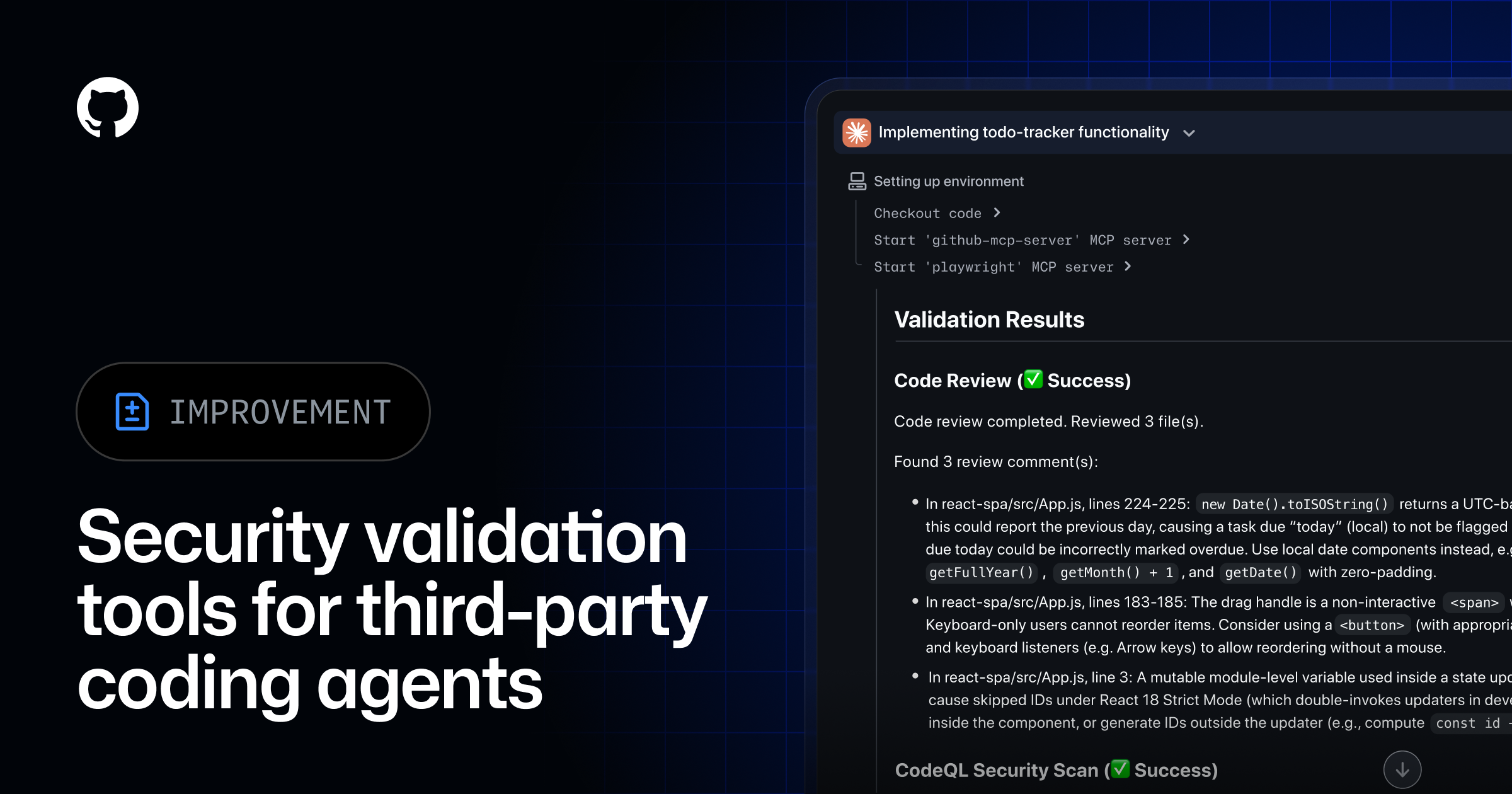
GitHub’s most important coding-agent announcement this week is not a new model, a bigger context window, or another button that promises to turn red CI green. It is a security gate. That sounds less glamorous, which is usually a clue that it matters.
The company has made security validation for third-party coding agents generally available, extending checks already used for Copilot cloud agent to agents including Claude and OpenAI Codex when they create code directly in GitHub repositories. The validation stack is familiar: CodeQL for code-level vulnerabilities, dependency checks against the GitHub Advisory Database, and secret scanning for accidentally committed keys and tokens. If GitHub finds a problem, it says the agent attempts to resolve the issue before finalizing the pull request.
That is the right place to put the control. The future of coding agents is not one blessed assistant installed everywhere. It is messy, multi-agent, and already here: Copilot in GitHub, Codex in OpenAI workflows, Claude in long-running refactors, local CLI agents, IDE agents, and internal wrappers that nobody remembers formally approving. Security teams can either try to evaluate every agent vendor’s safety story in isolation, or they can enforce controls at the repository boundary where the code lands. GitHub picked the sane abstraction.
The useful security model is “agent output is just a diff”
The announcement matters because it lowers the amount of special pleading around AI-authored code. Agent-generated pull requests should not be treated as magic. They also should not be treated as radioactive by default. They are diffs. The practical question is whether the repository can apply the same baseline controls regardless of whether the branch came from a human, Copilot cloud agent, OpenAI Codex, Claude, or tomorrow’s agent with a better launch video.
GitHub’s validation covers three boring failure modes that show up constantly in real engineering work. CodeQL looks for vulnerability patterns across supported languages including C/C++, C#, Go, Java/Kotlin, JavaScript/TypeScript, Python, Ruby, Rust, Swift, and GitHub Actions workflows. Dependency checks compare newly introduced packages against advisories, including malware and high- or critical-severity vulnerabilities in Copilot’s documented cloud-agent protections. Secret scanning catches the classic agent mistake: producing a config file, test fixture, or README snippet that contains an API key, token, or credential-shaped string that should never reach a branch.
None of those tools prove correctness. They do not tell you whether the agent understood your architecture, preserved product behavior, or deleted the wrong abstraction with impressive confidence. But they do make agent output less exceptional. A repository-level gate can say: before this PR becomes reviewable, it must clear the same minimum security pass. That is a better policy than asking each development team whether they “trust” a given agent.
On by default is the product decision
The checks are on by default and follow the repository’s Copilot validation-tool settings. GitHub also says the validation does not require GitHub Advanced Security. That detail matters. If this had been locked behind the highest security SKU, the practical result would have been predictable: well-funded teams get guardrails, everyone else gets vibes. Making the baseline broadly available is the correct move if agent-authored pull requests are going to become normal repository traffic.
GitHub says the original Copilot cloud agent validation, released in October 2025, has already “proactively prevented hundreds of potential security leaks and vulnerabilities.” Treat that as vendor-supplied evidence, but the shape is plausible. Agents are good at producing a lot of plausible code quickly. They are also good at copying patterns, adding dependencies, creating config, and working with logs — exactly the zones where secrets and vulnerable libraries sneak into commits. The velocity argument for agents only survives if the review surface gets automated pressure too.
The escape hatch is where teams need discipline. Repository administrators can disable one or more validation tools if they need speed or have conflicts with other security products. That is reasonable for exceptional workflows. It is also the knob that turns a guardrail into a PDF policy if nobody governs it. “The agent was faster with validation off” is not an engineering argument. It is how the incident timeline gets a paragraph that starts with “temporarily.”
Where this still fails
CodeQL coverage is strong, but not universal. Unsupported languages can produce incomplete analysis or no alerts. Advisory checks only catch known bad dependencies. Secret scanning is not a formal data-flow proof, and it will not understand every internal credential format unless teams configure their own patterns and keep them current. These tools are security gates, not security absolution.
There is also a workflow risk. If GitHub lets the agent attempt to fix detected issues before finalizing a PR, teams should preserve the trail. A second agent-generated fix can hide the original failure mode unless logs, comments, or validation results remain inspectable. Reviewers should be able to see not only the final diff, but whether the agent first introduced a vulnerable dependency, leaked a token-shaped string, or triggered CodeQL and patched around it. Agent quality is not just “did the final PR pass?” It is “how often did the agent need the guardrail, and what kind of mistakes did it make?”
That metric is going to matter. Engineering leaders love velocity dashboards until someone asks about defect rate. Agent adoption needs the same accounting: number of agent-authored PRs, validation failures, fixes attempted, human edits required, review comments, reverts, and production incidents. Without that, “agent productivity” becomes a story told by merged pull requests and ignored risk.
What teams should do now
Start by inventorying where agent-authored code can enter your repositories. Copilot cloud agent is obvious. Claude and Codex may arrive through GitHub integrations, CLI workflows, IDE extensions, or internal automation. Define which agents may open pull requests, which repositories they can target, and what branch protections apply. If an agent can push a branch, it should be covered by validation, review, and workflow-approval policy.
Second, audit validation settings across sensitive repos. Make sure CodeQL, dependency checks, and secret scanning are enabled where GitHub supports them. For languages CodeQL does not cover well, supplement with the security tools your team already trusts. If you use custom secret formats, add patterns. If agent PRs can introduce dependencies, require dependency review rather than relying on package names and optimism.
Third, keep the human merge boundary intact. GitHub’s Copilot cloud agent docs already describe important constraints: the agent cannot approve or merge its own pull requests, cannot mark them ready for review, and GitHub Actions workflows require approval by default before running on agent-authored PRs. Do not relax those controls just because a validation badge is green. A security gate catches classes of mistakes. It does not understand product intent.
The larger read is that GitHub is conceding the right thing: developers will use multiple coding agents, including competitors. The platform’s job is not to pretend one vendor will own the workflow. The platform’s job is to make every agent-produced diff pass repository policy before it gets near main. That is less exciting than a model launch. It is also much closer to how real software survives contact with production.
Sources: GitHub Changelog, GitHub Docs on Copilot cloud agent risks and mitigations, GitHub Docs on validation tools, GitHub Docs on CodeQL