GitHub Quietly Exposed Sub-Agent Streaming in Copilot SDK, Which Tells You Where Agent UX Is Going

The interesting changes in coding agents are increasingly the ones nobody outside product and platform teams notices. GitHub’s Saturday merge exposing includeSubAgentStreamingEvents across the Copilot SDK is a good example. It looks like a minor plumbing flag. It is not. It is a small but very clear signal that the next stage of agent UX is about managing live work across multiple agents, not just generating one polished answer at the end of a request.
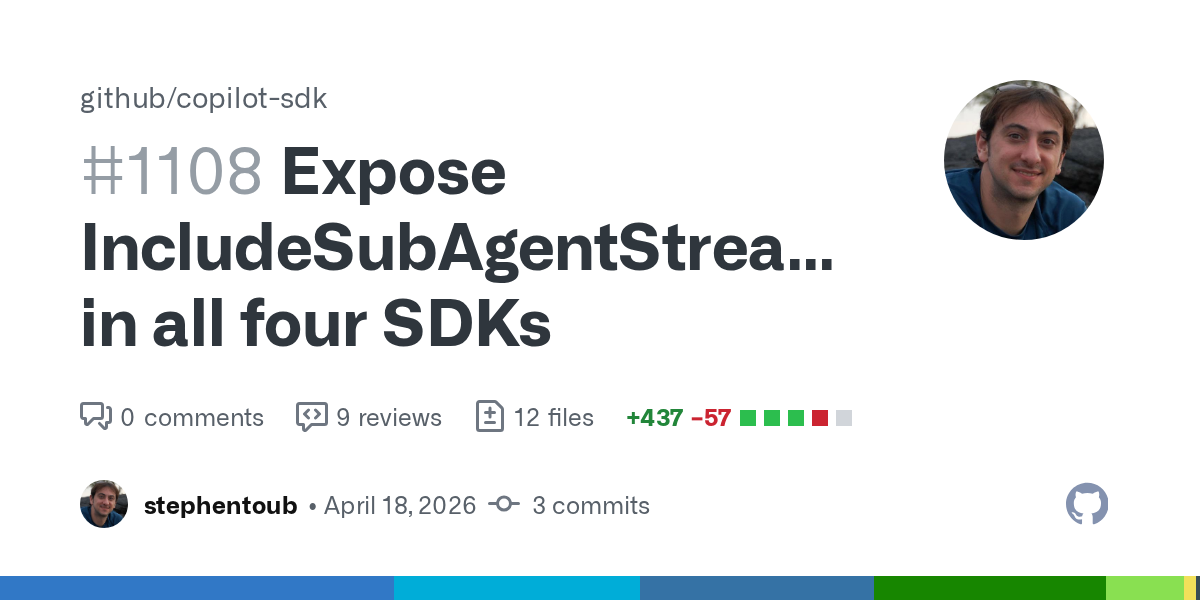
Here is the concrete change. In PR #1108, GitHub added an includeSubAgentStreamingEvents property to session configuration across all four Copilot SDKs: Node/TypeScript, Python, Go, and .NET. The property controls whether streaming delta events from sub-agents are forwarded through the client connection. Those events include things like assistant.message_delta, assistant.reasoning_delta, and assistant.streaming_delta when an agentId is attached. When the flag is set to false, clients still receive non-streaming sub-agent events and broader subagent.* lifecycle events. If the property is omitted, the default is true.
That last detail matters. GitHub did not add this as an exotic enterprise-only knob behind a side door. It added the option while keeping live sub-agent streaming as the default behavior. That tells you what the company thinks “normal” will look like in embedded agent products going forward. Not a request in, answer out model. A visible, ongoing, multi-agent session where the client may need to decide how much detail to show, suppress, or reshape.
There is a reason this matters beyond SDK trivia. The first generation of AI coding tools trained users to think in terms of completions and chats. The current generation is training them to think in terms of workflows. Plan, execute, validate, review, retry, hand off, resume. Once you adopt that frame, sub-agents stop being an implementation curiosity and start becoming part of the product surface. If several agents are doing different parts of a task, event design becomes user experience. The output stream is no longer just content. It is observability.
GitHub’s own surrounding product moves reinforce that reading. Copilot CLI has already been pushed toward a more runtime-like role with BYOK, local-model routing, autopilot, remote sessions, document attachments, and more explicit workflow control. The Copilot SDK README positions the SDK as a way to access the same engine behind Copilot CLI, with optional own-provider configuration and bundled CLI support in several languages. In other words, GitHub is not just shipping a chatbot API for code. It is giving developers a session runtime that increasingly assumes tool use, orchestration, and nested agent behavior.
Once that is the product, streaming policy becomes a first-class design problem. Too little visibility and users think the system is stuck, hallucinating progress, or hiding important behavior. Too much visibility and the client becomes unreadable, especially when nested agents emit token-by-token deltas simultaneously. The new property exists because GitHub knows integrators need a way to decide where that line should sit.
The deeper point is that the coding-agent market is converging on the same architecture even when the branding differs. OpenAI is spending release budget on trust gates, plugin controls, review semantics, and background task visibility in Codex. GitHub is hardening Copilot CLI and now making sub-agent streaming tunable in the SDK. Other vendors are doing their own versions through orchestration panels, tool permission layers, or multi-model review passes. Different packaging, same reality: these systems are becoming workflow runtimes with multiple actors, not single assistants with better autocomplete.
That shift should change how practitioners evaluate tools. A year ago, the obvious question was whether a coding assistant could write usable code. Today that is table stakes. The more useful questions are whether the system can show its work, whether it can break tasks into coherent units, whether it can recover state across sessions, and whether its event model is legible enough to support trust. A runtime that emits the wrong amount of information at the wrong layer can feel unusable even if the underlying model is excellent.
The implementation details from PR #1108 also reveal something about GitHub’s seriousness here. This was not a one-language patch. The change landed with test coverage across all four SDKs, checking both the default-true path and the explicit-false path for create and resume flows. The PR reports 437 additions, 57 deletions, and 12 changed files. That is a modest change set, but it is the kind of disciplined cross-SDK work you do when you are treating the event contract as product infrastructure, not a side experiment.
There is also an enterprise angle hiding in plain sight. As coding agents move deeper into professional workflows, embedded uses are going to matter more: internal developer portals, review dashboards, issue triage tools, secure coding surfaces, and custom orchestration consoles. Those environments do not all want raw live token streams from nested agents. Some will want a verbose operator console. Some will want only milestones. Some will want to preserve streaming for the primary agent but collapse sub-agent chatter into summarized lifecycle updates. The new flag does not solve all of that, but it provides the first necessary control surface.
If you build on top of these runtimes, the actionable takeaway is simple. Treat event design as product design. Decide what users need to see when a sub-agent spins up. Decide whether token-level reasoning deltas are helpful or just noise. Decide where to attribute work, how to surface agent identity, and what should be resumable later from logs or state snapshots. The default streaming behavior may be fine for a developer console. It may be terrible for a tool used by a broader engineering organization. The right answer depends on your interface, your audience, and how much trust the workflow needs to build live.
There is a market lesson here too. Vendors used to compete on model mystique. Increasingly they are competing on runtime ergonomics. The winner in coding agents is not going to be the company with the prettiest benchmark chart alone. It will be the one that gives developers and integrators the right balance of visibility, control, and recoverability as agent systems become more parallel and more autonomous. GitHub’s new sub-agent streaming knob is a small move, but it lands squarely in that fight.
My view: this is exactly the kind of boring-looking SDK change serious builders should pay attention to. It indicates that GitHub expects multi-agent behavior to be common enough that clients need explicit policy around how it appears in the stream. That is not a toy-product concern. That is a runtime-platform concern. And it is one more sign that the future of coding agents is going to be decided as much by event plumbing and workflow visibility as by model quality.
Sources: GitHub Copilot SDK PR #1108, commit 922959f, github/copilot-sdk README, GitHub Copilot CLI docs