GitHub Turns Merge-Conflict Cleanup Into a One-Click Cloud-Agent Workflow

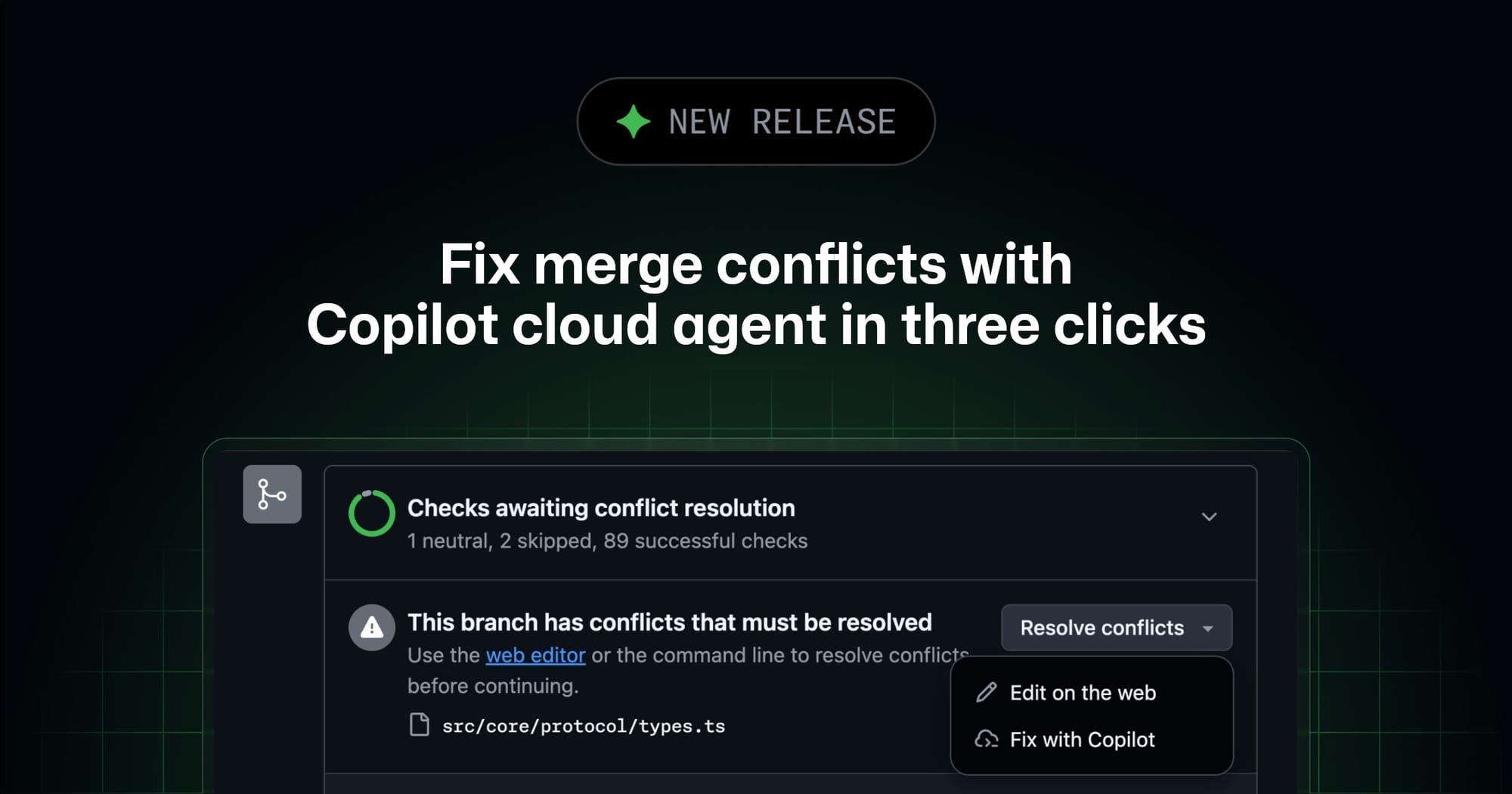
GitHub’s smartest move in agentic coding this month is not a benchmark, a new model, or another glossy demo about the future of software engineering. It is a button in the merge box.
That sounds small until you remember how much real development time gets burned on merge conflicts, especially the boring kind. Not the hairy architectural conflicts that deserve a human in the loop, but the routine branch drift that shows up after a long-running PR sits for a few days, another teammate lands a refactor, and someone now has to reconcile two sets of changes nobody is emotionally invested in. This is exactly the sort of work developers hate, managers underestimate, and platforms love to ignore until it becomes a friction tax on the entire workflow.
GitHub is no longer ignoring it. On April 13, the company added a new Fix with Copilot button for pull requests with merge conflicts, powered by Copilot cloud agent. Click it, GitHub prepopulates the request, Copilot resolves the conflicts in its own cloud environment, validates that the build and tests still pass, and pushes the result back to the branch for review. The same capability was already available through an @copilot comment, but turning it into visible UI matters more than the raw feature itself. This is GitHub converting agentic coding from prompt literacy into normal product behavior.
The boring work is where platforms get sticky
The most interesting part of this launch is what it says about where the market is heading. The last year of AI coding coverage has been dominated by the wrong scoreboard: benchmark deltas, model rankings, and demos where an agent builds a toy app or fixes a bug under ideal conditions. Those are useful signals, but they are not what makes a tool indispensable inside a working team. What matters is whether the product removes recurring pain from the actual development loop.
Merge conflicts qualify. They are common, tedious, and just risky enough that teams cannot safely ignore them. The conflict markers themselves are only half the problem. The real work is understanding intent, preserving behavior, re-running validation, and making sure the “fix” did not quietly break something adjacent. That is why GitHub’s implementation detail matters: according to the docs, Copilot cloud agent does not just patch the conflict markers and call it a day. It analyzes the conflicting changes, resolves them, and ensures that the build, tests, and linter still pass before handing the result back for human review.
That last part is the difference between a gimmick and a workflow. Plenty of products can offer “AI conflict resolution” as a text-generation trick. GitHub can offer it as infrastructure because it already owns the pull request, the branch state, the checks, the repository context, and the cloud execution environment. Copilot cloud agent runs in an ephemeral GitHub Actions-powered environment, which means GitHub can keep the entire task inside its own control plane rather than pretending your laptop is the only place development can happen.
GitHub is productizing the handoff, not just the generation
If you zoom out, this fits a pattern. GitHub has spent the past few weeks doing a series of unglamorous but strategically sharp updates around Copilot cloud agent. It added enterprise usage metrics for cloud-agent adoption. It sped up validation by running checks in parallel. It expanded mobile access. Now it is reducing one of the most annoying review-stage chores to a couple of clicks. None of these changes are individually headline-grabbing. Together, they tell a clearer story than any benchmark chart does.
GitHub thinks the future of coding agents is not just better generation. It is better handoff.
That is the correct read of the market. Developers do not need more evidence that models can emit code. They need a reason to trust the surrounding workflow. Can the agent work in the background? Can it leave a reviewable trace? Can it fit inside branch protection and CI habits? Can it shave time off the messy middle of software delivery instead of merely writing a first draft faster? A merge-conflict button is one answer to those questions, and a surprisingly good one.
There is also a quiet UX lesson here. The old @copilot comment flow was functional, but it assumed users knew the feature existed, remembered the syntax, and felt comfortable delegating work through a textual command. The new button removes all of that friction. Good platforms do this constantly: they take a capability that was available in theory and move it into the path of obvious use. If GitHub wants cloud agents to feel normal, this is exactly how it happens.
This is also a warning about where standalone agents are weak
Standalone coding agents still have real advantages. Many are faster-moving, more flexible, or better suited to local repo exploration. But GitHub’s merge-conflict workflow highlights the structural edge a platform owner has once agentic coding moves beyond code generation and into process automation.
Conflict resolution is not just a model problem. It is a state-management problem. You need visibility into the PR, the base branch, the checks, the permission model, and the review surface. GitHub owns all of those layers already. That makes it easier for the company to turn AI into a background operation attached to the existing developer lifecycle rather than a separate tool that developers have to remember to use.
That matters for competition. The coding-agent vendors that win long term are not necessarily the ones with the most impressive demos. They are the ones that capture the workflow chokepoints where developers already live. GitHub owns one of the biggest of those chokepoints: the pull request. If Copilot cloud agent keeps getting folded deeper into the PR lifecycle, from planning to validation to conflict cleanup, GitHub’s advantage stops being model quality and starts being workflow gravity.
Practitioners should treat this as a leverage tool, not a trust substitute
The right response from engineering teams is pragmatic. Yes, this feature is useful. No, it does not mean you should stop reviewing conflict resolutions carefully.
GitHub’s own docs frame Copilot cloud agent as an autonomous helper that can research repositories, create plans, fix bugs, improve test coverage, update docs, address technical debt, and resolve merge conflicts. That is a broad surface area. Broad capability is useful, but it also means teams need clear rules for where AI assistance ends and human judgment begins. Merge conflicts are one of those places where silent correctness matters more than syntactic correctness. The agent can preserve a green CI run and still miss the semantic intent of two competing changes.
So the operational advice is straightforward.
- Use this workflow first on repetitive, low-novelty conflicts, not on high-risk architectural merges.
- Keep branch protection, test coverage, and review standards intact. Faster conflict cleanup is only good if your guardrails still hold.
- Watch for where the agent saves time versus where it creates second-order review work. If reviewers spend longer revalidating AI-made merges, the time savings are fake.
- Document when developers should click the button and when they should resolve conflicts by hand. Teams that skip this step tend to drift into inconsistent trust models.
There is a broader lesson here too. Agentic coding is maturing into infrastructure, and infrastructure gets adopted when it removes toil. The industry spent too long treating AI coding tools like they needed to replace developers to be impressive. They do not. Turning a dreary, error-prone, context-heavy task into a reviewable background workflow is already a meaningful improvement.
That is why this launch matters more than it looks. GitHub is not promising that Copilot will write your entire system while you sleep. It is making one annoying part of collaborative software development slightly more automatic, slightly more visible, and slightly less costly. That is how platforms actually win. Not with magic, with friction removal.
The deeper editorial take is simple: the next phase of agentic coding will be decided less by who can generate the flashiest diff and more by who can absorb the ugliest chores in the development lifecycle without breaking trust. A button in the merge box is a very credible start.
Sources: GitHub Changelog, GitHub Docs: make changes to an existing pull request, GitHub Docs: Copilot cloud agent