GitHub’s Release Notes Now Credit the Human Behind Copilot PRs — Small UX, Big Accountability Signal

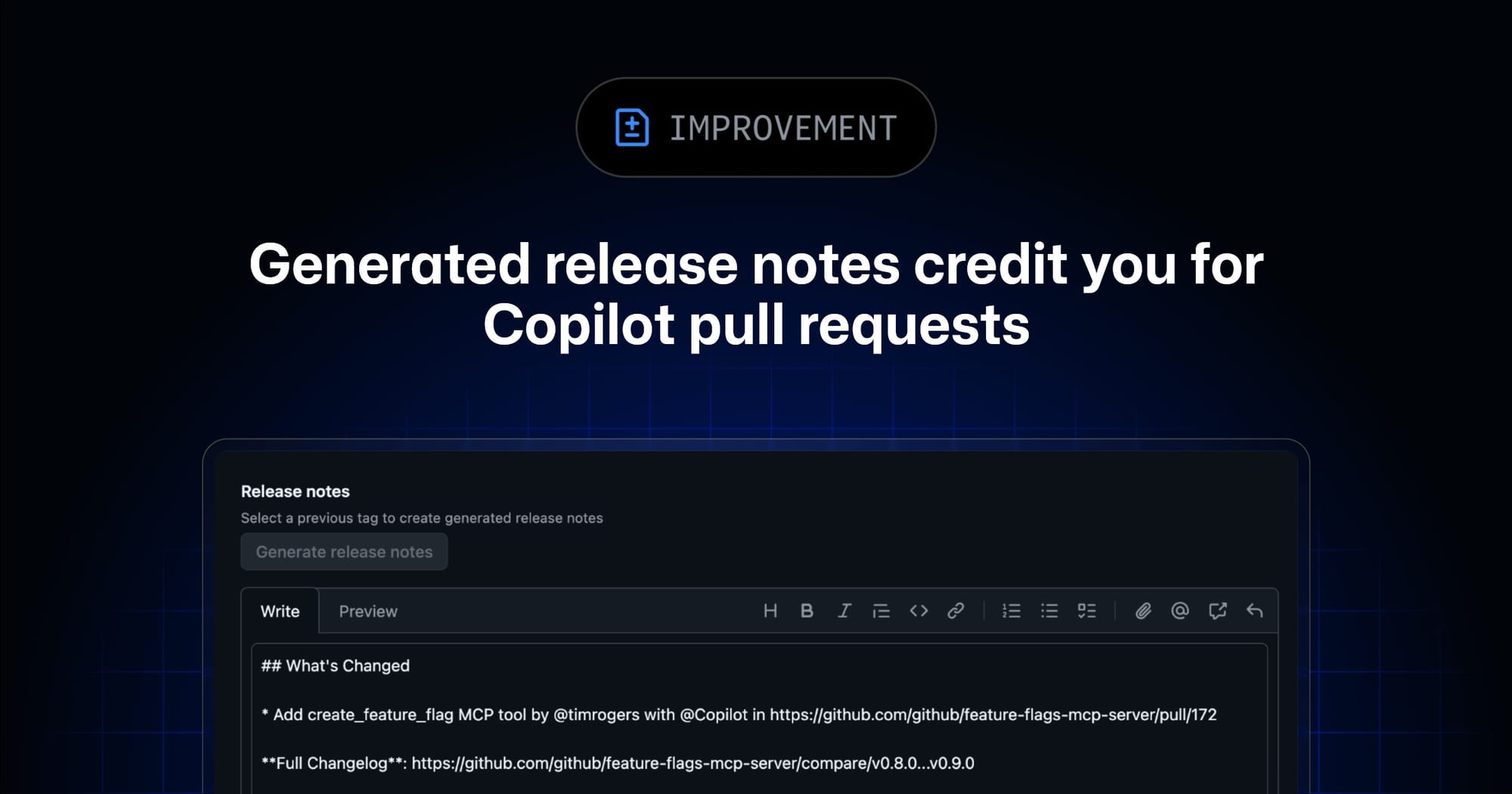
Attribution is the kind of product detail nobody cares about until it becomes the only thing that matters. GitHub’s latest generated-release-notes change looks tiny: when Copilot cloud agent opens a pull request, release notes now credit the human who asked for the work alongside @copilot. But small metadata changes are how platforms quietly decide what “ownership” means in an agentic development workflow.
The before-and-after example from GitHub is almost comically modest. A generated note that used to say Add create_feature_flag MCP tool by @copilot now says Add create_feature_flag MCP tool by @monalisa with @copilot. No new model. No new editor surface. No grand manifesto about the future of software. Just a release artifact preserving the human route back to the person who delegated, reviewed, and accepted the change.
That is exactly why it matters.
Release notes are not just ceremonial changelogs. For many teams, they are operational breadcrumbs: what changed, who touched it, which feature shipped, which regression might be related, and who should get pulled into the incident channel when something behaves strangely in production. If AI-created pull requests collapse that trail into a bot handle, the release record becomes less useful at the exact moment development is getting harder to audit.
The agent can write the patch; it cannot own the pager
GitHub says the change is available now for all repositories and all plans. The scope is narrow: it affects generated release notes for new releases when merged pull requests include PRs created by Copilot cloud agent. The generated note now credits the developer who had Copilot create the PR, while still acknowledging Copilot’s role.
That dual attribution is the right default. Listing only @copilot is technically descriptive but organizationally useless. Listing only the human would be cleaner for release notes but would erase a meaningful fact: an autonomous or semi-autonomous coding system participated in producing the change. “@monalisa with @copilot” preserves both facts without pretending the bot is an employee or the human is merely a passenger.
This distinction will matter more as cloud coding agents move from novelty to normal workflow. A Copilot-generated PR is not the same artifact as a hand-authored PR, but it is also not a magical external event. A developer selected the task, provided intent, accepted or modified the result, and merged the work through the repository’s controls. The human should get credit for that judgment. The human should also remain accountable for the merged change.
The industry keeps trying to find a comfortable verb for this work: prompting, delegating, supervising, reviewing, orchestrating. None of them are perfect. But release notes force the practical question: when users read about the shipped change, whose name should appear? GitHub’s answer is pragmatic: the person who asked Copilot to do the work, with Copilot visible as the tool that helped execute it.
Metadata becomes governance before anyone calls it governance
The most interesting part of this change is not recognition. It is downstream governance.
GitHub’s generated release notes already pull from merged pull requests, contributors, and full changelog links. Teams can customize categories and exclusions in .github/release.yml, including excluding labels, authors, or entire categories. Many repositories already use those controls to keep dependency bumps, bot updates, or housekeeping work from drowning out user-facing changes.
Agent-authored PRs complicate that filtering model. If a repo excludes bot authors too aggressively, does it hide Copilot-created work that a human actually requested? If release tooling groups contributors by GitHub handle, does agent-assisted work inflate bot contribution statistics while undercounting the engineers operating the system? If compliance evidence relies on release notes, does @copilot alone satisfy “who changed this?” Not really.
The better long-term model is provenance that can answer multiple questions at once. Who initiated the task? Which agent or tool produced the first PR? Who reviewed it? Which checks passed? Which files changed? Was the change made under an organization policy that allowed cloud-agent execution? GitHub’s release-note attribution is only one field in that larger record, but it is a visible one, and visible fields shape behavior.
There is also a measurement trap here. Engineering organizations will be tempted to classify Copilot PRs as “bot work” because it makes dashboards look clean. That is probably wrong. Agent PRs are delegated human work with an execution trace. Counting them as pure automation erases the human review and decision-making involved. Counting them as purely human hides the fact that a different production process produced the code. The useful metric is not “bot versus human.” It is “agent-assisted change, owned by a human, merged through normal controls.”
That wording is less catchy. It is also much closer to reality.
Teams should inspect their release-note config now, not after an audit
The practical work here is straightforward. If your team uses GitHub generated release notes and has started using Copilot cloud agent, generate a test release and inspect the output. Look specifically at PRs created by Copilot: does the human-with-Copilot attribution appear? Are your category rules preserving it? Are bot exclusions accidentally hiding the work? Do full changelog links still make it obvious which pull request introduced the change?
Then decide what you want release notes to mean in your organization. For public product releases, dual attribution is useful because users and maintainers can identify the responsible maintainer without losing agent provenance. For internal platform releases, it can help teams study whether agent-assisted changes behave differently: more review churn, faster cycle time, different failure modes, different test coverage. For regulated environments, it is one small part of a defensible audit trail.
Developers should also treat the attribution as a reminder, not a trophy. If your name appears next to a Copilot PR in generated release notes, you own the merged change. “The agent wrote it” is not a useful sentence during an incident. The right workflow is still boring: review the diff, understand the tests, check the edge cases, and make sure the release note says something a future maintainer can route.
GitHub’s changelog says the feature is available on all plans, which is good because this should not be an enterprise-only hygiene feature. Agent provenance is not only a Fortune 500 compliance problem. Open-source maintainers, small teams, and solo developers also need contributors and users to understand who stands behind a change.
The bigger trend is that agentic development is turning mundane metadata into product surface. Budgets, policy gates, MCP tool provenance, generated artifacts, release notes, authorship, review state — these are not administrative leftovers. They are how teams keep software development legible when more work is initiated in chat, executed by agents, and merged through automation.
GitHub did not solve AI coding governance with one attribution tweak. But it fixed a failure mode before it became normalized: release notes that credit the machine and lose the human. That is worth more than it looks like. The future of agent-assisted software will not be governed only by sandboxing and model choice. It will be governed by boring fields that tell the truth about who asked for the work, what tool did it, and who is willing to own it after it ships.
Sources: GitHub Changelog, GitHub Docs on generated release notes, GitHub Copilot plans