Google ADK's SkillToolset Lets Agents Write Their Own Expertise at Runtime

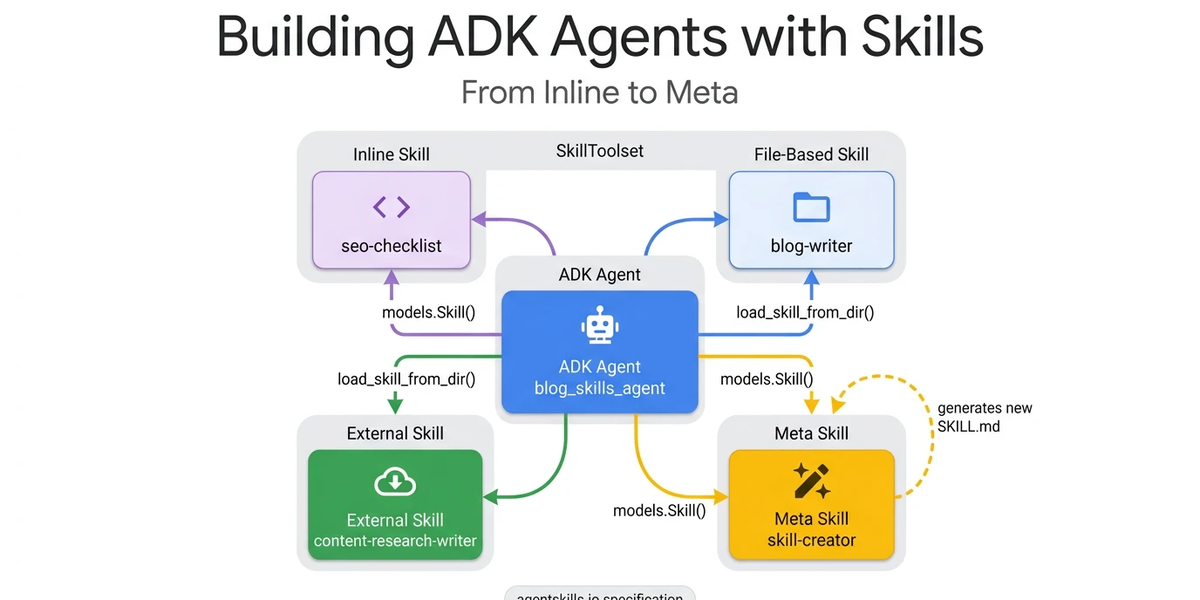
One of the persistent pain points in production agentic systems is token bloat: an agent equipped with ten capabilities burns thousands of tokens loading all of them on every single call, even when it only needs one. Google's ADK team has published a practical developer guide introducing SkillToolset, a progressive-disclosure architecture that directly addresses this problem. Instead of front-loading every piece of knowledge into a monolithic system prompt, SkillToolset breaks agent expertise into three token tiers: L1 Metadata (roughly 100 tokens, always loaded), L2 Instructions (loaded only when a skill is deemed relevant), and L3 Resources (loaded only when a skill is actively in use).
The guide walks through four concrete skill patterns: an inline checklist, a file-based skill, an external import, and the most ambitious one — a "skill factory" pattern where the agent writes brand-new skills on demand at runtime. This last pattern is a notable step toward genuinely adaptive systems: an agent that can extend its own knowledge base dynamically, rather than being constrained to whatever was specified at build time. The guide includes working code examples for each pattern, making it immediately actionable for teams already running on Google ADK.
Progressive disclosure for agent skills is the kind of infrastructure-level improvement that doesn't generate headlines but quietly determines whether a multi-capability agent system is viable in production. Token economics are real, and SkillToolset offers a principled architectural answer to a problem most teams currently solve with ad-hoc prompt trimming.