Google Beam Shows the Next AI UX Fight Is Still the Room

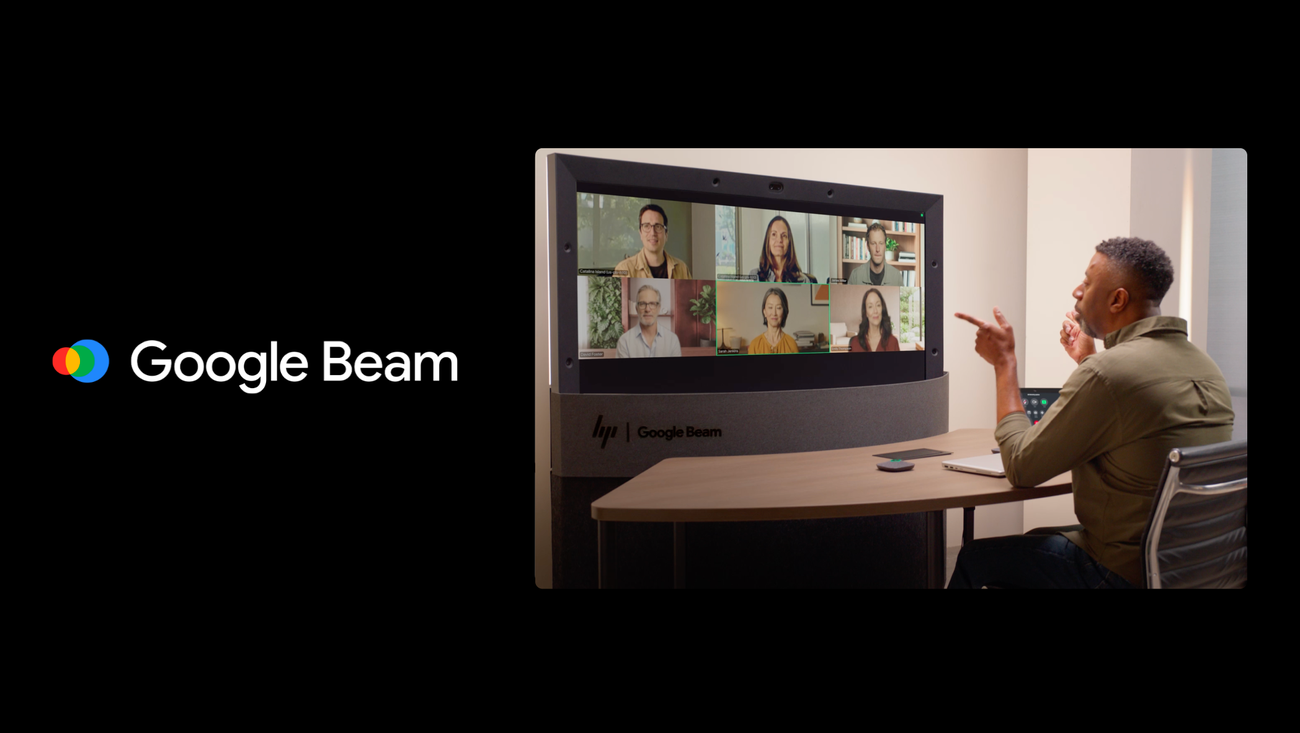
Google Beam is the kind of product engineers are tempted to dismiss on sight. It is hardware-heavy, enterprise-coded, and built for meeting rooms — three phrases that can drain the oxygen from a developer conversation faster than “digital transformation.” But Beam’s new group-meeting experiment is worth a second look because it makes a point the AI industry keeps forgetting: not every useful AI interface is a chat box.
The experiment, built around HP Dimension’s immersive display, renders participants who join from non-Beam devices at true-to-life size, positioned as if they are sitting around a table. Spatial audio anchors each voice to the person speaking. Google says this kind of approach can produce a 50% stronger sense of social connection and a 21% increase in reported ability to contribute to conversations. Those numbers need the usual research caveats, but the problem is real. Hybrid meetings still treat remote participants like postage stamps taped to the conference room wall.
Beam is the commercial descendant of Project Starline, Google’s long-running effort to make remote communication feel more physically present through AI volumetric video, 3D rendering, and specialized display hardware. The new group-meeting experiment matters because Starline’s original magic was easiest to understand in one-to-one conversations. Work, unfortunately, happens in messier rooms: three people at a table, two people on laptops, one person calling from home, someone trying to interrupt politely, and someone else silently calculating whether the remote colleague has been forgotten again.
The inclusion gap is a systems problem
The smartest part of the Beam update is that it does not pretend hybrid meeting failure is just a video-quality problem. Standard videoconferencing compresses human presence into a grid. It removes scale, gaze, turn-taking cues, spatial orientation, and much of the body language people use to decide when to speak. The person in the room can glance around the table and read social state. The person in the rectangle often has to barge in or disappear.
Rendering remote participants at true-to-life size is not cosmetic if it changes who gets included in the conversation. Spatial audio is not a gimmick if it helps the room map a voice to a person instead of to a speaker bar. The question is whether Beam can make remote participation socially legible to the people physically present in the room. That is a UX problem, but it is also a power problem. Meetings decide budgets, roadmaps, promotions, architecture choices, and whose objections are taken seriously.
Google’s earlier Project Starline research claimed more hand gestures, more head nods, more eyebrow movements, lower self-reported meeting fatigue, and faster post-meeting cognitive-task reaction times compared with traditional videoconferencing. The new Beam post adds the 50% social-connection and 21% contribution claims. None of that proves Beam will become a mass-market collaboration platform. It does suggest that presence is measurable enough to optimize, which is more interesting than another meeting-summary bot pretending to fix work.
AI hidden in the display stack
The Beam story also usefully widens the definition of AI product design. The current market is obsessed with visible AI: assistants, sidebars, copilots, agents, prompt boxes, generated summaries. Beam is AI that mostly disappears into the communication medium. The model work happens in volumetric reconstruction, rendering, perception, compression, and scene presentation. If it works, users should not praise the model. They should feel like the meeting was less broken.
That is a healthier product ambition than many AI launches. A good AI feature does not always need to announce itself. Sometimes it should reduce friction so completely that the user only notices the outcome: fewer interruptions, less fatigue, better participation, less travel, better trust between teams. For enterprise software builders, Beam is a reminder that the interface layer still matters. Adding an LLM to a bad workflow is often just a faster way to generate bad workflow artifacts.
The integration details will decide whether this is a serious product or a beautiful executive-suite appliance. Google says it is continuing to work with Google Workspace and Zoom to elevate meetings on Beam. That is mandatory. No enterprise wants a magical room that only works when every participant changes their calendar habits. Beam also needs admin controls, identity integration, room scheduling, network requirements that do not make IT cry, accessibility support, compliance and recording policies, support contracts, and a cost model that does not restrict it to boardrooms.
There is also a deployment asymmetry problem. If Beam rooms make the people in the room feel more connected to remote participants, great. If they make non-Beam participants look acceptable but still leave them with a worse experience on ordinary laptops, the system may reinforce hierarchy rather than reduce it. The best version of Beam is not “the fancy room wins.” It is graceful degradation: the room gets better without punishing everyone outside it.
What teams should actually watch
Practitioners should ignore the sci-fi sheen and ask operational questions. What is the room footprint? What bandwidth does it need? How does it behave with poor lighting or cheap webcams on the remote side? Can it work across Zoom and Workspace without awkward mode switches? How does it handle recordings, transcripts, captions, and participants with disabilities? Can admins manage it like normal collaboration infrastructure, or does it require a specialist every time a meeting starts five minutes late?
For product teams, the broader lesson is to stop treating “AI UX” as synonymous with text generation. Beam is attacking the meeting substrate itself. That may be expensive and niche today, but the direction is sound: AI should reshape interfaces where the existing interface is the bottleneck. In hybrid work, the bottleneck is not lack of summaries. It is social presence, attention, and whether remote people can participate without performing extra labor to be noticed.
The skepticism is still warranted. Google has not published enough detail about study design, sample size, price, availability, or independent validation. Enterprise telepresence has a long history of impressive rooms that never escaped the budget tier where executives “collaborate” with other executives. Beam has to prove it can become infrastructure, not theater.
But the product instinct is good. The AI world keeps shipping assistants that talk more. Beam is trying to make a room listen better. That is the more interesting bet.
Sources: Google Research, Google Beam, Project Starline research