Google Is Trying to Make DESIGN.md the README for AI-Native UI Systems

AI-generated UI has a memory problem. The models can sketch a landing page, generate a dashboard, or spit out a component tree on command, but the second you ask for iteration, the cracks show. The colors drift. The spacing logic gets fuzzy. The accessibility decisions evaporate. The rationale behind the design system disappears, and the team ends up re-explaining the same taste, brand, and layout constraints every time the agent wakes up. That is the real problem Google is trying to solve with DESIGN.md, and it is more important than the tiny Stitch announcement makes it sound.
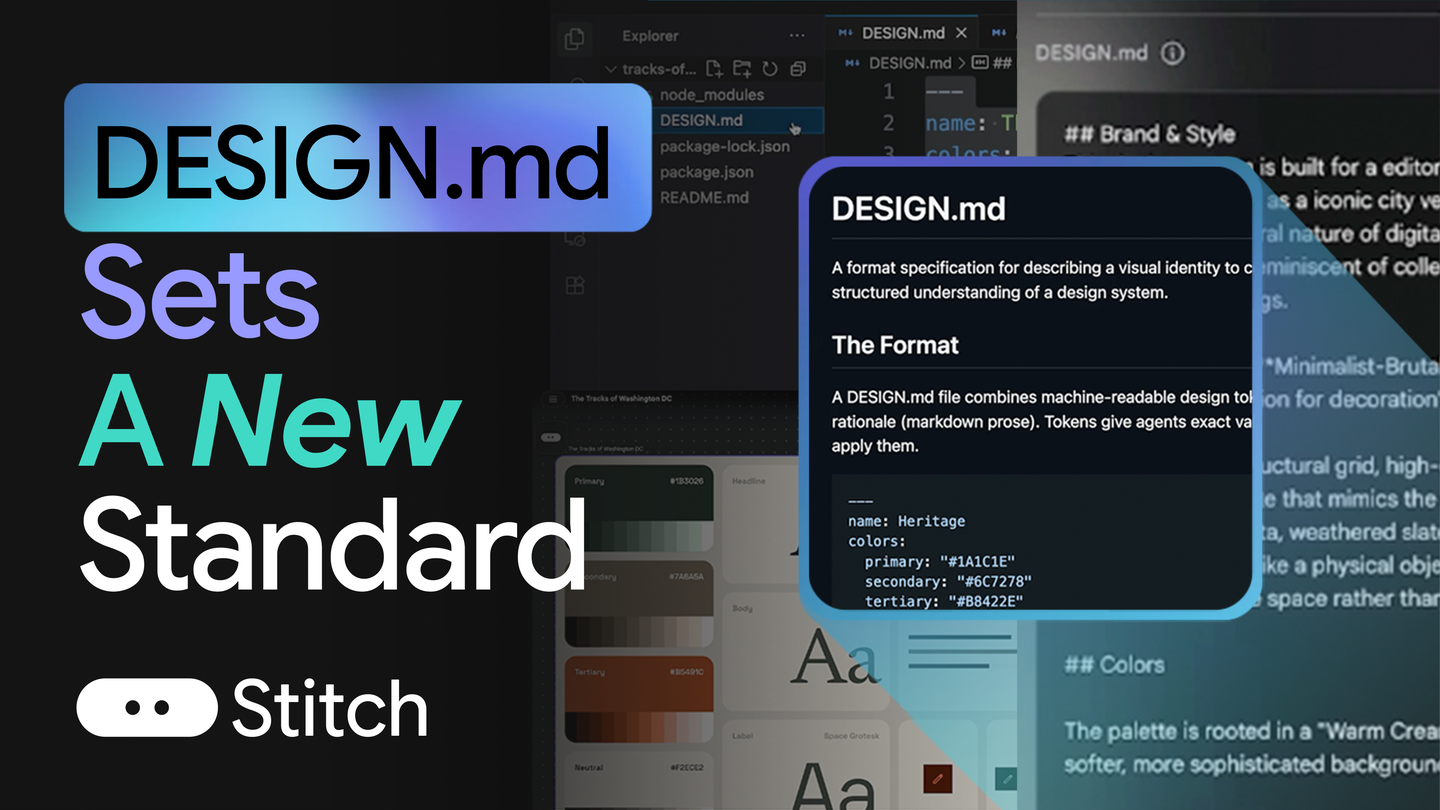
Google Labs has open-sourced the draft specification for DESIGN.md, a format meant to describe a visual identity to coding and design agents. The file combines YAML front matter for machine-readable design tokens with markdown prose for human-readable rationale. In plain English, it tries to store both the values and the judgment. Tokens tell an agent what the primary color is. Prose tells it why that color exists, when to use it, and what the system is supposed to feel like.
That may not sound glamorous, but it is exactly the kind of plumbing AI-native product design needs. Most current tooling treats design context as disposable prompt text. That works for demos and fails for systems. A persistent format that can travel with a project is a far more credible answer than forcing designers and developers to rebuild context from memory on every run.
Design tokens alone were never enough
The smartest part of this spec is that it does not stop at token export. Plenty of existing tools can move colors, typography, spacing, and radius values between systems. That is useful, but incomplete. Design systems do not usually break because somebody lost a hex code. They break because the team loses the reasoning behind the choices. Why is this accent color reserved for action instead of decoration? Which type styles signal hierarchy versus metadata? What kind of visual mood is the interface meant to sustain?
DESIGN.md tries to preserve that layer. Google’s example shows exactly the split that makes the format interesting: YAML for tokens such as colors.primary, typography scales, rounded corners, and spacing, followed by markdown sections like Overview, Colors, Typography, Layout, Shapes, Components, and Do’s and Don’ts. The file is not just a bundle of variables. It is part style dictionary, part design review note.
That matters because AI agents need more than facts. They need constraints plus intent. A coding agent can generate a button with the right background color and still get the product wrong if it does not understand whether the brand wants quiet seriousness, playful motion, or sharp editorial contrast. By pairing structured values with prose, Google is effectively treating design context the way good engineering teams treat architecture docs: the system should store not only what exists, but why.
The CLI tells you this is meant to be workflow infrastructure
The open-source repo already ships a command-line tool with lint, diff, export, and spec commands. That detail is easy to skim past. Do not. A spec becomes real when teams can validate it, compare revisions, and export it into other ecosystems without handwork.
The linter checks for broken token references, missing primary colors, missing typography, poor contrast ratios, orphaned tokens, and section-order issues. It can surface structural findings as JSON, which makes the output machine-actionable. This is not an accident. Google is designing the format so agents can consume it, reason over it, and react to validation failures programmatically.
The export path is equally telling. DESIGN.md can already export to Tailwind theme config and DTCG tokens.json, which means Google is not positioning this as a Stitch-only file trapped inside one product. At least in theory, the goal is portability. That is the only way this becomes meaningful outside a Google demo.
There is also a subtle accessibility argument embedded in the launch. Google explicitly says agents can validate choices against WCAG rules. That is more consequential than it sounds. AI-generated design has a bad habit of making things look plausible before anyone checks whether the contrast is readable or the hierarchy is sane. If the context file itself bakes in validation and normative structure, accessibility has a better chance of surviving automated generation.
The real fight is whether this becomes shared plumbing or vendor syntax
At launch, the GitHub repository had roughly 554 stars, which is a healthy day-one signal for something this nerdy. That does not make it a standard. It makes it interesting. Specs win when enough tools adopt them that teams stop thinking about the format and start relying on the interoperability.
That is the hard part ahead. Every AI design and coding vendor would love to be the home of project context. Fewer of them want to accept somebody else’s format as common infrastructure. Google deserves credit for open-sourcing the draft instead of keeping it locked inside Stitch, but the market question is bigger than Google’s intentions. Will other agentic design tools read DESIGN.md? Will code-generation tools preserve the prose layer instead of stripping the file down to tokens? Will teams treat it like a living artifact in version control, or will it become one more experimental file that quietly rots?
The answer depends on whether practitioners feel the pain strongly enough. My guess is yes. AI-native UI tools are getting good enough that inconsistency, not raw generation, is becoming the bottleneck. The next wave of value is not another pretty mockup. It is statefulness. Teams want agents that remember the house style, preserve the system, and stop improvising like interns who forgot the brand guide existed.
What builders should do next
If you build with AI-assisted design or frontend generation, this is worth piloting now, even if the spec changes. Start by creating a small DESIGN.md for one product surface, not your entire organization. Put in the core color system, typography tokens, component intent, and a short overview that explains the desired feel in plain language. Then run your agents against it and compare the output with and without the file. Measure not only visual quality, but consistency across iterations.
Second, treat the prose seriously. The temptation will be to dump in tokens and call it done. That misses half the value. The whole point is to give agents access to rationale. Document what makes your design system opinionated. What is the accent color reserved for? What kinds of motion or decoration are discouraged? Where should the interface feel dense, quiet, playful, or editorial? That is the stuff teams currently lose between prompts.
Third, wire validation into review. If the linter catches broken references or WCAG contrast issues, make that part of the same quality loop as tests and code review. AI-assisted design should not get a free pass on rigor just because the output looks polished in a screenshot.
My take is simple: DESIGN.md is not important because Google said so. It is important because the industry keeps pretending model intelligence can compensate for missing project memory. It cannot. Good interfaces come from durable context, clear constraints, and taste that survives iteration. If DESIGN.md helps make that context portable across tools, it has a shot at mattering. If it stays trapped as Stitch-adjacent branding, it will become another forgotten mini-spec. But the need it addresses is real, and real needs tend to find a format eventually.
Sources: Google Blog, google-labs-code/design.md on GitHub, Google Blog (Stitch)