Google’s TPU 8t and 8i Signal That the AI Hardware Stack Is Splitting in Two

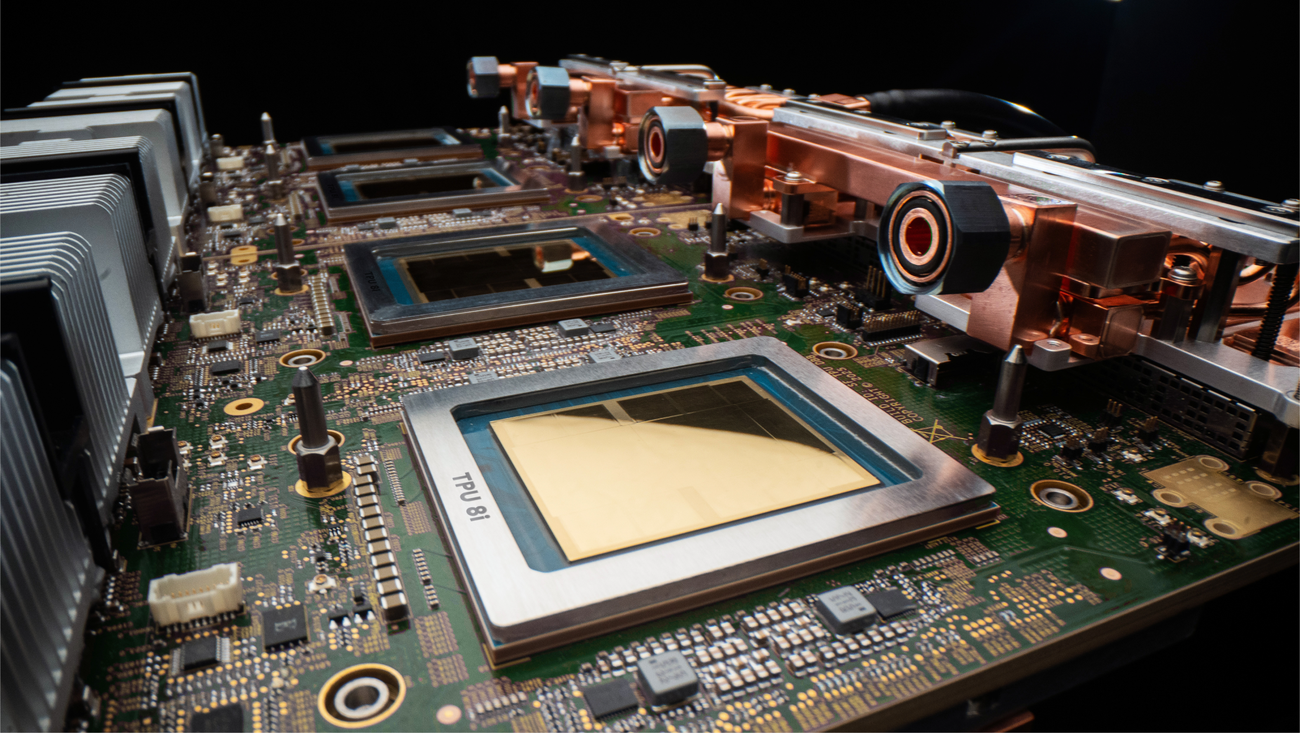
Google’s eighth-generation TPU announcement is one of those infrastructure launches that reads much smarter if you ignore the “agentic era” paint job for a minute and focus on the engineering choices underneath. The interesting part is not that Google built bigger chips. Everyone builds bigger chips. The interesting part is that Google split the stack more explicitly than usual, with TPU 8t for training and TPU 8i for inference and reasoning-heavy serving. That is a real architectural claim about where AI workloads are heading.
Google is effectively saying the old assumption, that a single general-purpose accelerator family can elegantly span frontier pre-training, post-training, and production inference, is breaking down. Training giant models and serving reasoning systems now stress different bottlenecks hard enough that specialization wins. That is the kind of statement that matters more than one more exaflops number on a keynote slide.
The headline specs are large enough to satisfy the launch-day spectacle. Google says TPU 8t scales to 9,600 chips in a superpod, with two petabytes of shared HBM and 121 exaflops of compute per superpod. It claims nearly 3x compute performance per pod over the previous generation, 10x faster storage access, and near-linear scaling up to one million chips when paired with Virgo Network, JAX, and Pathways. On the inference side, TPU 8i gets 288 GB of HBM, 384 MB of on-chip SRAM, 19.2 Tb/s of ICI bandwidth, a Boardfly topology that reduces network diameter by more than 50%, and a Collectives Acceleration Engine that cuts on-chip collective latency by up to 5x. Google also claims 80% better performance-per-dollar and up to 2x better performance-per-watt versus the previous generation.
Those are big numbers, but the numbers are not the best part of the announcement. The best part is the vocabulary. Google keeps talking about goodput, bandwidth, storage access, memory locality, all-to-all latency, network diameter, and performance-per-dollar. In other words, it is describing the real failure modes of production AI infrastructure instead of pretending peak FLOPS alone decides anything.
The split says a lot about how Google thinks inference is changing
TPU 8t is the easy one to understand. Frontier training keeps demanding larger clusters, faster storage, better utilization, and more forgiving failure handling. Google’s 97% goodput target is especially notable because it frames performance the way operators actually experience it. A trillion-parameter training run does not care what the peak theoretical throughput was if network stalls, storage starvation, or checkpoint churn keep eating days. Goodput is a more honest metric because it measures useful compute time, not marketing optimism.
TPU 8i is the more revealing product. Its design choices point directly at the inference profile of modern reasoning systems: long context, large KV caches, communication-heavy Mixture-of-Experts behavior, sequential decoding, and workloads where many agents or subroutines may need to coordinate under latency pressure. That is why the extra SRAM matters. That is why the Collectives Acceleration Engine matters. That is why the network topology matters. Google is not optimizing for generic “LLM serving.” It is optimizing for the messy reality where reasoning systems spend a lot of time waiting on memory and synchronization unless the hardware is explicitly designed to keep them moving.
The technical deep dive makes that even clearer. Google frames the infrastructure challenge as a shift from dense LLMs to MoEs, world models, and reasoning-heavy architectures. It highlights native FP4 on TPU 8t, SparseCore for embedding-heavy operations, Axion CPU hosts to remove data-prep bottlenecks, and Boardfly on TPU 8i to reduce hop counts for communication-intensive workloads. None of that reads like generic capacity expansion. It reads like a company that has seen enough real training and serving pain to know where the old assumptions stop working.
This is also a bet that “agentic” AI changes hardware economics
The industry talks about agents far too loosely, but Google’s hardware story gives the term at least one concrete meaning. If future workloads involve longer chains of reasoning, more iterative execution, more tool calls, more context retention, and more coordination across specialized model components, then the infrastructure bottlenecks shift upward from raw matrix math toward memory bandwidth, cache behavior, collective operations, and tail latency. A chip family designed around that assumption could age better than one designed mainly to win yesterday’s training benchmarks.
That matters even if you never rent a TPU pod. Hardware design leaks upward into software architecture and price curves. If Google can make reasoning-heavy inference materially cheaper or more efficient, then more products become economically viable: deeper background agents, more aggressive test-time compute, longer-context assistants, and higher-concurrency enterprise systems that would otherwise be too expensive to serve. The hardware decision today becomes the product decision twelve months later.
The other strategic point is that Google is using specialization to make a platform argument against one-size-fits-all accelerator economics. NVIDIA’s advantage has been enormous precisely because CUDA and a broad-purpose accelerator story reduced the need for users to reason too much about workload-specific silicon. Google is countering with a claim that enough AI value now comes from tightly co-designed infrastructure, silicon, host CPU, storage path, network, software stack, that specialization is not only acceptable but necessary. That is a strong claim. It may also be right for the top end of the market.
Still, practitioners should keep two caveats in view. First, most developers will not touch TPU 8t or TPU 8i directly in a hands-on way. These products matter downstream through cloud services, model pricing, and workload characteristics more than through direct hardware intimacy. Second, “built for the agentic era” is still marketing language unless it cashes out in measurable serving economics and developer experience. Google has provided more substantive evidence than usual here, but the proof will come from real availability, pricing, framework support, and how these systems perform under messy workloads rather than launch demos.
So what should engineers do with this information? If you run large-scale training, pay close attention to goodput, storage path design, and scale-out network behavior, because Google is telling you those are becoming first-order differentiators. If you build inference systems, especially MoE or reasoning-heavy ones, look harder at memory locality and collective latency rather than fixating on generic token throughput. If you are selecting cloud platforms, ask how the provider’s hardware story maps to your workload shape instead of assuming all accelerators are substitutable. They increasingly are not.
My take is that Google’s smartest move here was not launching a new TPU generation. It was admitting that the AI stack is splitting into distinct hardware problems. Training wants scale, stability, and productive utilization. Reasoning-heavy inference wants memory, coordination, and low-latency communication. Packaging both under one generic accelerator narrative would have been simpler marketing. Building for the divergence is better engineering.
Sources: Google Blog, Google Cloud technical deep dive, Hacker News discussion