GPT-5.6 Luna Won the Usage Race. The Real Shift Is Model Routing

The most important model leaderboard result this week is not that OpenAI took first place. It is that the models winning production traffic increasingly look unlike the models winning blind preference tests.
GPT-5.6 Luna moved to the top of OpenRouter’s weekly usage table with 18.18 trillion prompt-and-completion tokens, up 40.5% from the preceding period. Tencent’s Hy4 preview, the former leader, still grew 14.6% to 16.82 trillion tokens. This was not a collapse by the incumbent; it was a faster-growing challenger passing a model that was itself adding traffic.
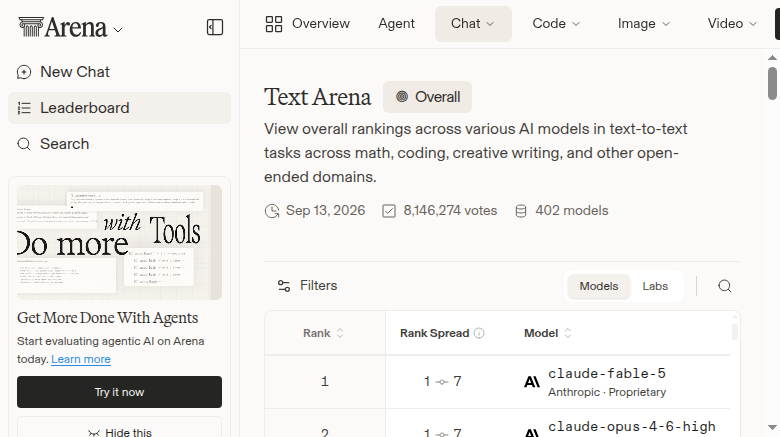
Meanwhile, Arena’s preference leaderboard remains heavily concentrated among Anthropic and Meta-branded models. Claude Fable 5 holds first place, followed by Claude Opus 4.6 High and Claude Opus 4.7 High. Muse Spark 1.2 xHigh climbed to fourth, displacing Claude Fable 5.1 Max, while the new Muse Spark 1.3 Max appeared at eighth. OpenAI’s highest entry in the top 20 is GPT-5.6 Sol xHigh at number 18.
Put those tables side by side and the usual “best model” question starts to look underspecified. Arena asks which answer people prefer in a controlled, pairwise comparison. OpenRouter records which models actually receive routed workloads inside one large marketplace. One is closer to a taste test; the other is closer to a utility meter. Neither is the whole market, but the disagreement between them is useful.
Luna won on economics as much as capability
Luna’s pricing helps explain how a model can dominate traffic without dominating preference rankings. OpenRouter lists it at $0.20 per million input tokens and $1.20 per million output tokens, with a roughly 1.05-million-token context window and up to 128,000 output tokens. Hy4 preview costs $0.834 per million input tokens and $2.501 per million output tokens, while offering a similarly large context window and a 64,000-token maximum output.
That makes Luna’s listed input price about 76% lower and its output price about 52% lower than Hy4’s. At small scale, the difference is a rounding error. At trillions of tokens, it becomes architecture. A team running repository analysis, document extraction, agent traces, or long-context classification can tolerate a modest quality gap if the cheaper model clears the required accuracy threshold. Production systems optimize for acceptable outcomes per dollar and per second, not applause per response.
Hy4 is hardly an obsolete alternative. It is a 770-billion-parameter mixture-of-experts model with 49 billion active parameters, and its continuing growth shows that developers still find it useful. But the head-to-head illustrates why parameter count and leaderboard aura are weak purchasing guides. Buyers see an API contract: price, latency, context capacity, reliability, and whether the answer survives their tests. The internals matter only when they change one of those outcomes.
The growth below first place is the stronger signal
Xiaomi’s MiMo-V2.5 stayed at number five on OpenRouter, yet its usage jumped 230% to 7.77 trillion tokens. Gemini 3.8 Flash rose 139% to 2.56 trillion and entered the top 10. Muse Spark 1.3 Contributor grew 137%. These are not marginal fluctuations. They show workloads spreading across a widening group of fast and economical models even when their ordinal rank barely changes.
DeepSeek V4.1 Flash is the clearest example. It reached sixth place with 4.94 trillion tokens only days after appearing in OpenRouter’s catalog on September 10. It is listed at $0.15 per million input tokens and $0.60 per million output tokens, supports a 1,048,576-token context window, and is available through 16 providers. DeepSeek now owns four of OpenRouter’s top 20 positions.
Provider breadth deserves more attention than it gets. Sixteen providers do not guarantee identical latency or behavior, but they create options for failover, regional placement, price competition, and capacity management. For an agent that must finish a batch overnight—or a customer-facing workflow that cannot simply return “model overloaded”—availability can be worth more than a few benchmark points.
The broader top 20 is fragmented: four DeepSeek models, three from Z.ai, two from OpenAI, two from Anthropic, plus entries from Tencent, Google, Meta, NVIDIA, Upstage, Moonshot, MiniMax, and Xiaomi. That distribution looks less like a platform winner taking all and more like a database market, where teams choose different engines for different workloads and keep an abstraction layer nearby.
Stop paying for one default model
For engineering teams, the practical response is not to replace this week’s default with next week’s leader. It is to treat model selection as a routing problem.
Start by separating task classes. Extraction, summarization, code transformation, tool selection, customer-facing prose, and high-stakes reasoning should not share one undifferentiated benchmark. Measure exact task success, structured-output validity, tool-call accuracy, latency at the 50th and 95th percentiles, and retry frequency. Then calculate effective cost per successful task. A model that is 30% cheaper per token but causes twice as many retries is not cheaper.
When a model combines triple-digit traffic growth, competitive pricing, and multiple providers, it has earned an internal evaluation—not an automatic migration. Shadow 1% to 5% of real traffic, scrubbed and permissioned appropriately, and compare it against the incumbent. Keep the prompts and scoring stable. Watch failure modes by task category instead of averaging them into one flattering number.
Teams should also record why the router chose a model. Without decision logs, a multi-model stack becomes impossible to debug: an incident can look like prompt drift when it is really a provider change, or like model regression when a fallback path silently took over. Routing is infrastructure, and infrastructure needs observability.
Arena still matters. Its 8.1 million-plus votes provide a broad signal about what humans prefer, and its current table shows Anthropic’s strength at the high end. But preference is not reliability, and a chat comparison does not price the answer. OpenRouter usage also needs caveats: it excludes first-party and much enterprise traffic, token volume favors long-context and verbose workloads, and tokens are not users, requests, revenue, or satisfaction. The current Arena interface did not expose trustworthy Elo or vote counts per model, so rank order is the responsible limit of the comparison.
The useful conclusion is narrower and more durable than “Luna is best.” Model quality has become sufficient across enough vendors that economics, redundancy, and workload fit can move trillions of tokens in a week. The premium preference leaders will remain important for hard tasks. But the fastest-growing production traffic is telling builders to reserve premium intelligence for the places where it changes the outcome—and route the rest with the same discipline they already apply to storage, compute, and network calls.
GPT-5.6 Luna took the usage crown. The actual winner is the engineering practice of refusing to confuse a leaderboard with an architecture.
Sources: OpenRouter weekly rankings, Arena Text leaderboard, GPT-5.6 Luna model page, DeepSeek V4.1 Flash model page