GPT-6.1 Sol's 464% Surge Is a Migration Signal, Not a Crown

A leaderboard can look frozen while the market underneath it is changing fast. OpenRouter’s top five models held their positions this week, and no model entered or left the top 20. Yet one line near the bottom tells the more useful story: GPT-6.1 Sol is still ranked twentieth, but its trailing-seven-day token volume jumped 464%.
That is not evidence that GPT-6.1 Sol is the “best” model. It is evidence that developers have started moving serious traffic toward it. The distinction matters, especially in an industry that routinely turns every chart into a horse race.
OpenRouter counted 1.56 trillion tokens for GPT-6.1 Sol in the week through October 8, up from 1.4 trillion in the previous daily snapshot and more than five times the preceding week’s volume. At the same time, GPT-5.6 Sol fell three places, from fifteenth to eighteenth, despite eking out 4% weekly growth. GPT-5.6 Luna held fourteenth place but lost 73% of its weekly volume. This is the shape of a migration beginning, not a coronation ending.
A trillion tokens can still be a misleading unit
OpenRouter’s rankings measure prompt and completion tokens processed through its API in daily UTC buckets. Private requests are excluded, and free and paid versions may appear separately. That makes the table a useful view of routed activity, but a poor substitute for quality, customer count, revenue, or successful tasks.
Token totals reward several things that have nothing to do with answer quality. A long-context document pipeline can consume more tokens than thousands of short coding questions. An agent stuck in a loop can look like enthusiastic adoption. A verbose model can outrank a concise one while doing exactly the same work less efficiently. Even tokenizer differences make model-to-model comparisons imperfect.
The scale gap is nevertheless informative. DeepSeek V4.1 Flash remains first with 35.6 trillion tokens, up 51% week over week. That is roughly 22.8 times GPT-6.1 Sol’s volume. Space Bunny Alpha remains second at 22.8 trillion tokens even after contracting 26%, while GLM 5.3 Flash and Xiaomi’s MiMo-V2.6-Flash sit close together at 10.8 trillion and 10.5 trillion respectively. The leaders are not just winning a popularity poll; they appear to be carrying large, established workloads.
Rank is a lagging indicator because OpenRouter uses a trailing seven-day window. Space Bunny Alpha can lose more than a quarter of its weekly momentum and remain second on the strength of its accumulated base. GPT-6.1 Sol can grow 464% and remain twentieth because it started much smaller. Absolute volume answers “where is the traffic?” Growth answers “what should we investigate next?” Teams need both, and should confuse neither with “what should we deploy?”
The migration is happening inside model families
The most credible reading of this week’s data is generational churn within OpenAI’s portfolio. GPT-6.1 Sol’s acceleration arrives alongside GPT-5.6 Luna’s sharp contraction and GPT-5.6 Sol’s three-place slide. The public numbers cannot prove that the same applications switched endpoints, but platform teams should treat the pattern as a prompt to test rather than a mandate to migrate.
Claude Opus 5.5 supplies a useful comparison. Its 3.83 trillion tokens are up 85% week over week, placing it ninth—more than twice GPT-6.1 Sol’s volume, but far below the top tier. That combination suggests both momentum and an existing production footprint. It does not tell us whether teams are using Opus for difficult, high-value tasks, batch generation, agent loops, or simply longer outputs. Popularity data can show demand without explaining it.
There is another signal hiding at the provider level. DeepSeek holds first place plus eighth and twelfth with older Flash variants. Z.ai holds third, eleventh, and seventeenth. Looking only at individual model ranks understates provider concentration. Three apparently distinct fallback choices can still share billing infrastructure, policy controls, capacity constraints, or an outage domain.
That matters for routers. A fallback chain made of three versions from one vendor is version diversity, not operational diversity. Teams building resilient AI features should group models by provider and dependency domain, then make sure at least one fallback crosses that boundary. Otherwise the neat routing diagram collapses the moment the provider has a regional incident, changes a safety policy, or revises pricing.
Use the leaderboard to choose experiments, not winners
For engineering teams, the right response to a 464% usage spike is a controlled evaluation. Freeze explicit model identifiers in production rather than silently following a moving alias. Replay a representative task set against GPT-6.1 Sol and the incumbent. Measure task success, p50 and p95 latency, tool-call correctness, retries, generated-token count, and cost per successful outcome. If the application uses structured output, include schema-validity and repair rates; if it uses agents, cap turns and measure loop frequency.
Then canary real traffic with a reversible allocation. Five percent is often enough to expose latency tails, content-policy differences, and tool integration failures that offline tests miss. Log the selected model, provider, prompt version, token usage, latency, and a task-level outcome. Without that last field, a routing dashboard becomes an expensive chart of activity rather than a system for making decisions.
Teams should also normalize comparisons around completed work. Cost per million tokens is convenient procurement math, but cost per resolved support ticket, accepted code change, or correctly extracted document is what the product actually buys. A model that emits fewer tokens and needs fewer retries may be cheaper even with a higher list price. Conversely, a cheap model that triggers long loops can inflate both token usage and operational risk while climbing a usage leaderboard.
The stable top five offers a final operational lesson: market share and momentum move on different clocks. Mature models accumulate integrations, cached prompts, evaluation suites, and organizational trust. New models accumulate experiments. The transition from the second category to the first is visible only after teams promote successful canaries and retire older endpoints. This week’s OpenAI numbers look like that process starting, not finishing.
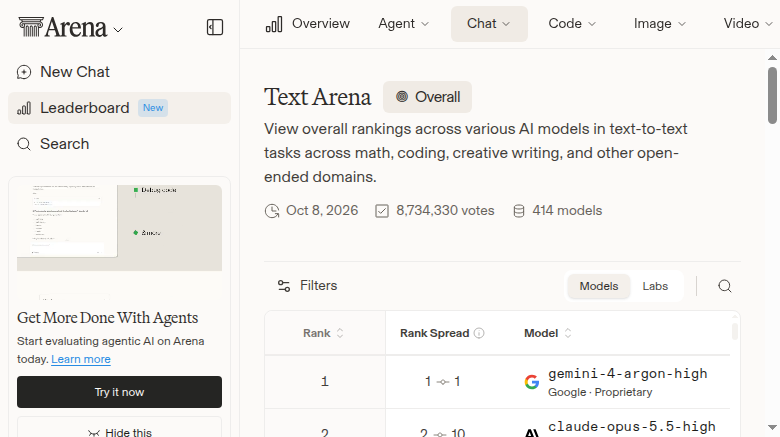
Arena’s leaderboard is useful context because it measures comparative human preference rather than routed usage. The current Text Arena page shows 414 models and more than 8.7 million votes, but the automated research run could not extract a verifiable Text or Code Elo table; it surfaced an agent ranking instead. We are not filling that gap with stale rows. Usage and preference answer different questions, and an unavailable cross-check should remain visibly unavailable rather than become invented certainty.
The verdict is straightforward: GPT-6.1 Sol has earned a place in the evaluation queue, not a default slot in production. OpenRouter’s chart says traffic is moving quickly across model generations. The engineering response is to make that movement cheap, observable, cross-provider, and reversible. Teams that build those controls will benefit from the next breakout model; teams that chase rank alone will mostly get better at migrating outages.
Sources: OpenRouter AI Model Rankings, OpenRouter API documentation, Arena Text Leaderboard. OpenRouter ranking data is licensed CC BY 4.0; usage data through October 8, 2026.