GPT-6 Astra Is #2 at Coding—and #17 in Actual Usage

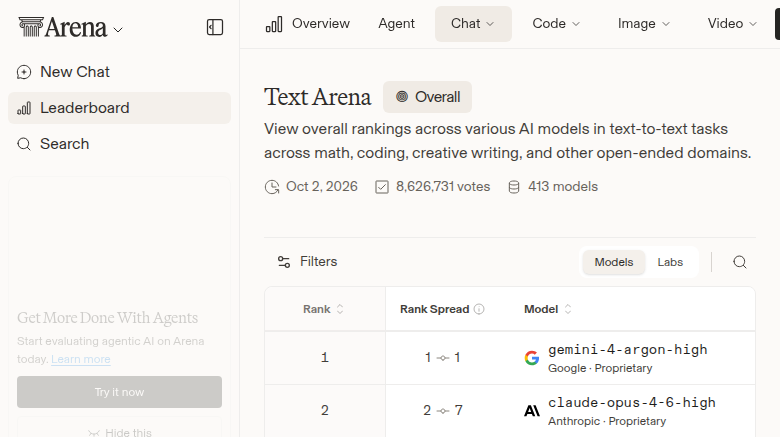
GPT-6 Astra has achieved the most misleading kind of success in AI: it is near the top of a leaderboard and nowhere near the top of actual usage. That is not a contradiction. It is a useful reminder that model quality and model adoption have become separate markets, governed by different constraints and measured with instruments that should never have been collapsed into one score.
On Arena’s WebDev board, GPT-6 Astra Max sits at number two with 1,788 Elo, just 27 points behind Claude Opus 5.5 Max at 1,815. On OpenRouter’s weekly usage ranking, Astra has only just entered the top 20: number 17, with 1.51 trillion tokens and 49% week-over-week growth. The first result says people often prefer its output in comparative evaluations. The second says that, after price, availability, defaults and workload economics have their say, relatively little OpenRouter traffic reaches it.
The gap between those positions is the real ranking update. It tells engineering teams more than another “Model X beats Model Y” headline because it exposes the distance between winning a test and winning a routing decision.
One leaderboard is a taste test; the other is a receipt
Arena and OpenRouter do not measure the same thing. Arena builds its rankings from paired human preferences. Users see competing outputs, choose one, and those votes feed an Elo-style score. OpenRouter’s table counts tokens processed through its marketplace, including prompt and completion tokens. One asks which answer people prefer; the other records what customers actually bought through a particular checkout.
Neither should be mistaken for universal truth. Arena’s own ranking method uses confidence intervals to describe the best and worst rank compatible with overlapping score uncertainty. When two models are separated by a handful of Elo points, a one-place move may reflect sampling noise rather than a meaningful capability change. OpenRouter, meanwhile, cannot see traffic sent directly to OpenAI, Anthropic, Google or cloud platforms. Its totals are also affected by free tiers, tokenization, verbosity and application defaults. A model that emits twice as many tokens may look more popular without completing twice as much useful work.
This week’s numbers make the danger unusually obvious. Space Bunny Alpha leads OpenRouter at 33.53 trillion tokens after growing 437% week over week. DeepSeek V4.1 Flash follows at 24.17T, while GLM 5.3 Flash fell 50% to 9.67T and MiMo V2.6 Flash jumped 201% to 9.38T. Those are not gentle changes in underlying intelligence. They look like a marketplace reacting to launch timing, price, promotions, routing defaults and application demand.
Astra’s 1.51T tokens therefore do not mean it is the seventeenth-best model, any more than Space Bunny’s volume proves it is the best. Astra’s positive 49% trajectory is more informative than its absolute rank. It shows adoption moving, while leaving open whether teams are testing it, shipping it, or merely consuming more tokens per task.
The expensive model still has to win the whole task
OpenAI’s first-party case for Astra is built around agentic work. The company reports 72.6% on OSWorld 2.0 at roughly 40 minutes per task, compared with GPT-5.6 Sol’s 65.7% at about 75 minutes. It also reports 100% on ExploitBench versus Sol’s 78.5%, 88.0% single-attempt performance on SRE-Bench versus 55.9%, and says an updated Codex harness completes Mind2Web tasks 1.9 times faster.
Those gains are substantial if they transfer to production. But Astra costs $10 per million input tokens and $50 per million output tokens, reportedly 2.5 times Sol’s launch pricing. That changes the relevant unit of comparison. The question is not whether Astra is cheaper per token—it is not—but whether it is cheaper per accepted outcome.
For a difficult migration, a security review or a failed deployment investigation, a model that succeeds in one 40-minute run can beat a cheaper model that needs two attempts plus an hour of engineer cleanup. For bulk extraction, routine transformations and speculative subtasks, the same premium can be waste. Token price is an input cost; retries, latency, review time and escaped defects determine the bill.
This is the first practical lesson from the split rankings: stop maintaining a single ordered list of “best models.” Maintain a routing matrix. Give ambiguous architecture, hard debugging, incident recovery and high-risk code review to frontier models. Route summaries, classification, extraction and disposable branches of an agent workflow to cheaper, faster models. Then measure cost per accepted result on your own tasks.
“Sonnet 5.5” is no longer a reproducible benchmark
The other notable WebDev change is Claude Sonnet 5.5 xHigh entering directly at number three with 1,786 Elo. That puts it two points behind Astra Max and 71 points above Claude Sonnet 5.5 High, now number six at 1,715. The gap may shrink as votes accumulate, but it highlights a measurement problem that teams routinely ignore: reasoning effort is part of the model configuration.
Saying “we evaluated Sonnet 5.5” is about as precise as saying “we benchmarked the database” without naming the instance size, indexes or query plan. A useful evaluation record now needs the exact model identifier, reasoning level, tool permissions, context policy, harness version, token budget and timeout. Otherwise the result cannot be reproduced, and a procurement comparison can quietly pit a high-effort configuration against a cheaper default.
The broader text leaderboard is calmer. Gemini 4 Argon High remains first at 1,525 Elo, followed by Claude Opus 4.6 High at 1,505. Gemini 3.8 Flash High made the biggest move, rising three places to number eight at 1,495. The narrow spread is itself a signal: Anthropic occupies much of the top tier, but ten points separate second place from several nearby entries, and one-vote narratives should not be built on crowded confidence intervals.
For practitioners, the right response is a small, durable evaluation suite rather than daily leaderboard switching. Choose 20 to 50 representative tasks: a real bug, a schema migration, an ambiguous product requirement, a test repair, a code review with a planted vulnerability, and several boring operations that dominate actual volume. Run them repeatedly, blind the reviewers where possible, and record acceptance, retries, wall-clock time, tokens, human correction time and regressions found later. Public leaderboards should nominate candidates; internal tests should decide releases.
Inconsistency is a production feature, not a social-media mystery
Developer reactions to Astra match the split data. Pranjal Paliwal wrote, “We don’t have AGI. We have a regression” after reviewing generated code. OpenCode builder Dax Raad said his team returned to GPT-5.6 Sol because spend doubled without enough improvement. T3Chat founder Theo gave the most credible diagnosis: Astra produced both work he “never thought a model could do” and “some of the stupidest things” he had seen, while Claude Fable behaved more consistently.
That variance matters more than peak capability. Agent systems compound errors across long trajectories, so an occasional spectacular run cannot compensate for unpredictable failures when each failure consumes tool calls, review time and state. A model with a slightly lower ceiling but a tighter distribution may be the better production component.
Teams should also resist the reflex to label every disappointing week a silent “lobotomy.” A backend revision is possible, but so are changed reasoning budgets, harness differences, ordinary sampling variance and the end of launch-week cherry-picking. Freeze model identifiers where providers allow it, keep canary tasks, log configuration changes and repeat runs. Without that discipline, nobody can distinguish a provider regression from an unreliable anecdote.
Astra’s number-two WebDev position earns it a serious evaluation. Its number-17 OpenRouter position says the market has not yet accepted the economics—or has accepted them somewhere OpenRouter cannot observe. The mature conclusion is not that one leaderboard is right and the other wrong. Capability, consistency and adoption are three different variables, and production teams need all three.
The leaderboard era is not ending, but the universal leaderboard should. The engineering advantage now belongs to teams that treat public rankings as discovery, model configurations as versioned dependencies, and their own acceptance tests as the release gate.
Sources: OpenRouter Rankings, Arena Leaderboard, OpenAI’s GPT-6 Astra announcement, Arena ranking methodology, Yahoo Tech’s developer reaction roundup