GPT-6 Luna Passed DeepSeek on OpenRouter. That Isn't a Quality Verdict

The most important change in this week’s model rankings is not that GPT-6 Luna moved up one row. It is that the two most-watched tables are telling completely different stories—and both can be correct.
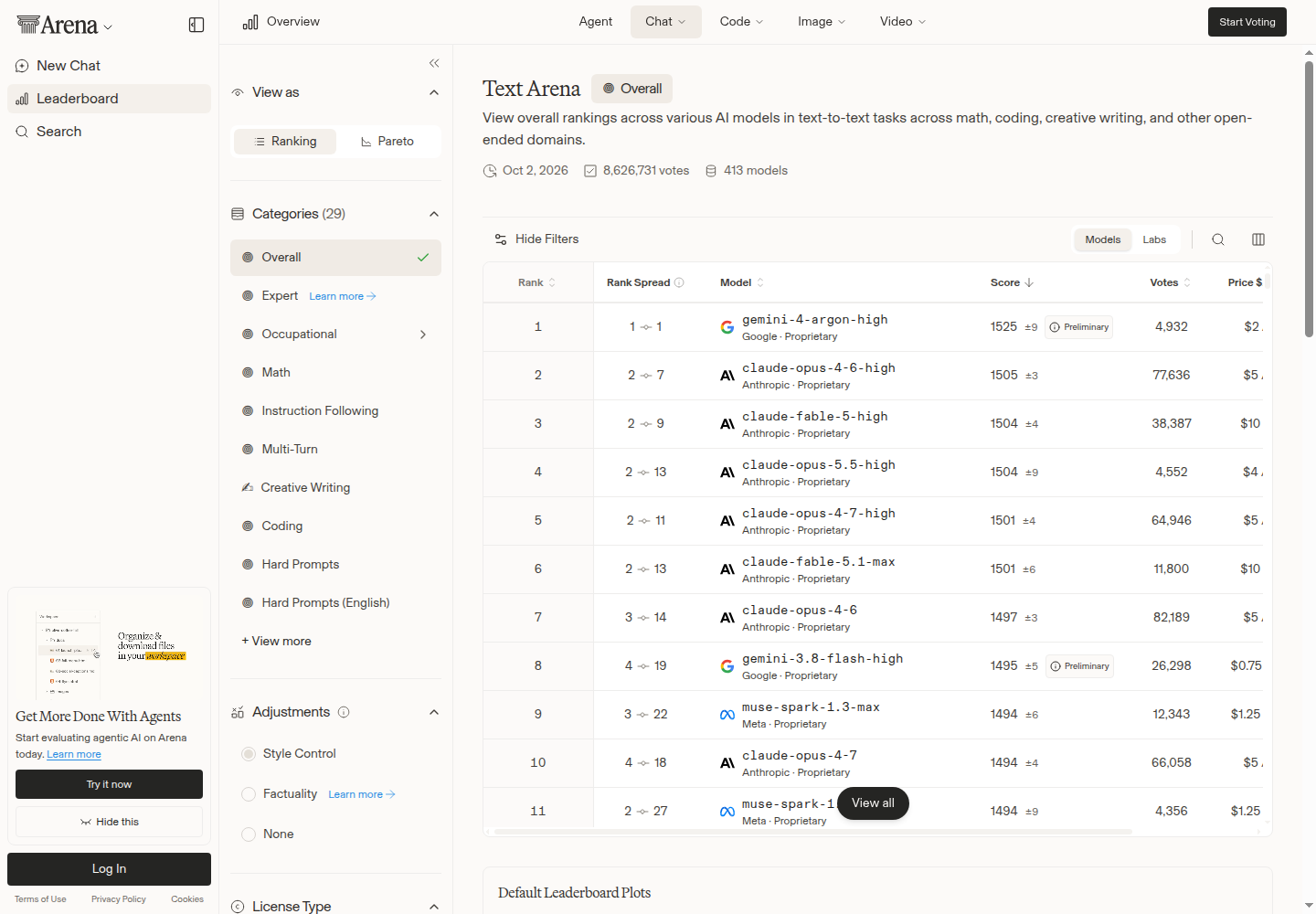
On OpenRouter, Luna climbed from seventh to sixth after processing 6.18 trillion tokens in the trailing seven-day window, up 116% week over week. It narrowly passed DeepSeek V4 Flash 0731, which handled 5.99 trillion tokens after a 23% decline. Meanwhile, Arena’s Text and Code leaderboards did not move at all. Gemini 4 Argon High still leads Text with a score of 1525, while Claude Opus 5.5 Max remains first in Code/WebDev at 1815.
That split is not a contradiction. Arena measures what people prefer in blind pairwise comparisons. OpenRouter measures prompt and completion tokens routed through one API platform. One is evidence about perceived output quality; the other is evidence about workload allocation. Treating either as a universal model score compresses pricing, availability, latency, verbosity, reliability, launch promotions, and actual capability into a single number that cannot carry all that weight.
A 190-billion-token lead is smaller than it sounds
Luna’s move is real, but its margin over DeepSeek V4 Flash 0731 is only 190 billion tokens, or roughly 3.2%. On a rolling seven-day chart, one large customer, one router-policy change, or one high-volume day entering the window can reverse that order. The correct reading is “Luna has reached the same production-traffic neighborhood,” not “OpenAI has conclusively beaten DeepSeek.”
The surrounding numbers make that distinction clearer. Space Bunny Alpha remains OpenRouter’s number one model with 38.7 trillion weekly tokens, up 179%. That is 13.1 trillion more than second-place DeepSeek V4.1 Flash and more than six times Luna’s volume. Claude Opus 5.5 grew 128% but remains thirteenth with 2.46 trillion tokens. Growth rate describes acceleration, not scale; rank describes volume, not usefulness.
OpenRouter says its ranking counts prompt plus completion tokens, excludes private requests, and separates model variants. Those definitions matter. A verbose model can generate more ranked tokens while completing fewer tasks. Different tokenizers can represent the same text with different token counts. A long-context summarization pipeline will naturally produce more traffic than a short classification service, even if both handle the same number of user requests. The chart does not count users, completed jobs, revenue, accuracy, or customer satisfaction.
There is another wrinkle: automatic routing increasingly shapes “adoption.” If an application asks a router for the cheapest model that meets a latency target, rising traffic can reflect a policy decision made by software rather than a deliberate preference expressed by developers. That does not make the data useless. It makes it operational data. Luna’s surge suggests it is available, economical, or reliable enough to receive serious workloads. It does not reveal which of those factors is doing the work.
The unchanged leaderboard is the useful control group
Arena Text still places Gemini 4 Argon High first at 1525, ahead of Claude Opus 4.6 High at 1505. But the leader is marked preliminary, based on 4,932 votes with a displayed uncertainty interval of plus or minus nine. Claude’s second-place model has 77,636 votes and a much tighter plus or minus three interval. The twenty-point score gap is interesting; the radically different evidence bases are equally important.
The Code/WebDev table needs the same restraint. Claude Opus 5.5 Max leads at 1815, with GPT-6 Astra Max at 1788 and Claude Sonnet 5.5 xhigh at 1786. The second- and third-place models are separated by two points while their displayed intervals are plus or minus ten and plus or minus eighteen. Writing procurement policy around that ordering would be fake precision wearing a benchmark badge.
Arena’s stability gives us a control against overinterpreting OpenRouter’s churn: human preference did not suddenly reorder when Luna passed DeepSeek in routed volume. More broadly, the top of Arena Text is concentrated among Google and Anthropic, while OpenRouter’s top five span a stealth model, DeepSeek, Z.ai, Xiaomi, and Tencent. Preference markets tend to reward the answer a judge likes in direct comparison. Usage markets reward an entire deployment package: price, quotas, regional access, context limits, response speed, and whether the provider stays up on a Tuesday afternoon.
This divergence produces a useful original signal. Models that rank well in both systems deserve immediate evaluation because they combine visible capability with evidence of deployability. Models that rank high in Arena but low in usage may carry a cost, access, or latency penalty. Models that surge in usage without a preference gain may be winning on economics or distribution. Those are hypotheses, not verdicts, but they are much better starting points than copying either top-20 list into an architecture document.
Benchmark the failure budget, not just the happy path
For engineering teams, this week’s move is a reason to add Luna to a test matrix, not to promote it directly into production. Start with 50 to 200 cases sampled from real traces. Include ordinary requests, tool calls, long contexts, ambiguous instructions, and the ugly inputs that created incidents. Score task completion and tool-call correctness, then record p50 and p95 latency, output length, retry rate, and total cost per successful task.
“Cost per successful task” is the metric public rankings cannot provide. A cheaper model that needs two retries, emits excessive output, or creates ten minutes of human cleanup can be more expensive than a premium model. Conversely, a model that loses a blind style vote may still be the right component for extraction, routing, or structured tool use. Teams should compare Luna with the relevant DeepSeek model, a Claude or Gemini candidate, and one smaller low-cost baseline under the same prompts and production constraints.
Run the evaluation in shadow mode where possible. Log the exact model and provider IDs, because aliases and router defaults can change underneath an application. Track malformed tool calls and fallback activation separately from content quality. Then repeat the test after a week. Luna’s 116% growth and Claude Opus 5.5’s 128% growth become meaningful adoption trends only if they persist after launch effects, promotions, or a favorable daily bucket roll out of the comparison window.
Teams using automatic selection should audit routing logs now. Ask whether the router recently changed weights, whether a preferred provider hit rate limits, and whether traffic shifted because of application mix. A leaderboard surge that comes from a routing-policy update is still operationally meaningful, but it is not organic developer migration. Without that audit, “the market chose this model” may actually mean “a default changed.”
Finally, keep a provider-neutral interface and a tested fallback. The diversity in OpenRouter’s top five is a reminder that the model market is not settling into one permanent winner. Availability and economics can move traffic faster than benchmark scores move, and a fallback that has not been exercised is documentation, not resilience.
The editorial verdict: GPT-6 Luna reaching number six is worth watching because production traffic exposes boring failures that benchmark demos miss. But the pass over DeepSeek is a routing signal, not a quality coronation. Use public rankings to generate candidates and spot changes. Use your own traces, failure budget, and unit economics to decide what ships.
Sources: OpenRouter AI Model Rankings, OpenRouter daily-token dataset documentation, Arena Text leaderboard, Arena Code/WebDev leaderboard