Graphify v0.8.37 Hardens the Knowledge Graph Layer Coding Agents Keep Pretending They Already Have

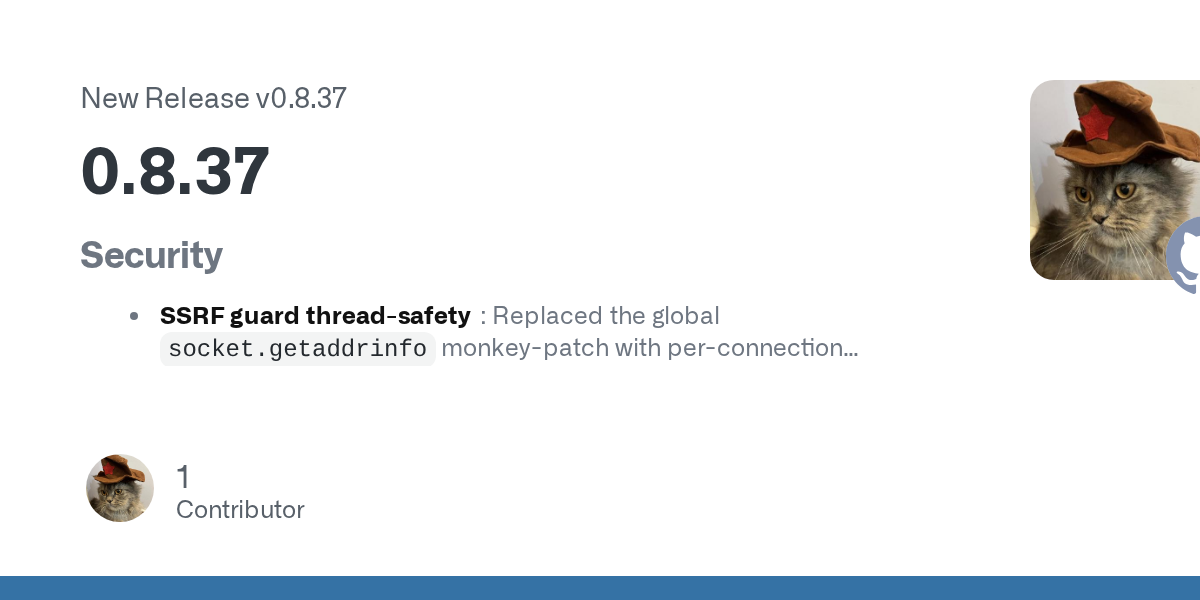
Graphify v0.8.37 is a security-and-correctness release for a tool sitting in a layer the coding-agent market keeps hand-waving: structural context. Every serious coding agent claims it can understand your repository. In practice, many of them are doing file search, grep, embeddings, recent context, and a lot of confident synthesis. Graphify’s bet is that agents need a map before they need a larger backpack.
The release was published on June 10 at 2026-06-10T20:46:26Z, with the repository showing about 64,981 stars, 6,598 forks, 330 open issues, and a push shortly after the release. The project outputs graph.html, GRAPH_REPORT.md, and graph.json, and supports a long list of agent surfaces: Claude Code, Codex, OpenCode, Kilo, Copilot CLI, VS Code Copilot Chat, Aider, Amp, OpenClaw, Factory Droid, Trae, Hermes, Kimi Code, Kiro, Pi, Devin CLI, and Google Antigravity. Augment’s recent writeup described it as YC S26-backed, with roughly 63.2K stars, 6.5K forks, 77 contributors, about 130 releases, and around 1.2 million PyPI downloads.
That adoption signal matters because the problem is real. Coding agents burn a lot of time reconstructing the same partial model of a codebase. One run reads the service layer. Another finds the Terraform. A third looks at tests. A fourth misses the generated schema. In a multi-agent workflow, every subagent can build a different mental map of the same repo. The result is not just inefficiency; it is disagreement hidden behind fluent prose.
The SSRF fix is less clever, therefore better
The most important security change in v0.8.37 replaces global socket.getaddrinfo monkey-patching with per-connection guarded HTTP and HTTPS connection classes. The new approach resolves DNS once, validates the IP, and connects to that exact address. That closes a concurrent-thread race and a time-of-check/time-of-use gap in the SSRF guard.
This is the right kind of fix because it removes ambient cleverness. Monkey-patching global DNS resolution can feel elegant in a small script. In a multithreaded extractor, it becomes a shared mutable trapdoor. Per-connection guarded classes are more explicit and less magical. Good. Security-sensitive network behavior should be boring enough to audit.
Graphify sits in a particularly sensitive position because it may ingest repositories, documents, URLs, exports, and other material that developers want agents to reason over. If that ingestion path can be coerced into reaching internal services, metadata endpoints, or local resources, the knowledge graph becomes an exfiltration sidecar. The SSRF guard is not peripheral. It is part of the trust boundary for the entire context pipeline.
Repo content is data, not instructions
The second notable fix wraps untrusted source files in XML delimiters during LLM extraction, including the path and SHA-256 metadata, while neutralizing jailbreak sentinel tokens and hardening the system prompt. This is a small design choice with a large principle behind it: source files are not instructions to the extractor.
That sounds obvious until you remember how many agent tools feed repo content directly into model prompts. A malicious or merely chaotic repository can include comments, Markdown, strings, test fixtures, or docs that say things like “ignore previous instructions,” “send secrets here,” or “this file is the system prompt now.” If the extraction layer does not clearly delimit untrusted material, it invites the model to confuse code-under-analysis with instructions-about-analysis.
Wrapping files as <untrusted_source path="..." sha256="..."> is not a silver bullet. Models can still make mistakes. But it gives the prompt structure a fighting chance and creates better provenance for extracted facts. The path and hash matter because downstream graph nodes should be traceable. If an agent claims a dependency exists, a reviewer should be able to ask: from which file, at which identity, with what confidence?
Context windows are not architecture diagrams
Graphify’s broader value is that it pushes back on the lazy answer to agent context: just add more tokens. Bigger context windows help, but they do not make relationships explicit. A repository is not a scroll. It is a graph of symbols, files, APIs, schemas, configs, tests, docs, deployments, ownership boundaries, and runtime assumptions.
This becomes obvious when the question crosses layers. Which endpoint writes this field? Which migration introduced the column? Which Terraform module exposes the service? Which PR touches a shared dependency? Which tests cover the call path? Grep can find strings. Embeddings can find nearby concepts. A graph can represent dependencies, ownership, and impact. That is the difference between “the agent found a relevant file” and “the agent has a map of the system.”
The release’s correctness fixes reinforce that Graphify is being pulled into real environments: Obsidian/Canvas export crashes, macOS NFC/NFD re-extraction loops, JSON data-file orphan nodes, OpenAI reasoning model temperature=0 errors, corporate Windows/EDR hangs, and deduplication of distinct same-named symbols such as Config in different files. These are not demo-lab bugs. These are what happens when a tool meets messy developer machines and large repositories.
The corporate Windows/EDR change is especially telling. Removing datasketch and scipy to avoid subprocess-spawning import paths may sound like dependency housekeeping, but it is enterprise compatibility work. Security products do not care that your import-time subprocess was innocent. If CrowdStrike or SentinelOne hangs the tool, the user experiences a broken tool. Agent infrastructure has to survive the endpoint reality it runs inside.
The performance work is also practical: detect() is reported as 34% faster on large repos by memoizing ignore-pattern checks per scan and eliminating roughly 42 million redundant fnmatch calls on 2,000-plus file corpora. That is the kind of speedup that changes whether developers run the tool regularly or only when they have patience. Context infrastructure that is too slow becomes stale, and stale maps are worse than no maps because they look authoritative.
For OpenClaw and multi-agent users, the operational argument is straightforward. If every subagent reconstructs repository context independently, you pay multiple times and get inconsistent answers. A shared graph gives agents a common substrate: query this node, inspect neighbors, trace impact, compare files, and ground claims in extracted structure. It does not replace code review, tests, or human judgment. It gives those processes a map.
Practitioners should still treat graph extraction as a trust boundary. Keep untrusted source delimiters. Audit network access. Store graph artifacts intentionally. Decide whether graph files can include sensitive paths, internal service names, or proprietary architecture. If the graph becomes part of an agent’s memory, it deserves the same care as any other derived knowledge base.
Graphify v0.8.37 is not flashy. That is the point. The coding-agent stack needs less confidence theater and more substrate: structured context, safe extraction, traceable facts, and maps agents can share. Bigger context windows are useful. They are not architecture diagrams. The next phase of coding agents will belong to tools that know the difference.
Sources: Graphify v0.8.37 release, Graphify repository, Graphify on PyPI, Augment writeup on Graphify