How I Built an Agent Factory That Ships Code While I Sleep

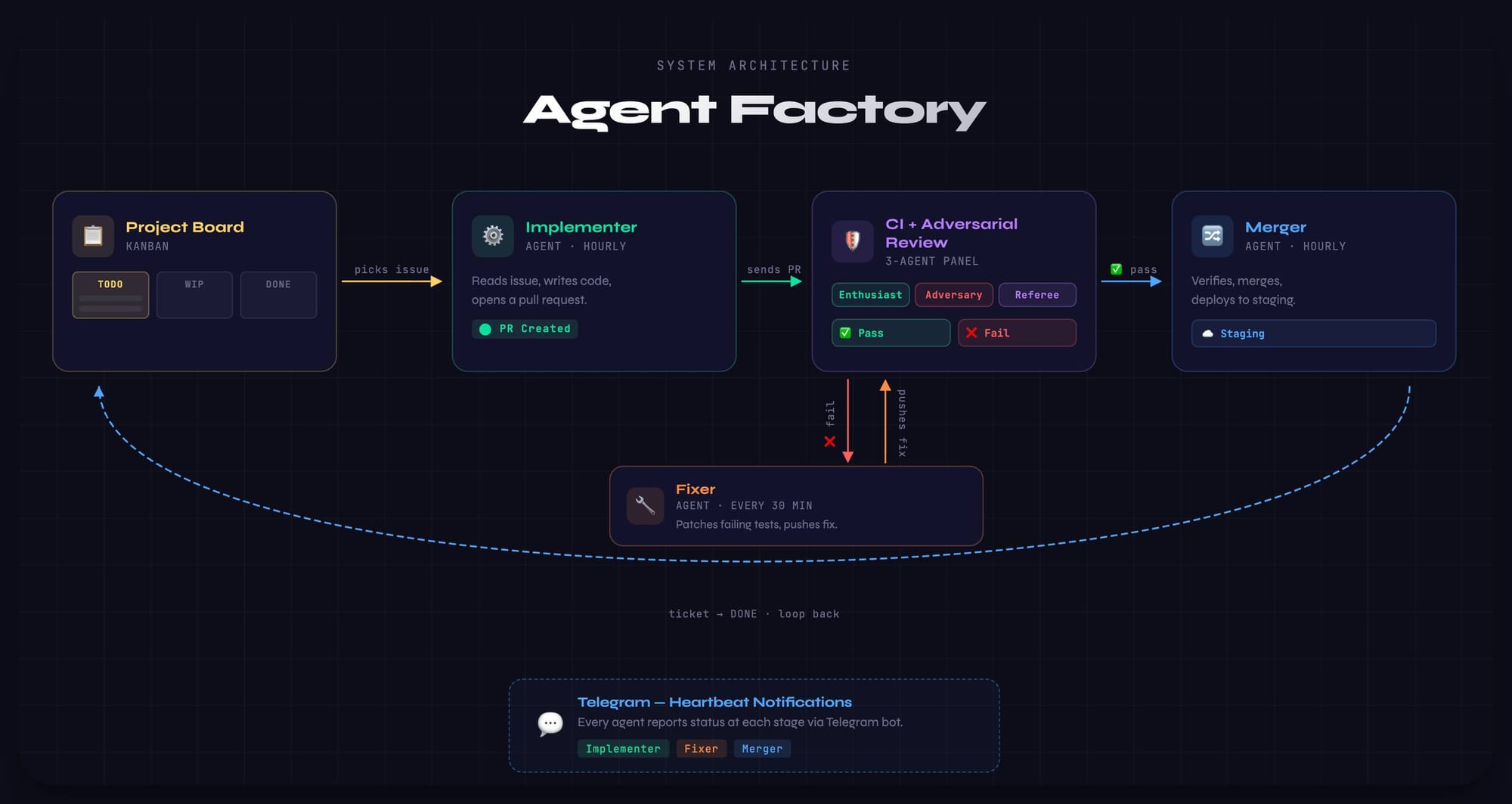
The idea of shipping code while you sleep has been a developer fantasy for years. Leo Cardz turned it into a functioning system, and his writeup is one of the more honest and practical accounts of what that actually looks like in the wild. The architecture is intentionally minimal: cron jobs fire on a schedule, a Markdown rules file tells each agent exactly how to behave, and a CLI-based coding agent does the implementation work. No elaborate orchestration framework, no expensive infrastructure — just disciplined configuration and reliable automation primitives.
What makes the post valuable isn't the novelty of the setup but the candor about its failure modes. Cardz details the cost guardrails he put in place to prevent runaway agent spend, the edge cases that caused overnight runs to stall, and the iterative process of tightening the rules file until the agents could be trusted to work unsupervised. The result is a concrete, reproducible template for anyone who wants to experiment with cron-driven autonomous coding rather than a glossy success story that papers over the hard parts.
For the OpenClaw community, this is validation of a use case the platform is explicitly built around: scheduled, unattended agents that do meaningful work between human check-ins. Cardz's pattern — cron trigger, rules-governed behavior, CLI agent execution — maps directly onto how OpenClaw's scheduling and agent runtime are designed to work together, making it a useful reference for builders exploring similar workflows.