Hy4 Just Took the OpenRouter Crown. The Arena Leaderboard Says Something Else.

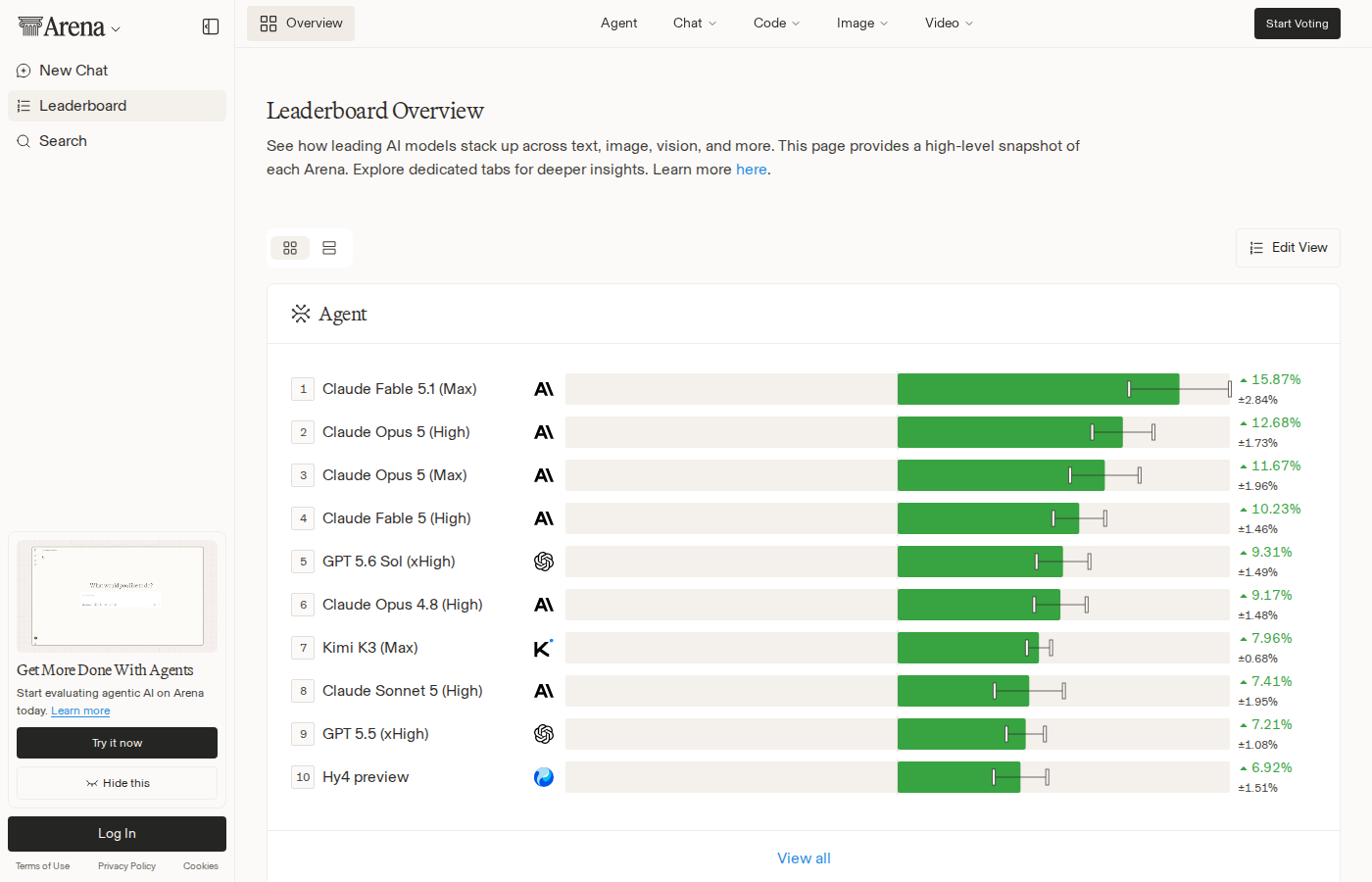
Two leaderboards told two different stories this week, and both of them are true. Tencent's Hy4 preview climbed to the top of OpenRouter's weekly token-volume ranking with 13.6 trillion tokens processed, leapfrogging GLM 5.3 Flash and pushing GPT-5.6 Luna down two slots. The same model sits at number ten on Arena AI's Code/WebDev leaderboard, 140 points behind Claude Fable 5.1 Max, with a confidence interval wide enough that a single bad week could move it three places. Both numbers are accurate. Neither tells the full story on its own, and treating either one as a buying signal is how teams end up rewriting their stack six months later.
This is the trap the 2026 model market has laid for builders. The leaderboards everyone cites measure fundamentally different things, and the gap between them is now large enough to be the story itself.
What OpenRouter actually measures
OpenRouter's headline number is tokens processed across its gateway in a trailing seven-day window. Not requests. Not users. Not spend. Not accuracy. Tokens. That distinction matters more than it looks, because verbosity is a hidden multiplier: a chatty model that says "Certainly! I'd be happy to help you with that. Let me think through this step by step..." before every answer will rack up tokens faster than a terse model that just answers. Hy4 preview's headline 13.6T number is impressive, but it includes the entire workload routed through OpenRouter, which spans everything from one-line completions to million-token agent runs.
OpenRouter also explicitly excludes private usage, ranks model variants separately rather than collapsing them, and warns that tokenization differences between providers can distort comparisons. A model with a chatty tokenizer that splits common words into more subword pieces will look like it processed "more tokens" than an identical-content model with a tighter tokenizer. None of this is dishonest, but it does mean the leaderboard measures gateway popularity plus verbosity plus pricing plus availability, not model quality. It's a foot-traffic counter, not a Michelin star.
What Arena AI's Code board measures
Arena's Code/WebDev leaderboard is built on blind pairwise comparisons: users get two anonymous completions, vote on which is better, and the Elo-style scores accumulate. Claude Fable 5.1 Max leads at 1763 with 2,227 votes. Claude Opus 5 Max sits third at 1687 with 10,812 votes. The Qwen 3.8 Max 0902 preliminary entry is second at 1689 from 1,769 votes. These are preference votes, not benchmark scores, but they aggregate a real signal: which model produces outputs humans prefer when they don't know which model they're looking at.
Hy4's tenth-place Code Arena result at 1623 is honest and unremarkable. The score is based on 1,600 votes, which gives it a confidence interval of about ±16 points. Compare that to Claude Opus 5 High's ±7 interval on 10,802 votes, and you can see that Hy4's rank is roughly twice as sensitive to noise. It might be a true tenth-place model; it might be a seventh-place model that got unlucky with a few hundred votes. The Elo math doesn't lie, but the math on a small sample is a wider target than people assume.
The Hy4 launch economics matter more than the rank
The reason Hy4 climbed OpenRouter's board isn't really about quality. It's about packaging. Tencent shipped the model under Apache 2.0, exposed it through OpenRouter on day one, priced it at $0.834 per million input tokens and $2.501 per million output tokens, and ran two weeks of free access through WorkBuddy and CodeBuddy. The cache-read price of $0.042 per million tokens is particularly aggressive: that's the rate you pay when you reuse the same long context across many requests, which is exactly how agent loops and repository-scale code work operate. Claude Fable 5.1 Max's $10/$50 input/output pricing makes Hy4 roughly twelve times cheaper on input and twenty times cheaper on output. The cache-read advantage is even larger.
When a model is twelve to twenty times cheaper, permissively licensed, available on the gateway you already use, and good enough to clear a reasonable Code Arena threshold, developers route traffic to it. That is exactly what happened. The 13.6T weekly token volume is what economic gravity looks like when you stack enough advantages in one model.
But here's the part that should make any engineering lead slow down before swapping production defaults: 13.6T tokens says nothing about whether those tokens translated into successful work. A model that's cheap and good enough will absorb exploratory traffic, throwaway scripts, and "let me try this once" experiments. The expensive question is what fraction of that traffic came back the next day, and what fraction was the kind of workload you actually need to ship.
The 49B-active spec hides an operations problem
Tencent's announcement describes Hy4 as a mixture-of-experts model with 770 billion total parameters and 49 billion active parameters, with a context window that exceeds one million tokens. The "49B active" figure is doing a lot of work in developer conversations because it sounds deployable. Sparse activation does reduce the compute required per generated token, but the model still requires loading and managing a 770-billion-parameter checkpoint, expert routing infrastructure, sufficient memory bandwidth to move weights during forward passes, and a KV-cache plan that doesn't fall over at long context lengths.
For most teams, the practical path remains a hosted API. Self-hosting Hy4 is not the same project as self-hosting a 49-billion-parameter dense model. Anyone evaluating local deployment should benchmark their actual quantization strategy, tensor and expert parallel topology, batch size, time-to-first-token at their target context length, sustained output rate under load, and failure modes when context length approaches the advertised limit. A one-million-token context window is a capacity claim, not evidence that million-token prompts are economical, accurate, or even well-supported by the model's training distribution. Most long-context claims age poorly under honest testing.
What the rest of the OpenRouter reshuffle actually signals
The rest of the OpenRouter top five tells its own story. GLM 5.3 Flash dropping to second after holding the lead for weeks is the natural consequence of any open-weight launch with a free trial period. GPT-5.6 Luna falling from second to fourth is more interesting: it suggests that whatever pricing or availability advantage Luna had when it launched has now been matched or beaten, and that OpenAI is competing on volume in a market that's getting crowded with cheaper alternatives. MiniMax M3 (free) entering at number five is a reminder that "free" still beats cheap on a leaderboard optimized for token volume.
Nemotron 3.5 Lightning (free) entering at number twenty and displacing DeepSeek V4 Pro 0813 continues a pattern: free variants rank separately and now occupy four of the top twenty slots. Anyone treating the leaderboard as a preference signal has to mentally subtract the free-tier entries before reading anything into the rankings. The fact that this caveat is rarely mentioned in coverage is part of why the leaderboard is so easy to misread.
What Arena's static top ten actually signals
Arena AI's Text leaderboard is unchanged across the entire top twenty this week. Claude Fable 5 remains first at 1507, two points ahead of Claude Opus 4.6 High. Anthropic holds seven of the top ten slots. The top twenty is dominated by Claude and Meta's Muse Spark line, with Google's Gemini 3.8 Flash High and OpenAI's GPT-5.6 Sol xHigh making the lower half. A static leaderboard on a preference platform that aggregates thousands of votes per day is itself a signal: the existing leaders are good enough that new entrants haven't meaningfully displaced them, even when those entrants win on price and adoption.
This is the part the "Hy4 took the #1 spot" framing buries. On the leaderboard that measures preference, the leader hasn't changed in weeks. The leaderboard that measured foot traffic rotated completely. A senior engineer trying to decide what to ship in production should weight the static preference board more heavily than the volatile traffic board, because shipping decisions compound: a model you choose today shapes your cost structure, your latency profile, your prompt patterns, and your evaluation surface for the next eighteen months. Foot traffic is what people tried. Preference votes are what they preferred when they didn't know what they were looking at.
The bake-off that actually matters
If you're a builder looking at this and wondering what to do, the answer is structured, unglamorous, and cheap. Pin the exact Hy4 preview version you tested. Run fifty to one hundred representative tasks against it and against your current production default. Measure the things that actually matter: task success rate, human rework rate, latency at the 95th percentile, total tokens consumed, tool-call reliability, and cost per successful task, not cost per million tokens. Price-per-million is a marketing number; cost-per-completed-job is an engineering number.
Split results by workload category. Repository-scale code changes behave differently from browser-driven agent loops, which behave differently from document synthesis, which behaves differently from short interactive work. A model that wins on one workload can lose badly on another. Add fallbacks and budget caps before any production rollout, because preview models change behavior between versions and a model that's free this month may not be free next month. Re-run the test when Tencent ships the non-preview Hy4 series rather than assuming the preview numbers carry forward.
None of this is exciting. It is, however, how you avoid being the team that swapped their default model on a Tuesday because of a leaderboard screenshot and spent the next quarter debugging the consequences.
The takeaway that isn't on either leaderboard
The interesting story from this week is not that Hy4 won a ranking. It is that the model market has split into two legible signals that no longer agree, and that the disagreement is structural rather than temporary. OpenRouter's traffic rankings will continue to rotate fast because cheap, open-weight, well-distributed launches will always absorb traffic from incumbents. Arena's preference rankings will continue to rotate slowly because preference votes aggregate over thousands of comparisons and don't move much from week to week. Builders who understand which signal answers which question will make better model decisions than builders who pick the leaderboard that flatters their current choice.
Hy4 preview is a real model with real adoption and a real price advantage. It is also a tenth-place model on the leaderboard that measures what you actually ship. Both of those things are true. The senior-engineer move is to keep them separate in your head.
Sources: Tencent Hy4 preview announcement, OpenRouter weekly rankings, Arena AI Code/WebDev leaderboard, Arena AI Text leaderboard, Hacker News launch discussion.