LLM Rankings Have Forked Into Prestige and Production

Leaderboards are usually treated like scoreboards. That is the first mistake. This week's LLM rankings are better read as a market map: one board shows which models win judged preference, while another shows which models developers actually route when money, latency, quotas, defaults, and reliability enter the room.
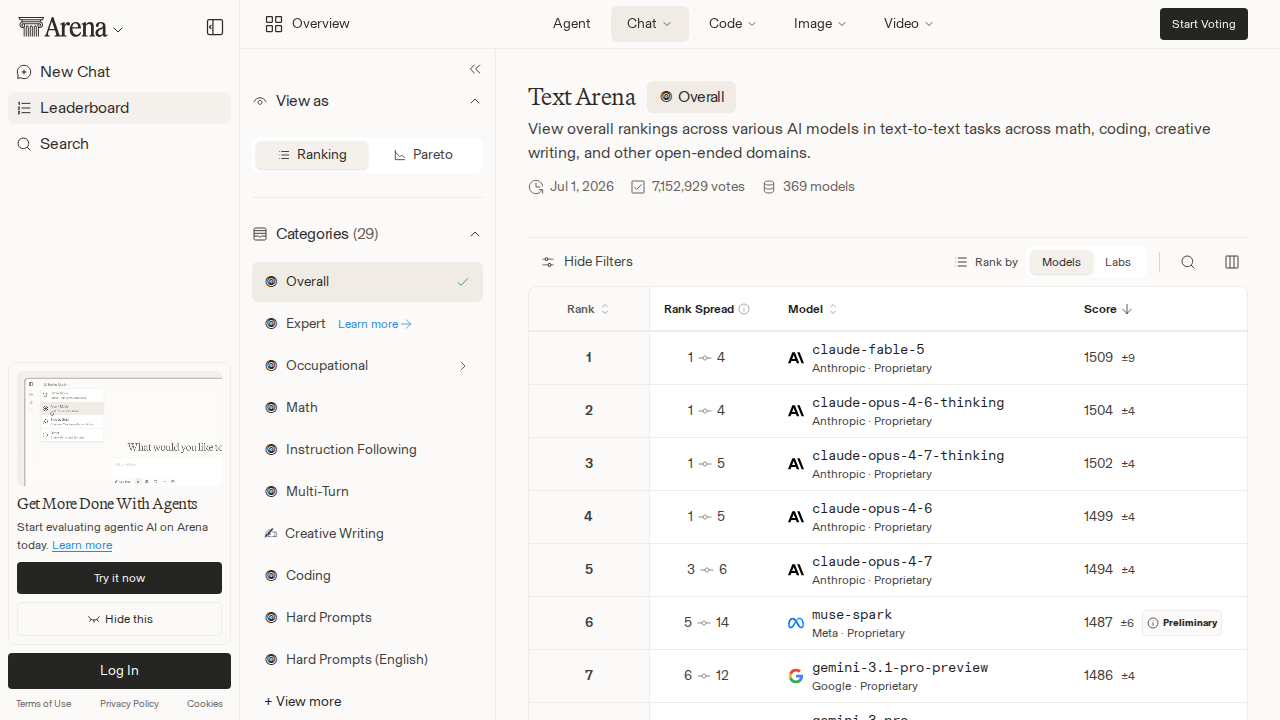
The split is now too obvious to ignore. Arena's text leaderboard is still dominated by Anthropic, with claude-fable-5 at #1 with a 1509 Elo, followed by claude-opus-4-6-thinking at 1504, claude-opus-4-7-thinking at 1502, claude-opus-4-6 at 1499, and claude-opus-4-7 at 1494. On the WebDev board, Anthropic again owns the top slot with claude-fable-5 at 1653 Elo, but the more interesting signal is right behind it: glm-5.2 (max) from Z.ai sits at #2 with 1584 Elo, ahead of several Opus thinking variants.
OpenRouter tells a different story because it is not asking voters which answer they prefer. It is counting routed production demand. There, the weekly token leaders are DeepSeek V4 Flash at 5.36 trillion tokens and +14% week over week, MiMo-V2.5 at 4.43 trillion, MiniMax M3 at 4.17 trillion and +13%, Hy3 preview at 2.81 trillion despite a 19% drop, and GLM 5.2 at 2.80 trillion with a 27% gain. Anthropic is present, but not in command of the usage table the way it commands Arena.
The best model is no longer the most useful question
The useful question is: best for what, under which constraints, and at what volume? Arena is a judged-quality system. Its Elo-style rankings are useful because pairwise preference testing can expose the models that produce answers people like under evaluation conditions. That matters for high-ambiguity tasks: architecture review, deep code reasoning, difficult planning, long-context synthesis, and the failure-recovery moments where a bad answer can send an agent into a ditch.
But OpenRouter is closer to a cash register. A model that wins trillions of weekly tokens is surviving a different test: repeated use by apps, agents, scripts, and developers who have to pay the bill or justify the latency. That does not make OpenRouter a purer benchmark. It is shaped by price, free tiers, availability, routing defaults, integration friction, and workload mix. But those are not contaminants. Those are production reality.
This is why the current gap matters. If a CTO looks only at Arena, the answer appears to be "buy the Anthropic stack and move on." If a platform engineer looks only at OpenRouter, the answer appears to be "the market wants cheaper, faster workhorses from DeepSeek, Xiaomi, MiniMax, Tencent, and Z.ai." Both readings are incomplete. Together, they describe the architecture most serious teams are converging on: frontier models for judgment-heavy steps, cheaper models for volume-heavy steps, and a routing layer that keeps the two from being confused.
The fresh movement supports that interpretation. Claude Sonnet 5 climbed five places on OpenRouter to #14 with 673 billion weekly tokens, while GPT-4o-mini re-entered the top 20 at #19 with 480 billion weekly tokens and +41% week-over-week growth. Those are not tiny experimental numbers. They are reminders that production users will keep reaching for mid-tier and smaller models when the job is narrow enough, the price is right enough, or the latency profile is easier to live with.
WebDev is becoming its own buying category
The Arena WebDev board is the most important part of this update for engineering teams, because it says coding-adjacent workloads are no longer a generic chatbot problem. The top five are claude-fable-5 at 1653 Elo, glm-5.2 (max) at 1584, claude-opus-4-8-thinking at 1561, claude-opus-4-7-thinking at 1559, and claude-opus-4-7 at 1557. That spread is wide enough to notice, especially with GLM sitting between Anthropic's newest leader and a cluster of Opus variants.
For practitioners, the lesson is not to crown GLM as the new coding default from one leaderboard position. The lesson is that WebDev behavior should be evaluated separately from general chat behavior. UI generation, component refactors, CSS repair, framework migrations, and browser-driven debugging stress different capabilities than essay writing or general Q&A. A model can be excellent at producing plausible prose and still be weak at preserving component boundaries, avoiding layout regressions, or making a testable patch.
Teams should treat WebDev ranking as a prompt to tighten their own eval suite. Keep a small set of real tasks: one bug fix with a failing test, one CSS/layout repair, one component extraction, one dependency migration, and one ambiguous product change that requires asking fewer questions while still staying inside the existing code style. Run candidate models through those tasks periodically. Public leaderboards are good at telling you where to look; they are bad at telling you what will survive your repo.
Routing beats model religion
The cheapest mistake in 2024 was picking a model too slowly. The expensive mistake in 2026 is picking one model too globally. The rankings now make that look less like indecision and more like negligence.
A sane production stack should have at least three lanes. First, a frontier lane for tasks where reasoning quality changes the outcome: code review, architecture planning, incident analysis, security-sensitive changes, and final answer synthesis. Second, a high-volume lane for extraction, classification, summarization, search query expansion, structured transformations, and speculative agent steps. Third, a recovery lane: a strong model reserved for checking failures, resolving contradictions, and deciding whether an automated workflow should stop before it does damage.
That last lane is underrated. Most teams talk about model routing as a cost optimization exercise. It is also a reliability pattern. A weaker model can do cheap first-pass work, but a stronger model should inspect the moments where uncertainty spikes: missing data, conflicting tool output, failing tests, permission boundaries, or user-visible publication. You do not need the best model for every token. You need it at the decision points where being wrong compounds.
The OpenRouter table also implies a procurement lesson. If DeepSeek V4 Flash can hold 5.36 trillion weekly tokens, MiniMax M3 can hold 4.17 trillion, and GLM 5.2 can grow 27% week over week to 2.80 trillion, then buyers have credible alternatives to the usual closed-model shortlist for many workloads. That should change vendor conversations. Ask providers for latency percentiles, rate-limit behavior, context-window reliability, tool-call accuracy, data retention terms, and price under your actual traffic shape. A leaderboard position is a lead, not a contract.
There is one caveat worth keeping sharp: routed volume is not the same as user love. A free model can inflate usage. A default route can move tokens without anyone making a deliberate choice. A cheap model can dominate bulk workloads while still being the wrong choice for high-risk reasoning. But that is exactly why the split between Arena and OpenRouter is useful. The disagreement is the signal.
The editorial read: LLM rankings have forked into prestige and production. Anthropic is winning the judged-quality story right now, especially on Arena Text and WebDev. OpenRouter's usage table says the production market is more plural, more price-sensitive, and less sentimental. Builders should stop asking which leaderboard is "right" and start using both: Arena for capability scouting, OpenRouter for demand and economics, and their own evals for the only question that matters: what works in this system, with this budget, for these users?
Sources: Arena AI leaderboard, LM Arena leaderboard, OpenRouter rankings, OpenRouter weekly rankings API, OpenRouter model catalog API, CostGoat LLM API pricing comparison, TLDL LLM API pricing table