LLM Rankings Have Split Into Prestige Models and Production Workhorses

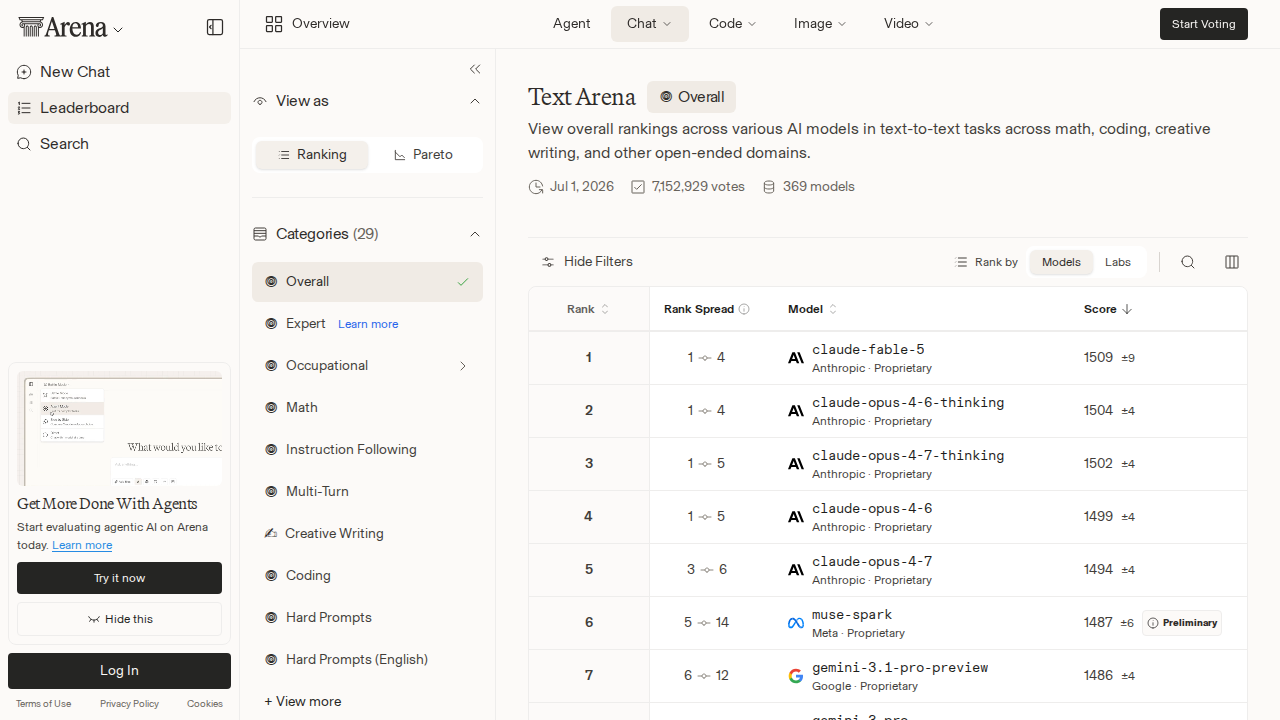
The useful LLM leaderboard story this week is not that one model moved one slot. That is leaderboard cosplay. The real story is that the industry now has two different scoreboards telling two different truths: models that win judged preference tests, and models that developers are willing to route trillions of tokens through when cost, latency, availability, and failure modes start mattering.
On Arena's text leaderboard, Anthropic is still sitting on the prestige layer. The top five are all Claude entries: claude-fable-5 at 1509 Elo, claude-opus-4-6-thinking at 1504, claude-opus-4-7-thinking at 1502, claude-opus-4-6 at 1499, and claude-opus-4-7 at 1494. That is not a close-call narrative. It is a clear signal that, in judged pairwise comparisons, Anthropic continues to own the top of the quality conversation.
But OpenRouter's weekly token rankings look like they came from a different market, because they did. The top five by routed weekly volume are DeepSeek V4 Flash at 5.28 trillion tokens, up 9% week over week; MiMo-V2.5 at 4.20 trillion, down 6%; MiniMax M3 at 3.90 trillion, up 2%; Hy3 preview at 3.54 trillion, up 8%; and GLM 5.2 at 2.44 trillion, up 27%. Claude shows up, but not where the Arena board would make you expect it: Claude Opus 4.8 is #7 by OpenRouter token volume, Claude Opus 4.7 is #8, and Claude Sonnet 4.6 is #11.
That split is the thing engineers should care about. Arena is closer to a controlled taste test. OpenRouter is closer to traffic telemetry. One tells you which models humans prefer under evaluation conditions; the other tells you which models survive repeated use inside apps, agents, experiments, quota games, default routes, and monthly bills. Treating those as interchangeable is how teams end up with either beautiful demos that are too expensive to operate, or cheap pipelines that quietly rot when the task gets ambiguous.
Usage is becoming its own benchmark
The most visible movement inside the OpenRouter top 20 is small but telling. Owl Alpha fell three slots to #9 and dropped 44% week over week. DeepSeek V4 Pro moved up one slot to #6 with 2.23 trillion weekly tokens, Claude Opus 4.8 moved to #7 with 2.07 trillion, and Claude Opus 4.7 moved to #8 with 1.93 trillion despite being down 17% week over week. GPT-5.5 sits at #12 with 1.16 trillion weekly tokens, up 19%.
None of that proves Owl Alpha got worse. It proves usage boards are behavioral data, and behavioral data is gloriously impure. A routed-volume ranking includes product launches, router defaults, pricing changes, free-tier effects, bursty app traffic, benchmark tourism, and developers swapping models because last week's winner started failing on their exact workload. That messiness is not a reason to ignore the ranking. It is the reason the ranking is useful.
Quality leaderboards abstract away many of the things that make production annoying. Usage leaderboards absorb them. If a model is too slow, too expensive, inconsistently available, or hard to trust in an agent loop, the token graph eventually notices. If a model is not the smartest but is cheap, predictable, and good enough for 80% of the call sites, the token graph notices that too.
OpenRouter's own DeepSeek adoption analysis puts numbers behind the shift. DeepSeek roughly doubled token share from 9% to 18% between January and June, and the V4 family pushed DeepSeek to nearly 20% token share by early June. More importantly, OpenRouter says agentic workloads use about 15x more tokens per request than normal human AI usage, and by late May V4 Flash comprised 70% of agentic token flow inside DeepSeek usage.
That last detail matters more than the rank badge. Agents are where LLM economics get ugly. A chat UI may burn a few thousand tokens per turn; an agent that plans, calls tools, retries, summarizes, branches, and verifies can turn one user request into a token furnace. In that world, a model does not need to be the best model in the abstract. It needs to be the model you can afford to let think repeatedly.
The price gap is architectural, not accounting
The pricing spread explains why token-volume rankings are diverging from prestige rankings. OpenRouter lists DeepSeek V4 Flash's cheapest endpoint at $0.09 input and $0.18 output per million tokens. GPT-5.5 is listed at $5 input and $30 output per million tokens. That is not a minor procurement detail. It changes the software architecture.
At GPT-5.5-class pricing, every extra reasoning pass needs to justify itself. You cache aggressively, compress context, avoid retries, and push more work into deterministic code. At DeepSeek V4 Flash-class pricing, the design space opens up: speculative parallel calls, cheap draft generation, bulk extraction, redundant verification, and background analysis become practical. Cheap tokens do not make bad engineering good, but they make certain robust patterns economically viable.
This is the part many model comparisons still miss. The right model is not just a quality decision; it is a control-system decision. You are choosing how often your software can ask for help, how much uncertainty it can afford to resolve, how many fallbacks it can run, and how much telemetry you can collect before the invoice turns into an incident.
BenchLM's comparison between DeepSeek V4 Flash and MiMo-V2.5 adds a useful counterweight. MiMo-V2.5 has the stronger provisional aggregate, 66 to 59, with an agentic average of 65.8 versus 49.1 and a Terminal-Bench 2.0 gap of 65.8% versus 49.1%. Yet BenchLM still frames DeepSeek V4 Flash as the better call when coding priority, latency, or reasoning-token burn matters more than the aggregate score. That is the modern model-selection problem in one sentence: the winner depends on the workload, not the fan base.
The practitioner reaction lines up with the data. In community discussion, the interesting question is no longer "which model is best?" It is "which cheap execution model can reliably follow a plan from a more expensive planner?" Developers are comparing DeepSeek V4 Pro, MiniMax M3, MiMo V2.5 Pro, and Qwen variants as components in a stack, not as one-model-to-rule-them-all replacements. Some prefer MiMo's benchmark profile and perceived honesty; others switch back to DeepSeek for lower failure rates, better coding fit, or routing behavior. That is what a maturing market looks like: fewer religious arguments, more bill-of-materials thinking.
Stop picking a global default
The engineering move is boring, which is usually a good sign: stop choosing one global default model. Route by task class.
Use frontier models for high-ambiguity planning, code review, user-facing synthesis, security-sensitive reasoning, and failure recovery. Use cheaper workhorse models for extraction, transformation, classification, summarization, draft generation, and speculative agent steps. Put evaluation around the boundaries: when does the cheap executor need to escalate, when does the planner need to re-check, and when should deterministic code replace an LLM call entirely?
Teams should also track their own rankings. Public leaderboards are useful external signals, but they are not substitutes for production evals. Arena cannot tell you whether a model preserves your customer-specific schema under pressure. OpenRouter cannot tell you whether your retrieval layer makes one model hallucinate less than another. Benchmarks cannot tell you whether your support workflow fails because the model is weak, the prompt is bloated, the tool schema is ambiguous, or your product data is a mess.
A practical setup is simple enough to start this week: define five to ten task classes, log model, latency, cost, escalation rate, tool-call error rate, and human correction rate for each, then run new leaderboard movers against the actual cases that hurt. If a model is #1 on Arena but triples your unit economics, it is a specialist. If a model is #1 by token volume but fails your most expensive edge cases, it is a worker, not a lead. Those are both valuable roles. They are just different jobs.
That is why today's rankings monitor is more important than its modest rank changes suggest. The market has forked into prestige models and production workhorses. Anthropic is winning the judged-quality board. DeepSeek, MiMo, MiniMax, Tencent, and GLM are winning huge chunks of routed volume. OpenAI remains a major player, but the data no longer supports the lazy assumption that the most famous frontier model automatically becomes the default production substrate.
The clean take: "best model" is becoming a junior question. The senior question is where each model belongs in the system, how fast you can swap it out, and whether your architecture can exploit cheap competence without letting it make expensive mistakes. The teams that answer that well will spend less, ship faster, and have fewer architecture reviews that sound like brand loyalty in a hoodie.
Sources: Arena AI leaderboard, OpenRouter rankings, OpenRouter DeepSeek V4 adoption analysis, BenchLM comparison: DeepSeek V4 Flash vs MiMo-V2.5