MAI-Code-1-Flash Is Copilot’s Small-Model Bet on Coding-Agent Economics

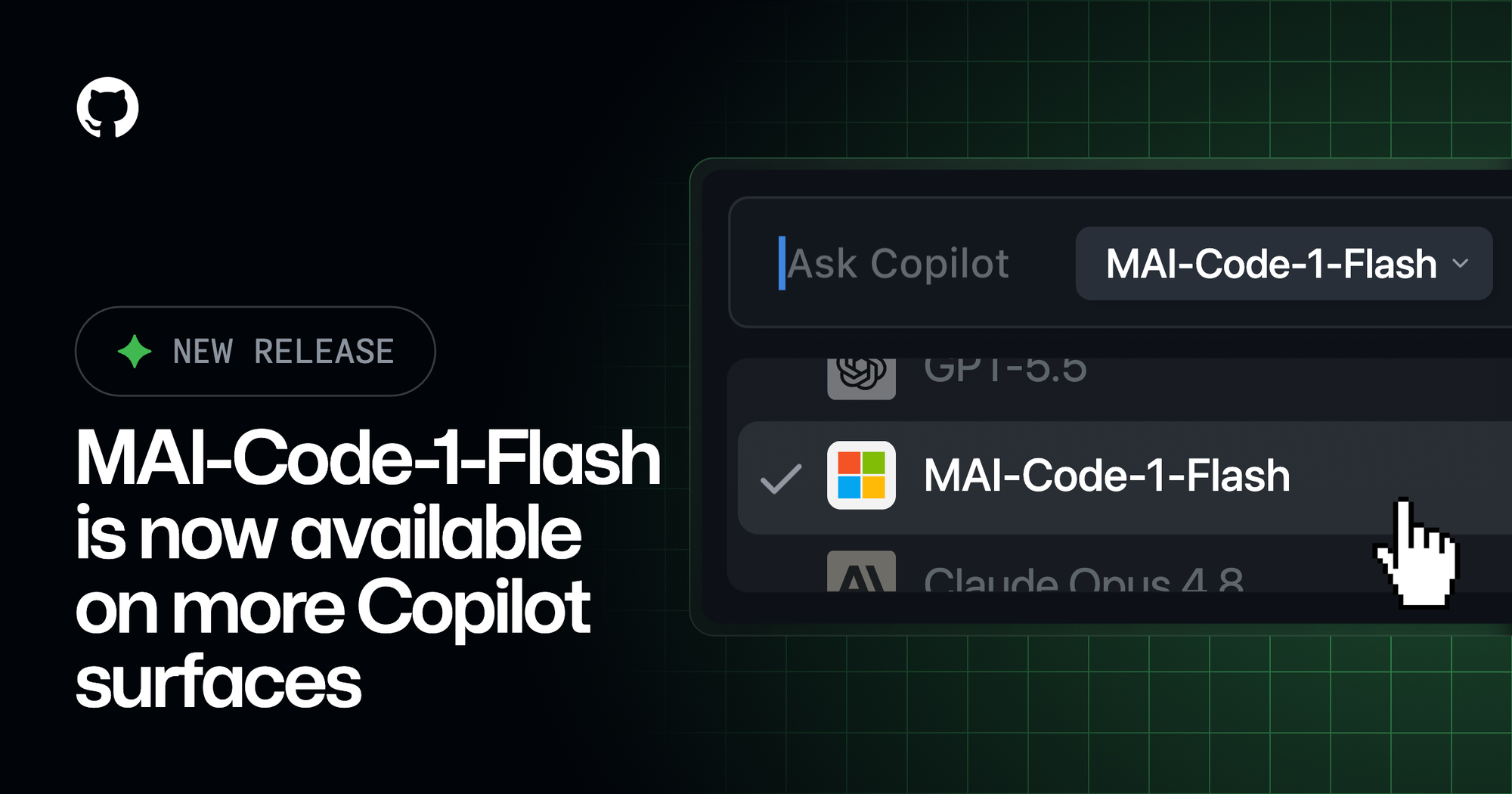
MAI-Code-1-Flash expanding across Copilot is being framed as a model availability update. That is technically true and strategically incomplete. The real product is not the model; it is the router deciding when a small coding model is good enough that GitHub does not need to spend a frontier model on your terminal question.
GitHub says Microsoft’s purpose-built small coding model is now available across more Copilot surfaces: Copilot CLI, the GitHub Copilot app, Copilot Chat on GitHub, Visual Studio, GitHub Mobile, JetBrains IDEs, Eclipse, and Xcode. The rollout starts with a limited set of Free, Student, Pro, Pro+, and Max users, then expands over the coming weeks. Business and Enterprise support is coming later. That staggered rollout is the tell: this is not just a dropdown option. It is GitHub testing the economics and behavior of routing developer work across a broader model portfolio.
GitHub describes MAI-Code-1-Flash as “best-in-class quality for its size” and tuned specifically for Copilot. Fine. The phrase that matters is “for its size.” Small models win when they are fast, cheap, predictable, and good enough for the task in front of them. They lose when product teams pretend “good enough for autocomplete and narrow explanation” means “safe for repo-wide refactors, security-sensitive review, and ambiguous multi-step debugging.” The edge is not whether MAI-Code-1-Flash can pass a benchmark. The edge is whether Copilot can route the right work to it without making developers feel the downgrade.
The future is not one best coding model
Copilot already lists models from multiple providers in its supported-model documentation, including OpenAI, Anthropic, Google, Microsoft, and smaller specialized options. Its model comparison docs explicitly say different models consume AI credits at different rates and recommend choosing by task rather than by name. That is the entire architecture in one sentence: Copilot is becoming a policy and routing layer over a fleet of models.
This is a more realistic shape for AI coding than the old leaderboard mindset. Developer tasks are heterogeneous. A CLI question about a flag does not need the same model as a cloud agent editing a migration across five services. A mobile triage prompt does not need the same latency/quality tradeoff as a security review. A file-local explanation can often be handled by a fast model; a production incident analysis with logs, diffs, and flaky tests probably cannot. Treating all of those as one workload is how teams either overspend or underperform.
MAI-Code-1-Flash gives GitHub another lane in the traffic system. If it is fast enough for routine interactions and accurate enough not to annoy developers, GitHub gets better margins and users get lower latency. If it is routed into tasks that need deeper reasoning, the product will feel cheaper in the bad sense. The model itself matters, but the routing policy matters more.
Small models are cost controls with UX attached
The timing is not accidental. Copilot is increasingly explicit about AI Credits, model multipliers, and the cost implications of agentic workflows. The uncomfortable truth for every coding-agent vendor is that a good agent can be expensive precisely because it does useful work: reading context, calling tools, trying fixes, running tests, compacting history, and recovering from mistakes. You cannot solve that only by showing a monthly bill. You solve it by spending cheaper compute where cheaper compute is sufficient.
That is why MAI-Code-1-Flash should be evaluated as cost-control infrastructure. It may reduce latency in Copilot CLI. It may make mobile and IDE chat feel more responsive. It may absorb simple explanations, narrow edits, and repetitive review nits that do not justify a premium model. Those wins compound. If a developer asks twenty small questions a day, routing those to a fast specialized model is more meaningful than discounting a single frontier-model session.
But the practitioner trap is benchmarking it like a toy contest. Do not ask whether it is “the best coding model.” Ask which work can be safely delegated to it. Good candidate tasks include explaining a file-local function, summarizing a small diff, generating boilerplate, answering CLI usage questions, drafting issue comments, and suggesting simple refactors. Bad first tasks include multi-repo migrations, auth-sensitive code changes, security review, performance debugging, and anything where the cost of a plausible wrong answer is high.
Enterprise delay is a governance signal
The Business and Enterprise delay is worth watching. Individual plans can absorb a new model as a feature. Enterprises need admin controls, data terms, auditability, rollout policy, and cost predictability. A new model inside Copilot is not just another engine; it is another place where organizations ask whether source code, prompts, telemetry, and retention semantics are acceptable.
When MAI-Code-1-Flash reaches Business and Enterprise, platform teams should expect the same questions they already ask about Claude, Gemini, and OpenAI models in Copilot. Who can use it? Which surfaces expose it? Does it have a different AI Credit rate? Can admins disable it? Are there policy differences by region or repository type? Can usage be reported separately? If the answer to those questions is unclear, the rollout will create friction even if the model is excellent.
This is also where model routing collides with compliance. If Copilot automatically routes a task to a model, users need enough transparency to understand what happened. If a regulated team approved one model family for certain repos and not another, “the router picked it” is not an audit strategy. The more Copilot becomes a routing product, the more admins need policy hooks around that router.
What engineers should do now
If MAI-Code-1-Flash appears in your Copilot surfaces, do not turn the rollout into folklore. Run a small task matrix. Compare it against your usual stronger model for fast CLI Q&A, file-local explanation, repetitive code-review suggestions, small tests, and narrow refactors. Track latency, obvious error rate, follow-up turns, and whether the answer needed human cleanup. Then separately test where it fails: multi-file context, ambiguous bug reports, security implications, and unfamiliar internal conventions.
For teams already thinking about agent spend, add small-model routing to the same architecture review as budget ceilings, usage alerts, premium-model approvals, and kill switches. A simple internal guide is enough to start: use MAI-Code-1-Flash for cheap, local, reversible questions; use stronger models for cross-repo reasoning, production changes, security review, and agentic tasks that will write code. The point is not to worship the biggest model. The point is to spend reasoning where reasoning buys down risk.
GitHub’s Copilot strategy is becoming clearer: many surfaces, many models, one routing layer, and increasingly explicit economics. MAI-Code-1-Flash is a small-model wedge into that future. If it works, developers will not celebrate the model name. They will simply notice that Copilot feels faster for routine work and stops burning premium capacity on questions that never deserved it. That is what success looks like here: not magic, just better allocation.
Sources: GitHub Changelog, GitHub Copilot supported models, GitHub Copilot model comparison, GitHub on context handling and model routing