Microsoft Foundry’s APIM Pattern Makes the AI Gateway Boring Enough for Production

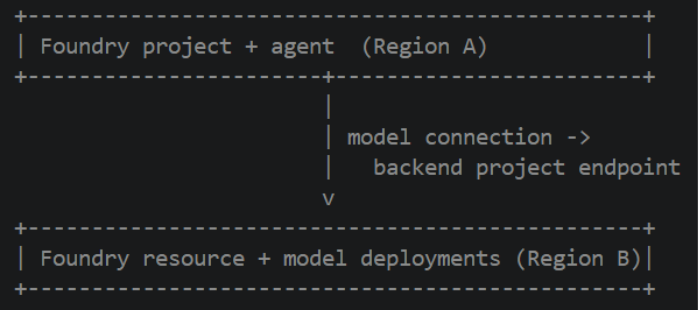
Enterprise AI architecture keeps rediscovering an old truth: the hard part is not calling the model. The hard part is calling the right model, from the wrong region, under the right identity, without punching a hole through your network model or your compliance story.
Microsoft’s new guidance on cross-region model connectivity in Microsoft Foundry is useful because it does not pretend otherwise. The post lays out two supported patterns for projects that need model capacity or agent capabilities outside their approved region: a direct Foundry-to-Foundry connection, or Azure API Management sitting in front as a governed model gateway. The first is the shortest path. The second is the one platform teams will actually recognize as production infrastructure.
That distinction matters. In demo land, a developer chooses a model from a catalog and ships. In enterprise land, the application may be approved for one Azure region, the model may only have quota in another, the agent runtime may need private networking, security may require centralized logging, and compliance may have opinions about every hop between the caller and the backend deployment. Foundry’s direct connection solves the happy path. APIM solves the organizational path.
APIM is becoming the model gateway Microsoft customers already know how to operate
The APIM pattern is not glamorous, which is precisely why it is interesting. Microsoft positions Azure API Management as a customer-controlled front door for model traffic: routing, throttling, policy, observability, network isolation, and managed-identity authentication all live in a layer many Azure platform teams already operate. Instead of treating AI gateway behavior as a special-purpose sidecar, Microsoft is pulling it into existing cloud plumbing.
The reference shape is specific enough to be useful. The project-side Foundry resource can stay in the approved region while a backend Foundry account hosts the model in the capacity region. APIM StandardV2 fronts the path, managed identities handle authentication, and the APIM managed identity is granted Cognitive Services User on the backend account. In the VNet-secured variant, APIM ingress can be exposed through a private endpoint in the project VNet’s pe-subnet, resolved through privatelink.azure-api.net, while the backend Foundry account also sits behind a private endpoint. Caller to APIM to backend stays on Azure’s backbone, not the public internet.
That is the kind of sentence that will bore half the room and save the other half three weeks of architecture review. Private DNS, subnets, managed identities, and RBAC are not footnotes when the model is handling customer data, regulated documents, or internal code. They are the product.
The supported-surface list is also worth reading closely. Microsoft says chat completions and the Responses API work through the pattern. Foundry agents work. Prompt agents work. Red teaming works. Offline and continuous evaluations are marked partial. Foundry IQ recommendations may have reduced fidelity. First-party on-behalf-of tools such as SharePoint Grounding and Fabric Data Agent are not supported through bring-your-own-model via APIM. Batch is direct-only in the documented matrix. Fine-tuning is not applicable to this connection.
That specificity is the best part of the guidance. “Use a gateway” is easy advice. “Use a gateway, but do not expect first-party OBO tools to survive that trust-boundary crossing” is the kind of advice engineers can build around.
The trust boundary is the real architecture diagram
The SharePoint Grounding and Fabric Data Agent limitation is not an arbitrary product gap. Microsoft’s explanation is basically a trust-boundary argument: Foundry must see the caller for agent surfaces, especially for MCP on-behalf-of flows, and tenant-scoped first-party tokens cannot be casually forwarded to a non-Microsoft-managed endpoint. That is exactly the kind of constraint enterprise AI systems should make visible.
Practitioners should treat this as a design fork. If an agent needs first-party Microsoft 365 grounding semantics, keep that flow on a directly connected Foundry deployment that preserves the identity and service assumptions. If another part of the workload needs cross-region model capacity, route that through APIM. Split the workflow if necessary. A cleaner diagram that breaks the security model is not cleaner; it is just wrong with better icons.
The evaluation caveat has the same flavor. Offline and continuous evaluations can run through a BYO connection, but metrics that rely on Foundry-side model introspection — token-level scoring, log probabilities, internal metadata, and similar signals — can degrade because Foundry sees only what the gateway exposes. If your governance program depends on deep evaluation telemetry, an APIM layer is not free. It may require separate direct-backend evaluation runs, explicit trace enrichment, or a documented loss of fidelity.
This is where engineering teams should resist the urge to universalize the pattern. APIM as an AI gateway is strong when the platform requirement is centralized policy and operations. It is weaker when a feature needs deep Foundry-native semantics that the gateway abstracts away. The right answer will vary by workload, which is annoying but honest.
Content safety moved — did your architecture notice?
The most operationally dangerous line in the guidance is the one many teams will skim: Foundry-side content filters do not automatically apply to bring-your-own connections. Microsoft recommends attaching Content Safety and Prompt Shields policies at APIM or invoking them as explicit pre/post steps.
Translation: the gateway gives you control, and then immediately makes you responsible for the controls. If your threat model assumes Foundry’s built-in content filtering is always in the path, a BYO/APIM connection can quietly invalidate that assumption. This is how production incidents happen: not because nobody cared about safety, but because safety moved from one layer to another and the deployment template did not move with it.
For platform teams, the practical move is to bake safety into the APIM template. Do not make Prompt Shields a wiki checklist. Do not make Content Safety an optional module that gets dropped when a deadline slips. Route policy decisions, request IDs, APIM trace IDs, backend deployment names, caller identity, and safety outcomes into the same observability path. If the gateway is the front door, it should also be the audit witness.
The routing nuance is similarly concrete. Microsoft notes that URL-parameterized APIM routing works cleanly for chat completions because the deployment name appears in paths like /inference/deployments/{deploymentName}/chat/completions. The Responses API carries the model name in the JSON payload, which makes body-based routing a different problem. If teams want cleaner dispatch there, Microsoft points toward Foundry dynamic model connection rather than clever APIM payload inspection. That is not a minor implementation detail; it affects latency, policy complexity, and how much request-body parsing you are willing to make part of your gateway contract.
The broader pattern is clear: Microsoft Foundry is becoming less a single-place model catalog and more an enterprise AI control plane. Models may live in another region. Agents may run in the project region. Gateway policy may live in APIM. Safety may be enforced outside Foundry. Evaluations may lose fidelity depending on the path. That sounds messy because real enterprise systems are messy. The useful question is whether the mess is documented, observable, and governable.
What should engineers do now? Start by inventorying the Foundry surfaces your workload actually needs: chat completions, Responses API, Foundry agents, prompt agents, first-party OBO tools, evals, red teaming, batch, fine-tuning, Content Safety, Prompt Shields, private networking, and managed identity. Then choose the connection pattern. Use direct Foundry connections when you want the fewest moving parts and can accept project-side governance. Use APIM when the platform team needs centralized routing, throttling, logging, identity, private endpoints, and policy enforcement. Do not choose APIM just because “gateway” sounds mature. Choose it because you are prepared to operate it.
My take: this is not elegant in the demo sense, and that is why it is credible. The right model is often in the wrong region, and enterprise teams need a governed path that survives compliance review, incident response, and the first quota emergency. APIM as a Foundry model gateway is not magic. It is better than magic: it is boring infrastructure with clear tradeoffs. That is usually what production needed all along.
Sources: Microsoft Tech Community, Microsoft Learn Foundry connections, Microsoft Foundry samples