Microsoft’s M365 Copilot Gateway Pattern Is a Quiet Admission That Enterprises Want Copilots Without Giving Up Their Existing Agent Stack

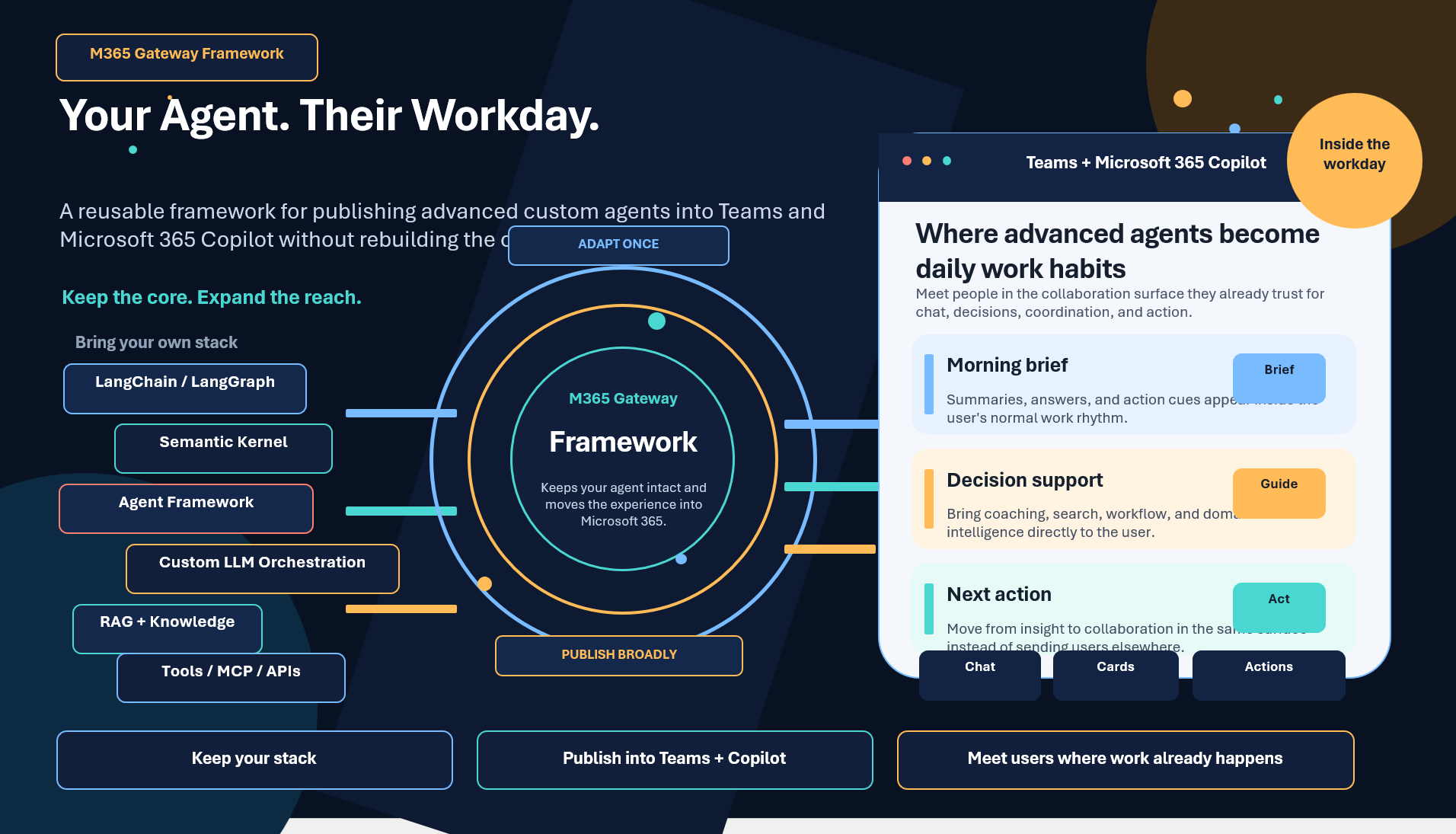
Microsoft just published one of its more revealing AI architecture posts of the year, and the headline undersells it. On paper, the new guide is about deploying an existing agentic service into Microsoft 365 Copilot using delegated On-Behalf-Of, or OBO, access. In practice, it is Microsoft admitting something enterprise teams have been saying for months: they want Copilot distribution, not Copilot lock-in.
That distinction matters. A lot of the AI platform market is still pretending every customer is eager to rebuild whatever they have into the vendor’s preferred runtime. Real teams do not work that way. They already have services built in LangChain, Semantic Kernel, Microsoft Agent Framework, or some internal stack that nobody outside the company has heard of. They have their own prompts, tool routers, session stores, approval flows, and ugly little integration scars. When leadership asks, “Can we put this into Copilot?”, what they usually mean is, “Can we get the reach of Microsoft 365 without rewriting the whole backend?”
Microsoft’s answer, finally, is yes, with caveats and a lot of auth plumbing.
The architecture it documents splits the system into two services. First, an M365-facing gateway handles Bot Framework traffic, validates channel-facing tokens, maps Copilot conversations to service sessions, and performs the first OBO exchange. Second, the actual agentic service stays where the business logic belongs: it owns orchestration, state, downstream API calls, and, if needed, its own further delegated token exchange. Microsoft explicitly describes these as independently deployable layers, with the gateway stateless and the service free to remain stateful, framework-agnostic, and mostly untouched.
That is the interesting product signal. Microsoft could have framed this as a migration path toward native Microsoft 365 Copilot agents. Instead, it documented a preservation path. Keep your existing service. Add a translation layer. Let Copilot become the front door rather than the whole house.
Copilot as channel, not cage
This is healthier than it sounds. Enterprise AI stacks are already messy enough without forcing every useful workflow into one blessed abstraction. If an internal service already knows how to maintain conversations, call tools, and act on downstream systems, then rebuilding it around Copilot-native assumptions would often be pure architecture theater. The gateway pattern avoids that. It treats Microsoft 365 Copilot as a distribution surface, not as the only acceptable runtime.
That is also why the guide leans so hard on separation of trust boundaries. The gateway validates the Bot and channel side. The service validates the service-scoped bearer it receives. Microsoft is blunt that JWT validation is non-negotiable at both boundaries, which is the right tone. This is not magic SSO dust. It is a multi-hop delegated-auth system where the wrong shortcut can quietly become a security bug.
The OBO details are worth reading because they tell you what Microsoft thinks the serious use cases look like. The guide recommends two Entra app registrations, delegated access_as_user permissions, tenant admin consent for both permission hops, and a chained OBO flow in which the gateway performs the first exchange and the downstream service can perform another one for APIs it needs to call as the signed-in user. In the Entra documentation, the OBO flow is specifically described as the pattern where one web API uses a user’s delegated identity to call another web API. That fits this design exactly: Copilot talks to the gateway, the gateway talks to the service, and the service may talk to Graph or another protected backend on the user’s behalf.
If that sounds complicated, it is. But it is the right kind of complicated. This is the complexity you pay when you want a user’s identity to survive across multiple services without anyone storing passwords or pretending a broad app-only token is the same thing as user intent.
The gateway pattern is really about ownership
Microsoft’s quiet concession here is that enterprises want to own more of the stack than vendors usually prefer. The post says the service can remain Bot- and Teams-agnostic. It says the gateway should absorb protocol translation. It says most of the wrapper can be reused, while the service-specific code stays limited to a client adapter and some request-shaping logic. Read between the lines and the message is clear: Microsoft knows many teams are already too invested in their own agent architecture to accept a wholesale rewrite just for Copilot reach.
That is smart. It lets Microsoft win the interface layer without demanding that customers surrender the orchestration layer. In platform strategy terms, that is often the better trade. If Copilot becomes the place users invoke workflows while the underlying service remains portable, Microsoft still gets the distribution advantage of Microsoft 365. The customer, meanwhile, keeps leverage.
There is another reason this matters. Microsoft 365 Copilot’s own extensibility story is increasingly broad: agents, connectors, and APIs designed to let organizations bring custom knowledge and workflows into the Microsoft 365 environment. This gateway model fits that direction, but in a more pragmatic way than the marketing copy usually suggests. Instead of assuming greenfield development, it acknowledges brownfield reality. Most enterprise systems are not blank canvases. They are renovations.
Azure Container Apps is part of that picture too. Microsoft recommends it as the deployment shape, which makes sense. The platform supports HTTP endpoints, internal ingress, background jobs, secret handling, autoscaling, and internal-only service discovery. In plain English, it is a decent home for a gateway-plus-service pattern that needs to scale the public edge separately from a more stateful backend. It is also another clue that Microsoft wants agent systems to look like normal cloud applications, not mystical AI exceptions.
What builders should actually do with this
If you already have a custom agent service and someone is pressuring you to “put it in Copilot,” do not start by rewriting orchestration. Start by drawing your trust boundaries. Decide whether the service truly needs delegated downstream access, which APIs need user-scoped tokens, and where validation must happen. Treat admin consent as an up-front deployment prerequisite, not a thing to debug later after the demo fails. If your service is externally reachable, assume that is a liability and harden it anyway. Private ingress is not mandatory, but it is a sensible default.
Also, be honest about what this pattern is for. It is for teams that want Copilot reach while preserving an existing service contract and auth model. It is not the cheapest possible path for a toy assistant. Chained OBO, bot auth wiring, session mapping, and service-boundary token validation are worth the trouble only when the backend matters enough to keep.
That is why this post stands out. Microsoft is no longer just selling Copilot as an all-inclusive AI destination. It is starting to sell Copilot as a governed entry point into systems customers already own. That is a more believable enterprise story, and probably a more durable one.
My take: this guide matters less as implementation help than as market evidence. Microsoft can see the same thing everyone else can see, namely that enterprise AI adoption is becoming a battle over interfaces and control planes, not just model access. The companies that win will be the ones that let customers plug existing systems into new surfaces without demanding a theological conversion first.
Sources: Microsoft Tech Community, Microsoft Learn: OBO flow, Microsoft Learn: Microsoft 365 Copilot extensibility, Microsoft Learn: Azure Container Apps overview