Microsoft’s MAI Push Is Really Azure’s Bid to Own the Enterprise Agent Media Stack

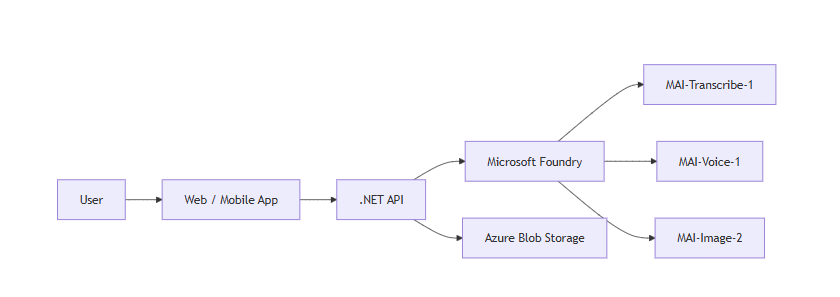
Microsoft’s latest App on Azure post is nominally about three in-house models, but the real story is simpler and more consequential: Azure wants to stop being just the place where companies rent GPUs for other people’s models. It wants to be the vendor that sells the entire media layer for enterprise agents, under one contract, one control plane, and one governance story.
That is what sits underneath the company’s renewed push around MAI-Transcribe-1, MAI-Voice-1, and MAI-Image-2. On paper, this is a fairly standard multimodal product set: speech recognition, speech generation, and text-to-image. In practice, Microsoft is making a more strategic argument. If your company is already building agents on Azure, already lives inside Entra, already has compliance teams asking about Purview, RBAC, logging, and identity boundaries, then Microsoft would very much like you to stop stitching together separate transcription, voice, and image vendors.
The specs are not trivial. MAI-Transcribe-1 supports 25 languages, and Microsoft says it delivers competitive recognition quality at roughly 50 percent lower GPU cost than leading alternatives. The company is pricing it from $0.36 per hour in Azure Speech, which is not just a product detail but a clue to the pitch: this is being sold as something finance and platform teams can reason about, not merely as a model demo.
MAI-Voice-1 is even more obviously aimed at agent builders. Microsoft says it can generate 60 seconds of expressive speech in under a second on a single GPU, with pricing starting at $22 per 1 million characters. The company is also advertising voice cloning from a 10-second audio sample, gated behind responsible-AI approval controls. That matters because it tells you who the intended buyer is. This is not a toy voice lab for novelty apps. It is a service Microsoft expects to end up in customer support systems, interactive copilots, internal assistants, and the increasingly crowded world of enterprise voice workflows.
Then there is MAI-Image-2, Microsoft’s highest-capability in-house image model, which the company says debuted at number three on the Arena.ai leaderboard for text-to-image model families. Microsoft prices it from $5 per 1 million text-input tokens and $33 per 1 million image-output tokens. Days after the broader MAI push, the company also shipped MAI-Image-2-Efficient, a faster sibling that it says is up to 22 percent faster and 4 times more efficient than the base model, with image-output pricing down to $19.50 per 1 million tokens.
That follow-up matters more than it may look. The industry still loves publishing leaderboards and benchmark rankings, but production buyers usually do not purchase “top three on a chart.” They purchase acceptable quality at tolerable latency and predictable cost. Microsoft shipping an efficient variant almost immediately reads less like victory-lap marketing and more like recognition that enterprise image generation is going to be won in the margins: batch throughput, operating cost, moderation fit, and whether the workflow survives procurement review.
This is where the Azure framing becomes the actual story. The App on Azure recap explicitly emphasizes first-party model ownership, Azure-native governance, and agent-first design. Read that closely and you can see Microsoft trying to redefine the competitive field. The company is not claiming that every Azure customer must prefer MAI on raw model merit alone. It is claiming that a model embedded inside Azure’s identity, logging, deployment, and policy surfaces may be more valuable than a slightly better standalone API sitting outside the rest of the enterprise stack.
That is a serious argument, and for many teams it is a persuasive one. Production AI systems are often held back by operational friction more than model quality. Different providers mean different auth flows, separate quotas, separate billing units, duplicated monitoring, inconsistent SDKs, and one more vendor for security to interrogate. Once you start wiring speech recognition from one provider, voice synthesis from another, image generation from a third, and orchestration from a fourth, the application begins to resemble an accidental systems integration project with a chatbot taped to the front.
Microsoft is trying to sell the opposite of that. It wants Azure customers to believe that multimodal agents should be composed from first-party building blocks that inherit the same identity, governance, and deployment logic as the rest of their cloud estate. That is a much stronger platform story than “we also have models now.”
It is also a quiet sign of where the company sees the next AI margin battle. Microsoft has spent the last two years benefiting from its relationship with OpenAI, but the longer-term platform play was always going to require more first-party leverage. A cloud platform that only brokers other companies’ frontier models is useful, but strategically limited. A cloud platform with its own viable speech, voice, and image stack has more room to bundle, price, optimize, and negotiate. Business Insider framed the MAI family as part of Microsoft’s effort to reduce dependence on OpenAI, and that is probably directionally right, but builders should interpret the move less as boardroom drama and more as platform consolidation.
That distinction matters for practitioners deciding what to do next. If you already run multimodal workloads on Azure, this is not a reason to rip out every external model tomorrow. It is a reason to benchmark the pieces that are currently causing you the most operational pain. If you are paying too much for transcription at scale, if your voice stack lives outside your existing governance boundary, or if your image generation pipeline is bottlenecked by cost and moderation overhead, MAI is worth a serious trial. The winning use case is not blind standardization. It is selective consolidation where vendor sprawl has become its own tax.
There are still real caveats. “First-party” does not mean “best.” Microsoft’s strongest evidence today is around efficiency, enterprise integration, and packaging, not universal supremacy on every creative or speech task. Teams should test recognition accuracy against their actual noisy audio, not brochure benchmarks. They should test MAI-Voice-1 on their own latency requirements, quality thresholds, and voice-governance needs. They should compare MAI-Image-2 and MAI-Image-2e not just on image aesthetics, but on moderation behavior, text rendering reliability, batching performance, and cost per completed workflow.
And there is a broader architectural lesson here. The enterprise AI market is moving past the phase where every launch can be judged as an isolated model event. What matters now is whether a provider can turn models into boring infrastructure. Can the system fit into your identity layer, your policy layer, your monitoring stack, your billing expectations, and your deployment workflow without creating another review meeting every time you add a feature? That is the real bar. Microsoft seems to understand that, which is why this announcement reads less like research theater and more like platform packaging.
My read is that the MAI family matters less as proof that Microsoft can ship another model and more as proof that Azure has chosen its lane. It wants to be the default place enterprises buy agent media infrastructure, not just agent compute. For developers, that is good news if it reduces glue code and governance drag. For competitors, it is a warning that the next fight is not only about model IQ. It is about whose stack is easiest to live inside for the next five years.
Sources: Microsoft Apps on Azure Blog, Microsoft Azure AI Foundry Blog, Microsoft Azure AI Foundry Blog on MAI-Image-2-Efficient, Microsoft Learn