Microsoft’s New RAG Tutorial Is Really a Quiet Push to Make Azure’s AI Stack Less Composed and More Bundled

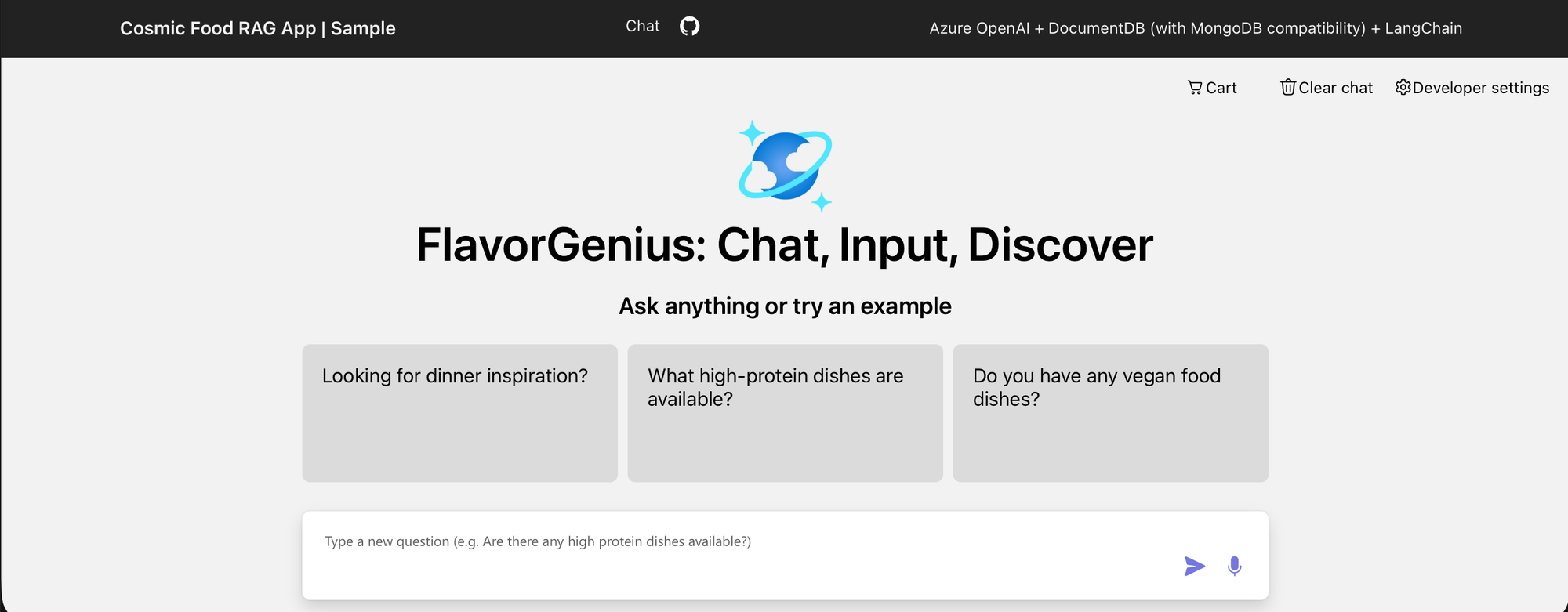
Microsoft’s latest RAG tutorial looks innocuous enough: a student-friendly walkthrough for wiring LangChain to Azure OpenAI, Azure DocumentDB, and App Service. The bigger story is that Microsoft is steadily trying to make Azure’s AI stack feel less like a set of interchangeable components and more like a bundled product. That is not a cosmetic shift. It changes how teams prototype, how they buy, and eventually how hard it is to leave.
The tutorial, published on Microsoft Tech Community, walks builders through a very specific architecture. Provision an Azure DocumentDB cluster with MongoDB compatibility at the M25 tier, deploy gpt-4o-mini for chat and text-embedding-3-small for embeddings in Microsoft Foundry, then ship the app to Azure App Service on Python 3.12 running on Linux with a Basic B1 plan. The sample app itself, Cosmic Food RAG, is not pretending to be novel research. It is a straightforward recommendation app built with Python, TypeScript, Bicep, and Azure Developer CLI.
That is exactly why it matters. Microsoft is not using a flashy frontier-model launch to sell this architecture. It is using a tutorial. Tutorials are where platform strategy becomes habit. The defaults people copy into their first internal demo have a funny way of surviving budget reviews, staffing changes, and roadmap churn.
One database, one cloud boundary, one fewer excuse to add another vendor
The pitch behind Azure DocumentDB’s integrated vector store is simple and unusually pragmatic. Microsoft’s own documentation says the point is to store, index, and query embeddings alongside the original JSON data so teams do not have to replicate data into a separate vector database. The docs also explicitly frame this as a way to avoid extra cost and keep multimodal operations closer to the source data. Under the hood, Microsoft is not treating this like toy vector support either. The Learn docs position DocumentDB around real indexing options, including DiskANN, HNSW, and IVF.
That is a materially different argument from the first wave of RAG infrastructure, where the default answer was, “add one more database.” A lot of early AI stacks quietly accumulated an embeddings service, a vector database, an application database, a model endpoint, and some glue code held together by environment variables and optimism. Microsoft is now making the opposite argument: if your data is already in an Azure-shaped world, you may not need the extra moving part.
For engineering leaders, that is not trivial. Most production AI pain is boring pain. Identity sprawl. Sync jobs. Separate pricing models. Another dashboard. Another compliance review. Another thing that pages a human at 2 a.m. because a connector drifted. A bundled architecture does not eliminate those problems, but it can reduce the number of places they appear.
The tutorial is less interesting than the normalization effort behind it
Look closely at the implementation details Microsoft chose to spell out. The guide hard-codes embedding dimensions at 1536, matching text-embedding-3-small. That is a small detail until you remember how many teams have lost time on schema mismatches between embedding models and vector indexes. It deploys on a modest App Service plan instead of pretending every AI app needs an expensive cluster on day one. It points readers at a public repo and low-cost deployment guidance. The message is clear: this is supposed to be copied by ordinary builders, not admired from a conference slide.
There is also a subtle Foundry story here. Microsoft increasingly wants Foundry to be the control plane where model selection, deployment, and enterprise governance meet. The tutorial is nominally about LangChain plus RAG, but the stack keeps bending back toward Microsoft-owned surfaces: Foundry for models, DocumentDB for vectors and source data, App Service for hosting, GitHub-driven deployment, Azure-native configuration everywhere. The composition is still there, but the composition is being domesticated.
That matters because enterprise cloud strategy often gets decided by what is “good enough and easy enough” rather than what wins a benchmark thread. If Azure can offer acceptable retrieval quality, acceptable latency, acceptable cost, and fewer integration seams, it does not need to be the most elegant architecture in abstract. It just needs to be the easiest architecture to approve.
What builders should actually test before buying the bundle story
None of this means teams should blindly consolidate. Integrated vector storage is compelling, but it is not automatically the right answer. The practical questions are annoyingly concrete. How does retrieval quality compare with the specialist vector database you would otherwise use? How painful is reindexing when you swap embedding models? What happens to latency under heavier concurrent load? How much operational visibility do you get when similarity search starts behaving strangely? And how expensive does “simple” stay once the prototype becomes a product?
This is where Microsoft’s tutorial stops being enough on its own. A step-by-step guide can prove developer experience. It cannot prove fit. If you are already using Pinecone, Weaviate, Qdrant, pgvector, or a managed search stack, you should treat Azure DocumentDB as something to benchmark, not a foregone conclusion. Run your ugliest documents through it. Measure recall, not just happy-path demo quality. Test index build times, schema evolution, and failure handling. Simplicity that disappears at scale is just deferred complexity with better marketing.
There is also a lock-in question that deserves more honesty than cloud vendors usually give it. When your embeddings, source data, hosting, deployment workflow, and model governance all converge inside one vendor boundary, leaving later gets harder even if each individual component looked replaceable at the start. Sometimes that trade is worth it. Plenty of teams would rationally choose tighter vendor coupling in exchange for faster delivery and fewer operational edges. But it should be a conscious trade, not something you accidentally inherit from a tutorial.
RAG is commoditizing, so platform packaging is the real battle
The deeper read on this post is that Microsoft knows plain RAG architecture is no longer exciting. Everyone has a vector-search story now. Everyone has a LangChain sample. Everyone says their platform can ground a model in enterprise data. The competition has shifted from “can you do RAG?” to “how much plumbing do I still have to own after I say yes?”
That is why this tutorial is strategically sharper than it first appears. It quietly reframes Azure AI from a toolbox into a path. Use the Microsoft embeddings model. Put the vectors in Microsoft’s database. Host the app on Microsoft’s platform. Manage the deployments in Microsoft’s control plane. There is nothing sneaky about it. It is just good platform design, if you are Microsoft, and something engineers should notice, if they are not.
The right practitioner takeaway is not cynicism. It is discipline. If you are an Azure-native team trying to get a useful internal assistant or customer-facing RAG app into production this quarter, this stack probably deserves a fair trial. The reduced surface area is real value. But do the grown-up work before standardizing on it: benchmark retrieval, trace total cost, document migration escape hatches, and decide where a bundled stack helps versus where it quietly narrows your options.
Microsoft did not just publish a RAG how-to. It published a template for how it wants enterprise builders to think about Azure AI in 2026: less stitched together, more vertically packaged, and just convenient enough that arguing for an extra vendor starts to feel like unnecessary architecture theater.
Sources: Microsoft Tech Community, Microsoft Learn, Azure-Samples/Cosmic-Food-RAG-app