Microsoft’s Prior-Authorization Template Is a Good Demo, but the Real Story Is That Foundry Is Becoming Compliance Workflow Infrastructure

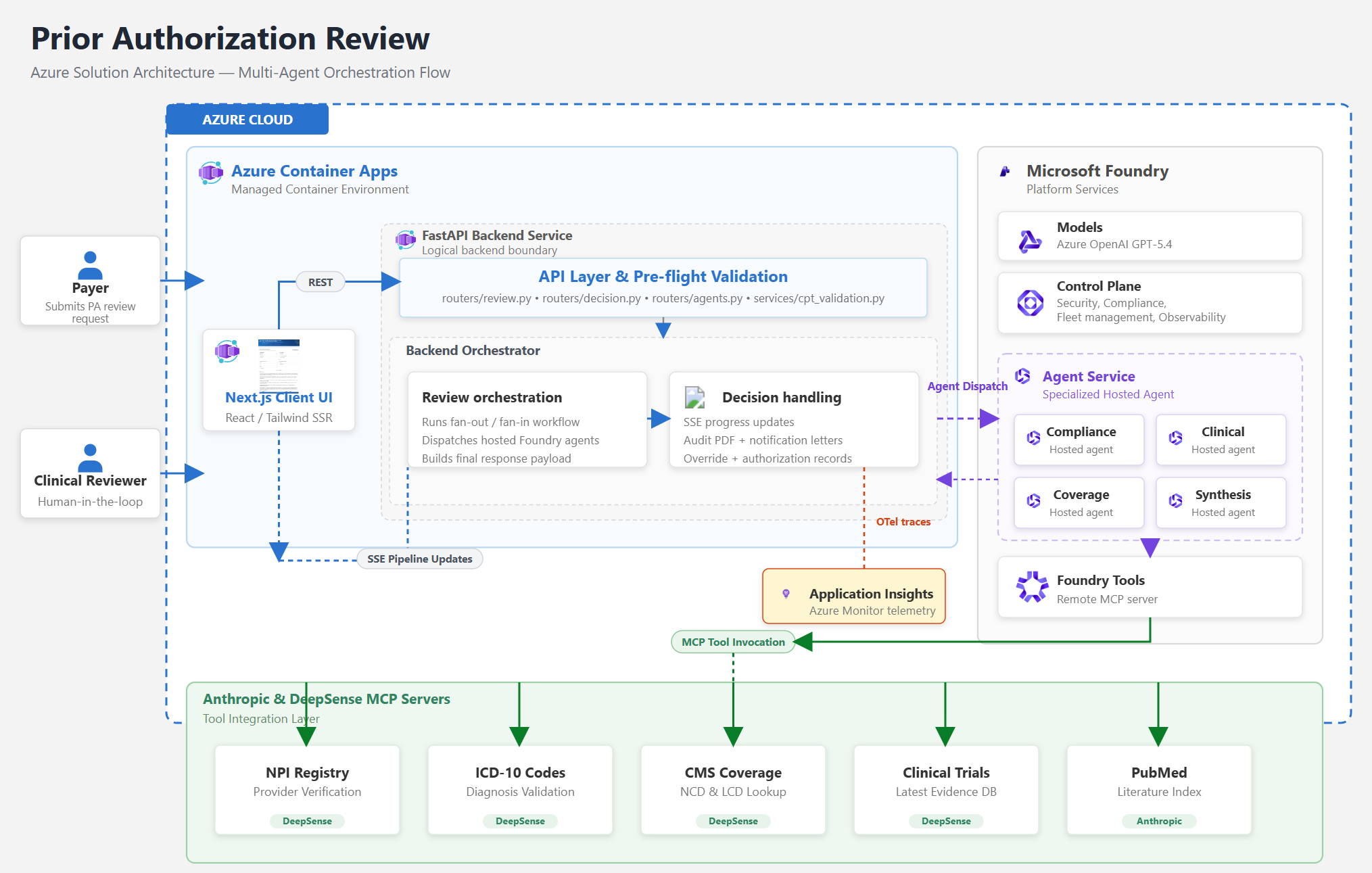
The most interesting thing about Microsoft’s new prior-authorization template is not that it uses four agents. Everyone has four agents now. The interesting thing is the kind of workflow Microsoft picked to prove its point.
Prior authorization is ugly work. It is politically toxic, operationally expensive, full of documentation friction, and under increasing regulatory scrutiny. That makes it a much better test of enterprise AI than another polished copilot demo. If Microsoft wants people to believe Foundry can host real decision workflows, not just impressive conversations, this is exactly the sort of battlefield it has to choose.
The company’s new Foundry template packages a payer-side prior-authorization review pipeline around four hosted agents: Compliance, Clinical Reviewer, Coverage, and Synthesis. The flow is deliberately structured. Compliance and Clinical run in parallel. Coverage waits for the clinical output. Synthesis then evaluates everything through a gated rubric that weights coverage criteria at 40 percent, clinical extraction at 30 percent, compliance at 20 percent, and policy match at 10 percent. The result is not sold as an autonomous denial machine. In its default mode, the system only recommends APPROVE or PEND, and every recommendation still requires clinician acceptance or override.
That last part is the entire story. Microsoft is not really launching a healthcare feature here. It is demonstrating a product thesis: Foundry wants to be the platform where regulated, human-reviewed, auditable AI workflows live.
The healthcare context makes the commercial ambition obvious. Microsoft cites the American Medical Association’s estimate that physicians complete an average of 39 prior-auth requests per week and spend roughly 13 hours of physician-and-staff time on that work. It also points to an estimated $35 billion in annual administrative spending tied to prior authorization. The regulatory pressure is tightening too. CMS-0057-F requires electronic prior authorization, with urgent response expectations beginning in 2026 and broader compliance timelines in 2027. That means payers do not just have a paperwork problem. They have a clock.
Microsoft’s internal testing claims the template can reduce end-to-end review time to under five minutes per synthetic case, while the open-source GitHub repository goes even harder in its pitch and describes full reviews in under two minutes. Those numbers should be treated carefully. They are internal, synthetic, and wrapped in a long list of disclaimers that make clear this is not a medical device, not production-ready software, and not proof of autonomous clinical decision-making. Good. Those disclaimers make the release more credible, not less. In regulated AI, honesty about the limits is part of the product.
Foundry is being positioned as compliance infrastructure
That is the real read. Microsoft could have shown a healthcare chatbot or a summary tool and called it innovation. Instead it is emphasizing typed outputs, audit PDFs, confidence scoring, OpenTelemetry traces, keyless authentication through DefaultAzureCredential, and a hosted-agent runtime that keeps each specialist independently containerized and versioned. The FastAPI backend is described as a simple dispatcher. The intelligence sits inside the Foundry-hosted agents. In other words, Microsoft is trying to make the messy parts of regulated AI look like managed platform features.
This matters well beyond healthcare. Prior authorization is just a particularly miserable example of a much broader enterprise category: decisions that cannot be fully automated, but are surrounded by repetitive evidence gathering, policy lookups, and justification work. Claims review, intake triage, fraud analysis, underwriting support, internal compliance review, exception management, vendor risk assessment, even parts of enterprise procurement all rhyme with this problem. If Foundry can become believable in one of those spaces, Microsoft has a stronger and more durable story than “we also host good models.”
The architecture shows how the company wants customers to think. The template uses five MCP-backed data sources, including ICD-10, the NPI Registry, CMS Coverage, PubMed, and ClinicalTrials.gov. Agent outputs are schema-enforced rather than loose blobs of text. Overrides are captured and folded into downstream artifacts, including audit documents and notification letters. Agent behavior lives in markdown skill files instead of requiring domain logic to be buried deep in application code. That is a subtle but smart choice. It means the people who understand policy changes best, clinicians and compliance owners, are at least closer to the control surface than they would be in a conventional hard-coded automation stack.
The best enterprise AI story is still about reducing paperwork, not replacing experts
This template is another reminder that the practical opportunity in enterprise AI remains narrower, and more valuable, than the market likes to admit. The exciting pitch is always “replace the expert.” The useful pitch is usually “compress the clerical work around the expert.” Microsoft is firmly in the second camp here, and that is the right place to be.
That distinction matters because prior authorization has terrible tolerance for black-box behavior. Patients, providers, regulators, and payers all have reasons to care how a recommendation was reached. A system that produces a fast answer without explainability is not a solution. It is discovery material for the next hearing. Microsoft’s template reflects that political reality. The decision policy is lenient by default. Human review is mandatory. Audit trails are first-class. The company is effectively saying that if agent systems are going to survive in regulated environments, they need to look less like autonomous copilots and more like evidence-assembly machinery with controlled handoff points.
For practitioners, that is the valuable lesson. Do not get distracted by the word “healthcare” and assume this is a vertical one-off. The template is a reference design for how Microsoft thinks serious agent systems should be built: scoped agents, explicit orchestration, typed contracts, real-time data connectors, keyless identity, observability from day one, and a human override path that is not bolted on after legal gets nervous. If you are building any review-heavy workflow, this is the pattern worth stealing.
There are also reasons to stay skeptical. The template currently leans on synthetic demo data and third-party MCP services included for demonstration only. Production deployments handling PHI will need different controls, self-hosted data services, harder security review, storage decisions, and a lot more testing than a one-command azd up story implies. The fact that agent behavior can be edited through markdown is powerful, but it also means governance around those edits matters. Text-based policy changes are easier to make and easier to get wrong. Regulated workflows do not stop needing change management just because the interface got friendlier.
Still, Microsoft deserves credit for choosing a hard problem and describing it in operational terms. Too much enterprise AI marketing still assumes the model is the product. Here the model is almost the least interesting component. The product is the workflow: how evidence is gathered, how policies are matched, how outputs are structured, how identity is handled, how humans stay in the loop, how decisions can be justified later.
That is the more serious market now. Foundry is not just trying to be where companies deploy chat experiences. It is trying to be where they operationalize messy, review-bound, regulator-adjacent work that nobody likes doing manually and nobody is willing to hand fully to a machine. That is a much harder claim to earn, but it is also the kind that can stick once proven.
My take is simple. Do not read this as “Microsoft solved prior authorization.” It did not. Read it as Microsoft using one of the worst workflows in American healthcare to make a broader platform argument: enterprise AI becomes real when it can survive audit, override, and accountability. That is a better story than another assistant launch, and a more useful one for builders deciding what kind of systems they should actually ship.
Sources: Microsoft Azure AI Foundry Blog, Microsoft Prior Authorization Multi-Agent Solution Accelerator, CMS-0057-F fact sheet