Nemotron 3 Ultra Is NVIDIA's Real Answer to Agent Cost: Smaller Active Model, Open Recipes, and Infrastructure Attached

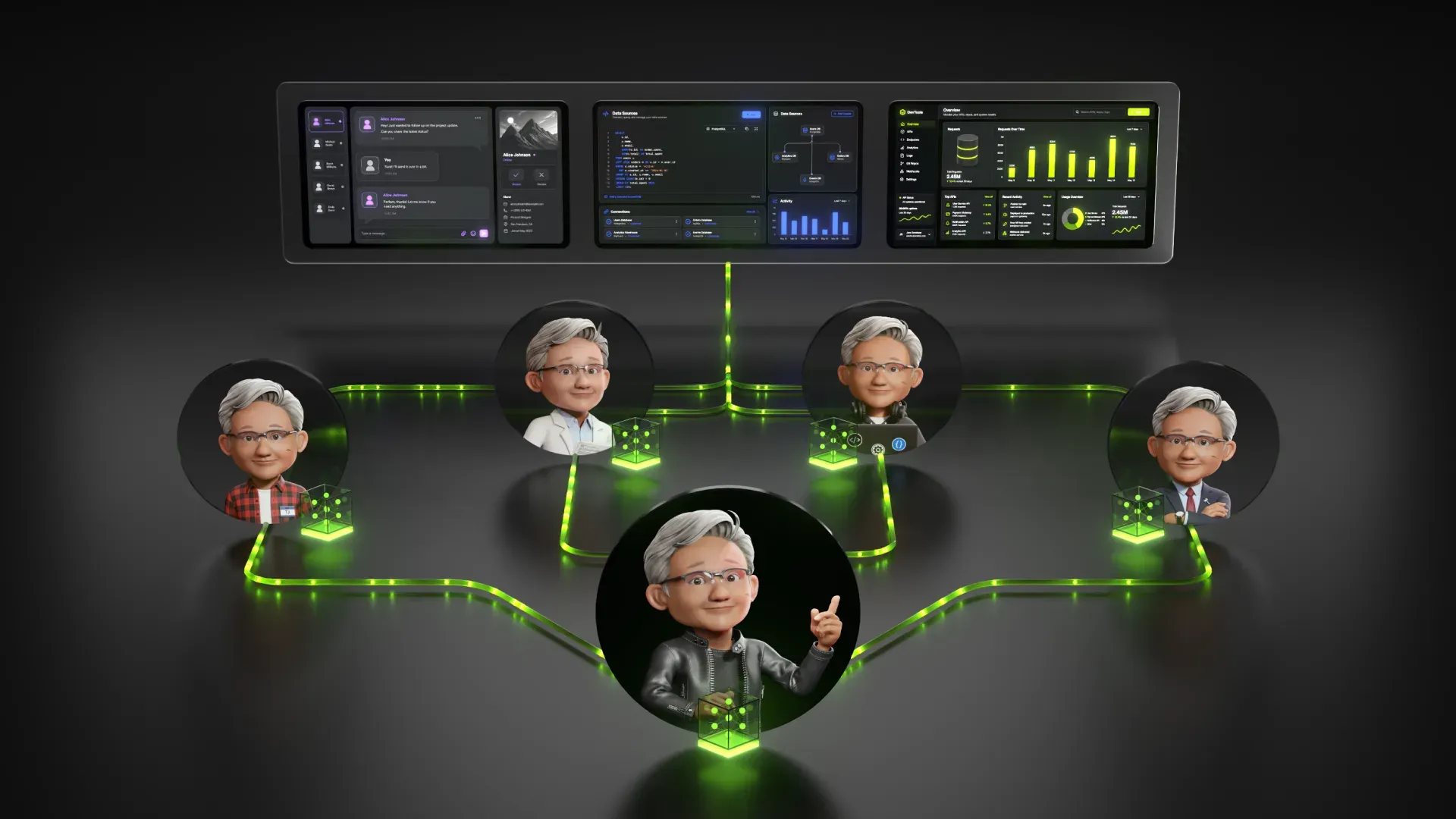
NVIDIA did not just ship another big open model. It shipped a thesis about where agent costs actually go.
Nemotron 3 Ultra is a 550B-parameter mixture-of-experts model with 55B active parameters, aimed squarely at long-running agent workflows: coding sessions, research loops, tool-heavy operations work, and multi-agent systems that spend more money talking to themselves than producing the final answer. The model matters, but the launch is bigger than the checkpoint. NVIDIA is bundling weights, recipes, runtime packaging, deployment guidance, safety companions, RL environments, and agent-harness integrations into one stack. That is the real product.
The headline architecture is familiar in shape but aggressive in execution: LatentMoE routing, a hybrid Mamba-plus-Transformer design, multi-token prediction, and NVFP4 checkpoint support across Hopper, Blackwell, and Ampere GPUs. NVIDIA says the model delivers 5× higher throughput than other open models in its class and can cut cost-to-task-completion by up to 30% on SWE-bench and Terminal-Bench 2.0-style experiments because it uses fewer total tokens and fewer tokens per turn. That last phrase is the important one. Agent cost is not mostly a price-per-million-token problem. It is a loop problem.
Agents plan, call tools, read observations, retry, delegate, validate, summarize, and then feed all of that back into the next turn. A model that is 20% cheaper per token but needs twice as many repair turns is not cheaper. A model that is slightly weaker on a static benchmark but completes the workflow with fewer tool calls can win the bill. Nemotron 3 Ultra is NVIDIA arguing that the evaluation unit should be completed tasks, not isolated completions.
The benchmark table is not the whole argument
NVIDIA's own numbers are not a clean sweep, which is good because clean sweeps in vendor tables usually deserve a code review. Nemotron 3 Ultra reports 91% on PinchBench, 33% on EnterpriseOps-Gym, 54% on Terminal-Bench 2.0, 82% on IFBench, 1,448 on GDPVal-AA, 56% on ProfBench Search, and 95% on RULER at 1M context. In the comparison table, GLM 5.1 leads EnterpriseOps-Gym at 40% and GDPVal-AA at 1,594. Kimi K2.6 leads Terminal-Bench 2.0 at 67% and ties ProfBench Search at 56%.
That makes the launch more interesting, not less. NVIDIA is not saying Nemotron 3 Ultra is the smartest model on every row. It is saying a 55B-active open model with a deployment story can be the better engineering choice for agent systems. That distinction matters for practitioners. The model market has been trained to worship peak benchmark rows. Production teams care about latency, throughput, observability, licensing, inference stack maturity, fine-tuning path, safety controls, and whether the thing survives the harness they actually use.
The harness point is especially important. NVIDIA says Nemotron 3 Ultra lands between 65% and 70.4% on SWE-bench Verified across Pi, OpenHands, Hermes, OpenCode, and Mini SWE Agent. That is not just a model score; it is a compatibility claim. Agent benchmarks vary wildly with scaffolding: retry policy, tool permissions, file editing behavior, terminal access, validators, and termination rules can move results as much as the model does. If a checkpoint performs consistently across several harnesses, that is more useful than one heroic number inside a bespoke setup.
Open weights are table stakes; open recipes are the differentiator
The more serious part of the release is the surrounding infrastructure. NVIDIA says Nemotron 3 Ultra builds on a 10T-token pretraining foundation plus 212B targeted tokens: 4B synthetic legal tokens, 35B synthesized Wiki-based tokens, and 173B refreshed GitHub tokens through Sept. 30, 2025. It is also releasing 10M new supervised fine-tuning samples, 1M new RL tasks, and 15 new RL environments, bringing cumulative Nemotron open data totals to 50M SFT samples, 2M RL tasks, and 55 RL environments.
That is the right kind of boring. Most “open” model launches hand developers weights and vibes. NVIDIA is trying to hand them a process: NeMo RL recipes, GRPO and MOPD paths, LoRA/SFT examples, NIM packaging, Dynamo deployment recipes, and partner endpoints through Hugging Face, OpenRouter, Anaconda, Perplexity, cloud providers, and inference services. For enterprise and sovereign-AI teams, that bundle is what turns a model from a weekend benchmark into something procurement and security can review without inventing the whole stack from scratch.
The MOPD detail is worth watching. Multi-Teacher On-Policy Distillation trains with more than 10 specialized teacher models, using asynchronous student rollout generation, teacher scoring, and student optimization. That is NVIDIA's way of making the model better at agentic work without betting everything on one monolithic teacher or one reward signal. It also fits the broader 2026 post-training pattern: the frontier is moving from “bigger pretraining run” toward “better loops around the model.”
Practitioners should not read this as “replace your frontier model tomorrow.” The right move is a routing bake-off. Put Nemotron 3 Ultra against your current model on long-horizon tasks, not chat transcripts. Measure completed-task cost, tool-call count, retry rate, validator pass rate, wall-clock latency, human-intervention rate, and regression risk. If it wins on total workflow economics while staying inside your quality bounds, it earns a route. If it only wins tokens-per-second while requiring more repair turns, the benchmark hid the actual cost.
Also be honest about the NVIDIA-shaped path. NVFP4, Blackwell-optimized throughput, NIM, Dynamo, and NeMo are advantages if your infrastructure can use them. They are not universal magic. Teams on mixed hardware or hosted-only stacks should test the deployed endpoint they plan to run, not the marketing architecture.
Nemotron 3 Ultra looks less like a model release and more like NVIDIA making the agent-runtime argument in public: open models win enterprise adoption when the model, data, recipes, runtime, safety, and deployment path arrive together. It does not need to beat every closed model on every benchmark. It needs to make long-running agents cheaper, more reviewable, and less surprising. That is a better bar than another leaderboard slide.
Sources: NVIDIA Technical Blog, NeMo RL Ultra guide, Hugging Face model card, NVIDIA technical report