NVIDIA Wants Coding Agents to Stop Faking Computer-Vision Expertise

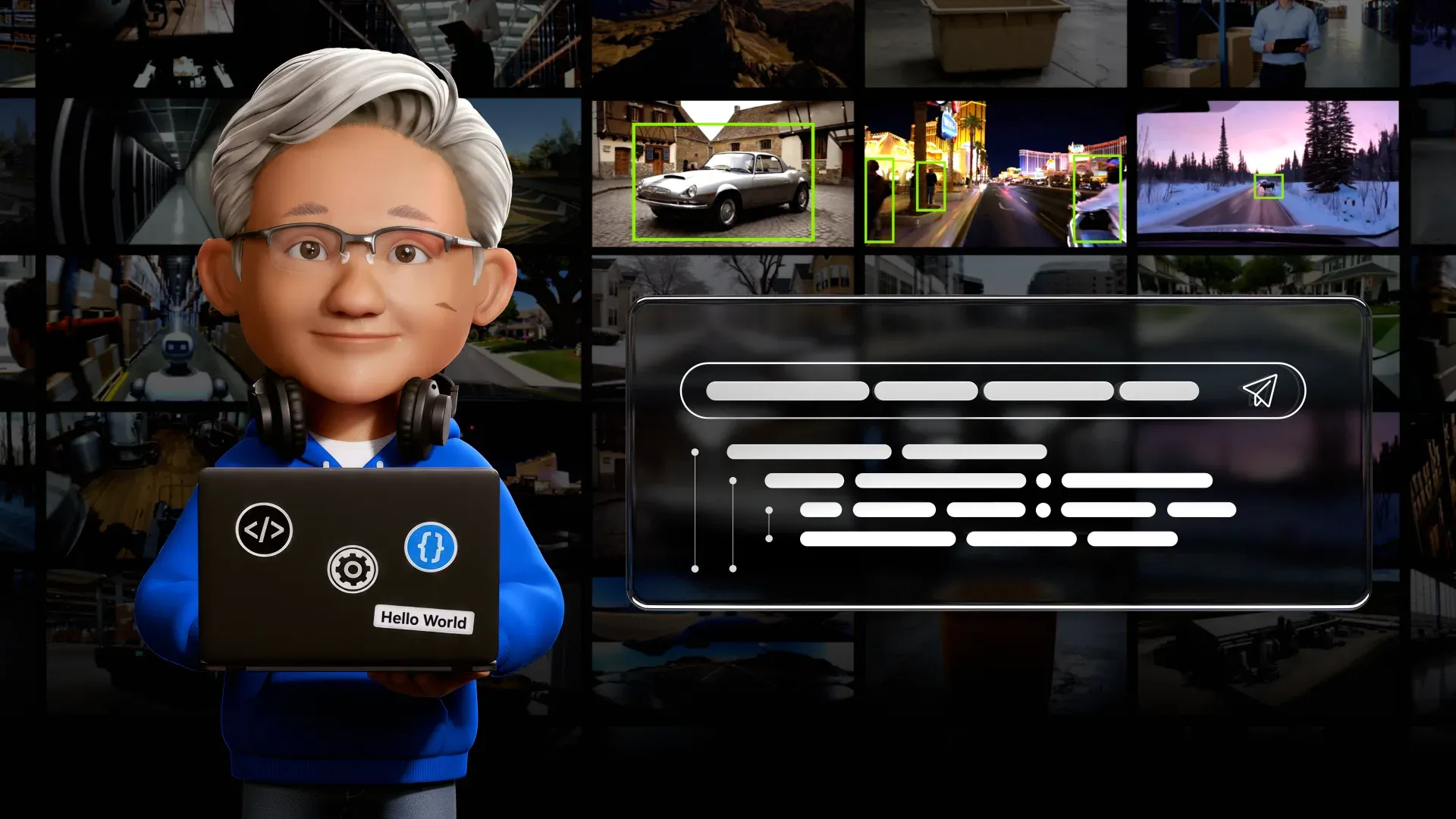
NVIDIA’s latest DeepStream pitch is interesting for a reason that has almost nothing to do with the usual agent-demo theater. The company is not asking developers to marvel at a chatbot that scaffolded another todo app. It is trying to convince teams that coding agents can be useful inside one of the more failure-prone corners of applied AI: real-time vision systems, where one bad parser, one wrong tensor shape, or one sloppy deployment assumption can turn a clean demo into an expensive debugging weekend.
That is what makes this launch worth paying attention to. NVIDIA is packaging a DeepStream coding-agent workflow around a curated skill, reference documents, and structured prompts that target DeepStream 9, its pyservicemaker APIs, and production-flavored deployment tasks. In plain English, it wants Claude Code, Cursor, and similar agents to stop improvising their way through GPU video pipelines and start operating inside a narrower, better-instrumented lane.
The distinction matters. Most of the current “agentic coding” market is still selling acceleration at the level of syntax and scaffolding. DeepStream is selling acceleration in a domain where context quality is the product. Vision pipelines are full of brittle details: decode paths, batching rules, parser ABIs, tracker configs, message brokers, deployment targets, and hardware assumptions that differ across x86, Jetson, and cloud GPUs. A model that can bluff its way through frontend boilerplate will fall apart quickly if it guesses wrong about infer-dims, postprocessing, or how streams are multiplexed.
NVIDIA’s post gets concrete fast. One example asks an agent to generate a Python application that ingests N RTSP streams, decodes and converts frames, samples them at configurable intervals, batches frames per stream, runs them through a multimodal vision-language model, and ships text summaries out via Kafka. The company frames this around Cosmos Reason 2, which it says can operate with a context window up to 256K tokens and sample frames dynamically based on frame rate and resolution. It then layers on a second prompt to turn the generated app into a FastAPI microservice with stream-management endpoints, health checks, metrics, a Dockerfile, and deployment guidance.
That is already more ambitious than most coding-agent marketing. Then NVIDIA moves to a YOLOv26 example, where the agent is supposed to inspect or ingest the model, generate ONNX-compatible deployment logic, and write the DeepStream glue needed to do real inference. The blog walks through the three details that always matter in this kind of integration: input tensor shape and scaling, output tensor naming and layout, and postprocessing. In its example, that means settings like infer-dims=3;640;640, net-scale-factor=1/255, and a custom parser that consumes an output0 tensor shaped [300, 6], with rows structured as [x1, y1, x2, y2, conf, class_id].
This is the important part: NVIDIA is not pretending the model will magically intuit specialized systems code. It is feeding the agent a constrained environment. The companion GitHub repository for DeepStream_Coding_Agent lays out the mechanism pretty clearly. The skill bundles condensed references for GStreamer plugins, DeepStream service-maker APIs, Kafka setup, tracker configs, MediaExtractor behavior, REST patterns, Docker usage, troubleshooting, and best practices. The target runtime is also spelled out with unusual specificity: DeepStream SDK 9.0, Python 3.12+, NVIDIA driver 590+, CUDA 13.1, TensorRT 10.14.1.48, and Ubuntu 24.04 on x86_64 or ARM64/Jetson.
That stack discipline is the real story. The market keeps asking whether coding agents are “good enough” in the abstract, but that is the wrong question. In specialized engineering domains, agents become useful when someone does the tedious work of building context rails around them. NVIDIA is effectively saying that if you package the right references, force the agent to consult them, and narrow the surface area of acceptable outputs, you can move from vibe coding to constrained generation.
That has two consequences for practitioners.
First, it suggests that the next durable coding-agent wins may come from domain packs, not just base models. The model still matters, but less than the workflow. A vendor that can make an agent reliable inside DeepStream, PCIe-heavy video stacks, or inference-serving infrastructure is building something more defensible than a generic “AI engineer” persona. This is the same pattern enterprise developers keep rediscovering elsewhere: the winning tool is usually the one that already knows the weird parts of your stack.
Second, it sharpens the line between acceleration and accountability. NVIDIA’s own repository includes the most mature sentence in the whole package: AI-generated code is a starting point and must still go through full SDLC review, testing, and security validation before production use. That disclaimer is not legal wallpaper. It is the operational truth. A pipeline that compiles and even runs is not the same thing as a pipeline you should trust with live cameras, GPU budgets, or downstream alerting.
There is also a broader market signal hiding here. Agentic coding vendors have mostly fought on the usual axes: model quality, agent autonomy, editor UX, cloud versus local, and price. NVIDIA is entering from a different angle. It wants to make the hardware and SDK layer more legible to the agent itself. That is strategically smart because vision AI workloads are not just code-generation problems. They are systems-integration problems attached to expensive infrastructure. If the agent can shorten the path from prompt to working DeepStream topology, NVIDIA sells more of the ecosystem around that topology too.
That does not mean teams should swallow the pitch whole. The obvious risk is false confidence. Once an agent writes a parser, a Kafka publisher, a Dockerfile, and a FastAPI wrapper in one shot, the output can look deceptively complete. In practice, the hard work starts after the first green run. You still need to inspect memory behavior, validate that frames never mix across streams, profile latency under load, make sure GPU allocation behaves sanely across multiple devices, and review every service boundary the agent just invented. The easier code becomes to generate, the easier it becomes to generate infrastructure debt at machine speed.
Still, this is one of the more credible agent launches in recent memory because it is not primarily selling magic. It is selling scaffolding. NVIDIA understands that the route to useful agentic coding in technical domains is not “trust the model more.” It is “make the problem smaller, make the references better, and make human review cheaper.” That is a much healthier product instinct than the endless parade of demos where the agent succeeds once in public and leaves the user alone with the consequences.
If you are running computer-vision projects, the practical move is not to hand your pipeline to an agent and hope. It is to steal the pattern. Build or adopt narrow skill packs. Codify your reference docs. Treat prompts like interfaces, not vibes. Make deployment targets explicit. And demand that every generated artifact stay legible enough for a human to review without reverse-engineering the model’s intent.
The deeper takeaway is that agentic coding is growing up by becoming less general than it first appeared. The strongest systems are not the ones that can allegedly do anything. They are the ones that can do a specific hard thing, inside a bounded environment, with enough context and guardrails that the output starts to look boringly usable. In software, boringly usable is how products actually win.
Sources: NVIDIA Technical Blog, NVIDIA DeepStream Coding Agent GitHub repository, NVIDIA DeepStream SDK Developer Guide