OpenClaw’s Beta Release Gate Fix Is Boring Supply-Chain Work, Which Is Why It Matters

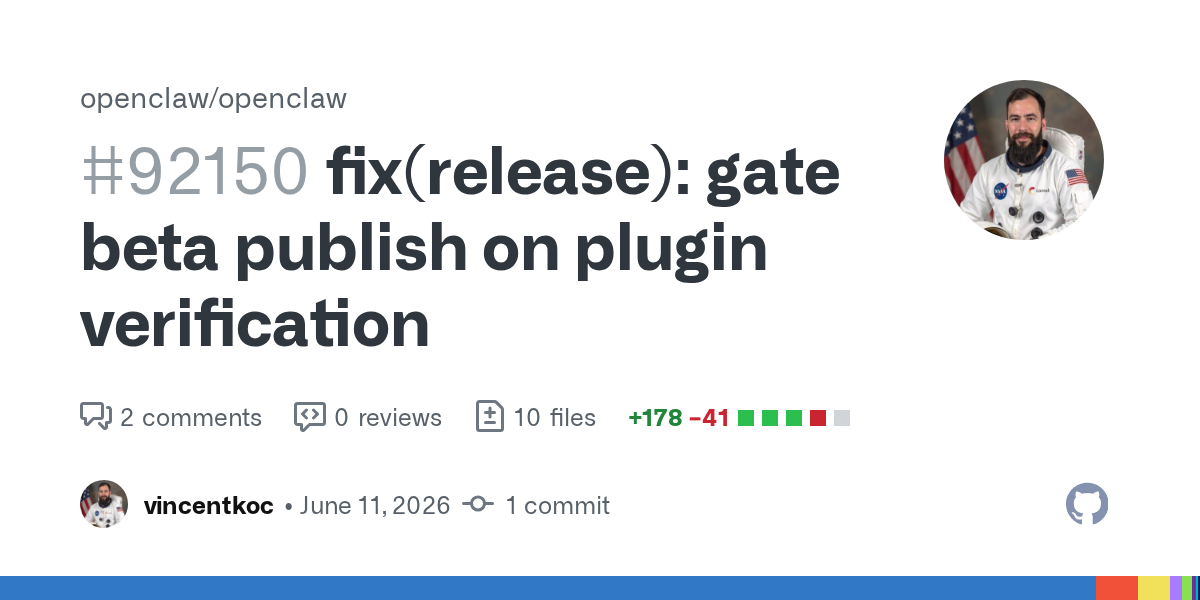
Release engineering is the part of the platform nobody wants to read about until the day it turns into an incident report. OpenClaw PR #92150 is that unglamorous layer getting the attention it deserves: beta releases should not become public artifacts until the project can prove the packages, plugins, dependency evidence, and release notes actually line up.
That may sound like inside-baseball CI work. It is not. OpenClaw is no longer just a CLI that wraps model calls. It is an agent runtime with first-party plugins, externalized provider adapters, channel extensions, browser bridges, MCP transports, local tools, and install paths that can touch credentials and workspaces. In that world, the release pipeline is part of the security model. A public GitHub release that appears before verification finishes is not merely “early.” It is a trust signal emitted before the trust evidence exists.
PR #92150, created on June 11 and merged roughly an hour later, changes OpenClaw’s beta publishing path so GitHub releases stay drafted until postpublish verification, dependency evidence upload, release-proof append, and required plugin publish completion have succeeded. It also fails before republishing an already-published OpenClaw npm version and updates maintainer instructions for newly publishable plugins. The files touched are mostly workflow, documentation, plugin inventory, runbook, and verifier test surfaces — exactly the places where supply-chain discipline either becomes muscle memory or remains tribal knowledge.
“Release exists” is not the same as “release is proven”
The subtle failure mode here is worth spelling out. A project can publish a GitHub release page, then attach artifacts, then run postpublish verification, then publish required plugins, then append proof. If any middle step fails, users still see something that looks official. Mirrors index it. Humans share it. Automation may install it. The release page becomes a stronger signal than the evidence behind it.
That order is backwards for an agent platform. The artifact should not become public first and gather proof later. Proof should be a gate on publication. OpenClaw’s patch moves the process closer to that model: keep the release draft-only while the evidence is assembled, fail before child publishes if the public release would be incomplete, and require plugin publish completion before undrafting. This is boring because good release engineering is boring. It is also the difference between an ecosystem that operators can reason about and one that depends on maintainers remembering which artifact is half-baked.
The maintainer proof posted on the PR is unusually concrete: workflow YAML parses; plugin inventory generation passes; branch autoreview is clean; Crabbox check:changed passed on cbx_9927b5d33a01 / blue-crab. Those details matter less as trivia than as a pattern. The release process is moving toward evidence that can be cited, rerun, and reviewed. That is what teams should want from infrastructure they are going to run next to API keys, GitHub tokens, Slack channels, and local filesystem access.
Plugins make release gates security-critical
The plugin angle is the real reason this PR matters. OpenClaw has been externalizing heavier runtime stacks and pushing more capability into installable packages. That is the right architectural direction: the core package should not drag every channel, provider, diagnostic stack, or local runtime into every install. But once plugins become first-class, release correctness becomes multidimensional. The core can be published while a required plugin is missing. Metadata can say one thing while npm says another. A generated inventory can drift from what the maintainer actually shipped.
The review thread caught exactly that kind of edge: @openclaw/llama-cpp-provider was returning npm 404, so release prep needs to mint or prepublish it through the owner-approved plugin flow before a full beta publish. That is not a cosmetic compatibility issue. If a release claims a plugin exists and the registry disagrees, operators inherit a broken install path and a confusing recovery story. Worse, automation may try to repair the mismatch by pulling from fallback sources, stale local installs, or source checkout paths. Every fallback is another trust boundary.
This is the supply-chain version of a lesson agent platforms keep learning elsewhere: ambiguity is the enemy. Ambiguous tool permissions create unsafe execution. Ambiguous model capabilities create routing failures. Ambiguous release evidence creates untrustworthy deployment state. The fix is not a bigger README paragraph. It is a gate.
What operators should take from this
If you run OpenClaw for real work, this PR should change what you ask before upgrading. Do not only ask whether the changelog contains a feature you want. Ask whether the release has package provenance, dependency evidence, required plugin completion, and a clean verifier result. If your deployment depends on externalized providers, channel plugins, diagnostics stacks, or local runtimes like llama.cpp, verify that the plugin packages referenced by the release are actually published and installable from the expected source.
For teams building their own agent platforms, the lesson is broader. Treat release publication as a transactional workflow, not a celebratory announcement. The minimum bar is: no public release until required packages exist; no plugin inventory without registry reality; no “latest” tag mutation without proof; no republishing of an existing version; and a documented recovery path for partial failure. Agent infrastructure has too much authority to tolerate “we’ll patch the release page after the fact.”
There is also a product lesson here. Users rarely thank you for preventing a broken beta from appearing. They do notice when an upgrade leaves half their plugins unresolvable. The best platform work often reduces the number of mysteries users ever see.
PR #92150 is not glamorous, and that is the point. Agent ecosystems will be judged not only by model routing, tool breadth, or slick chat surfaces, but by whether their release gates produce artifacts operators can trust. “CI was green at some point” is not provenance. A release is not done when the button is pressed. It is done when the evidence is attached, the required plugins exist, and the public artifact matches the thing the pipeline proved.
Sources: OpenClaw PR #92150, OpenClaw v2026.6.6-beta.1 release, OpenClaw v2026.6.5 release, OpenClaw GitHub workflows