OpenClaw’s Bundled-Dependency Fix Solves One Packaging Problem and Immediately Runs Into the Real One: Sandboxes Hate Surprise Writes

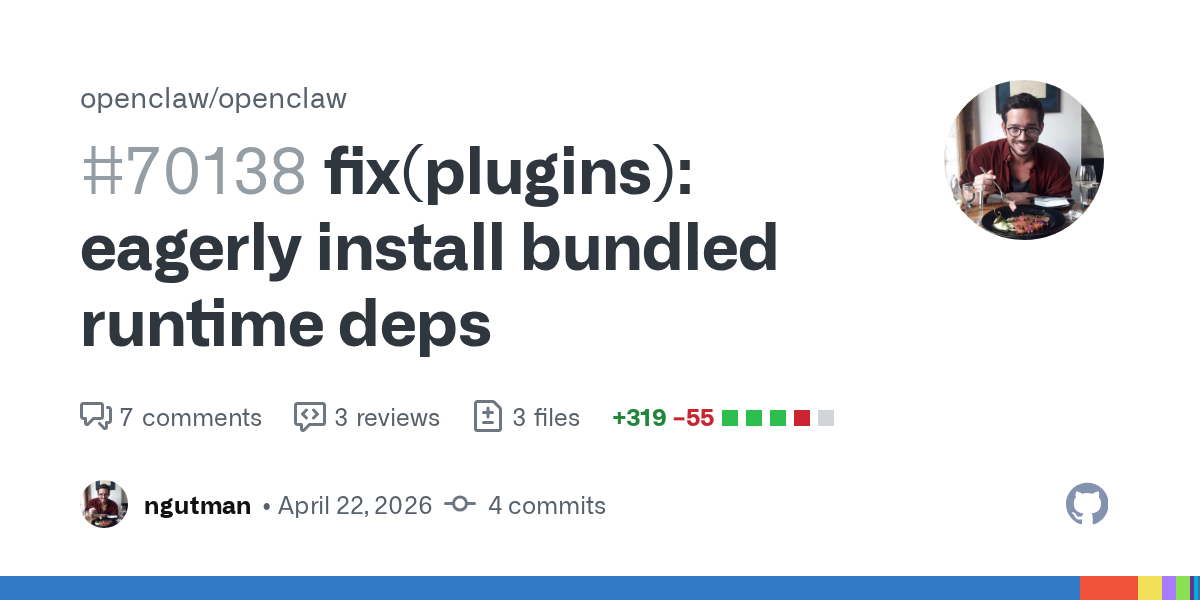
Packaging bugs are rarely glamorous, but they are where agent platforms meet reality. OpenClaw’s PR #70138, which eagerly installs bundled runtime dependencies for packaged installs, is a useful case study in how one sensible fix can immediately collide with a second, deeper constraint. Yes, packaged installs should not ship extensions that fail at first import because their runtime dependencies never arrived. But no, the answer is not automatically clean just because the missing modules finally show up. In agent systems, the moment dependency repair touches the network or writes into the installed runtime tree, you are no longer fixing packaging in isolation. You are redesigning part of the platform’s trust boundary.
The bug that motivated this change was real. Packaged OpenClaw installs had been excluding dist/extensions/*/node_modules, which meant bundled channel and provider entrypoints could exist on disk while the dependencies they expected to require() did not. Users saw apparently successful installs followed by plugin load failures and “Cannot find module” crashes. Even worse, the recovery story was inconsistent enough that openclaw doctor --fix could leave people in a half-repaired state. That is not a niche annoyance. If extensions are part of the default product surface, then missing runtime deps are production breakage.
PR #70138 responds by making eager bundled-runtime installation the packaged-install default, with an opt-out via OPENCLAW_EAGER_BUNDLED_PLUGIN_DEPS=0. In a normal developer environment, that instinct is understandable. Fail fast, materialize what bundled plugins need, and stop pretending a package tree is healthy when core integrations cannot even start. If this story ended on a laptop, it would be a straightforward win.
The sandbox immediately objects, and the sandbox has a point
It does not end on a laptop. The same-day NemoClaw regression report shows exactly where this logic runs into the real world. Hardened sandboxes intentionally make paths like /usr/local/ read-only for the service user. OpenClaw 4.20+ now wants to create per-plugin node_modules inside that installed runtime tree. The result, for one documented DGX Spark deployment, was deterministic EACCES failures such as permission denied, mkdir '/usr/local/lib/node_modules/openclaw/dist/extensions/acpx/node_modules'. In other words, the fix solved one packaging assumption by violating a sandbox assumption that serious operators rely on.
That is not just unfortunate timing. It is the architectural story. The npm world assumes postinstall can fetch packages, mutate trees, and make the installation whole after the fact. The sandbox world assumes runtime environments should not suddenly write dependency directories into privileged locations as part of normal startup or repair. Both assumptions are rational. They simply do not compose well once your software is both a package and a semi-privileged orchestration runtime.
Review bots immediately picked up the second-order risk. Aisle Security flagged the fact that eager postinstall expands the supply-chain surface by performing network npm install work during installation, with semver ranges and no lockfile. It also flagged path-traversal risk if dependency names are not validated tightly enough before they are used in sentinel paths or install specs. This is exactly the kind of review signal maintainers should take seriously. When plugin recovery starts fetching packages, deciding install targets, and probing the filesystem, it becomes security-sensitive code whether or not it lives under a “fix packaging” label.
There is no free lunch, only explicit tradeoffs
The deeper lesson is that agent platforms keep trying to postpone a decision about where plugin dependencies are supposed to live. Are they vendored and shipped fully materialized inside the package artifact? That increases package size, CI time, and release complexity, but it behaves predictably in offline and read-only environments. Are they installed lazily or repaired in place at runtime? That lowers artifact weight but pushes you into network access, filesystem mutation, reproducibility concerns, and all the operational weirdness of environments that do not want surprise writes. You can pick either set of costs. You do not get to make them disappear.
OpenClaw’s current path suggests the project is still feeling its way through that tradeoff in public. That is not a criticism so much as a reality of moving from fast-moving open-source project to serious runtime platform. Once you support bundled channels, sandboxed deployments, and operator-grade recovery tooling, “plugin loading” stops being a little module-resolution detail. It becomes part packaging system, part incident-recovery system, and part security boundary.
For practitioners running OpenClaw or building similar systems, the action items are clear. First, test packaged installs on the boring environments that hurt the most: read-only filesystems, least-privilege service users, sandboxed container layers, and enterprise hosts with restricted outbound access. Second, decide whether runtime dependency repair is allowed to touch the network in your environment. If not, treat eager install defaults as suspect until you prove otherwise. Third, if you maintain plugins, be explicit about what runtime dependencies are required and where you expect them to be materialized.
There is also a supply-chain point hiding here. If the platform is going to install bundled runtime deps dynamically, then version pinning, integrity controls, and validation become product requirements, not security-team wishlist items. A lockfile-free npm install step in a postinstall or repair path is not automatically catastrophic, but it is the kind of choice that should come with eyes open. Reproducibility and sandbox discipline are not luxuries for agent platforms. They are the difference between “recoverable” and “mysteriously hostile to production.”
That is what makes PR #70138 worth reading beyond the immediate bug. It captures platform engineering gravity in one thread. Fix a missing dependency problem, and suddenly you are debating writable runtime trees, postinstall network behavior, path hygiene, nested npm semantics, and sandbox compatibility. That is not scope creep. That is what happens when an agent framework grows up enough that packaging is no longer just a developer convenience problem.
The short version: OpenClaw found a real bug, shipped a real fix, and instantly exposed the harder design question underneath it. That is healthy. The right next move is not pretending the eager-install path is universally correct. It is being explicit about which environments it serves, which ones it breaks, and whether the platform wants packaging correctness, sandbox discipline, or developer ergonomics to be the default winner when those goals stop aligning.
Sources: OpenClaw PR #70138, Issue #70096, Issue #70163, NVIDIA NemoClaw.